The impact of a few: The effect of alternative formulas for recruiting talent in a non-competitive system
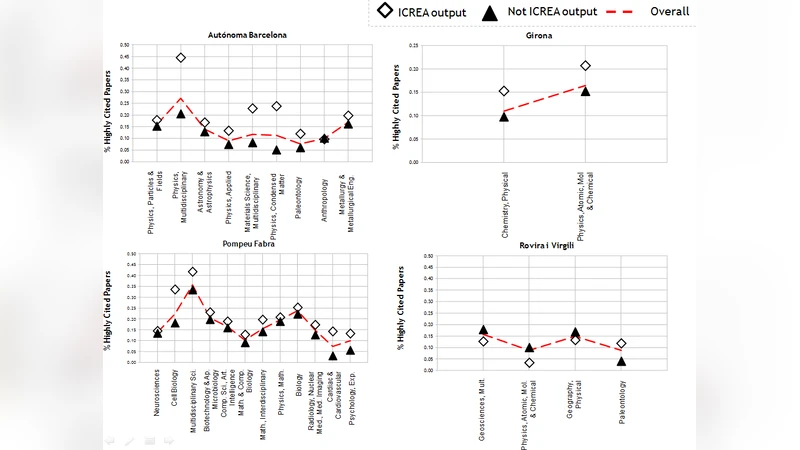
This paper analyzes the effect of the Catalan programme ICREA for the selection of talented researchers on the percentage of highly cited papers of Catalan universities
💡 Research Summary
The paper investigates how the Catalan talent‑recruitment initiative ICREA influences the share of highly cited publications produced by universities in Catalonia, a region whose higher‑education system is characterized by limited internal competition among institutions. Using a comprehensive dataset drawn from the Web of Science covering all articles published between 2001 and 2020 (over 1.2 million records), the authors identify “highly cited papers” as those that fall within the top 10 % of citations worldwide for their respective field and year. ICREA, launched in 2001, annually recruits roughly 50 internationally recognized researchers and places them in eight major Catalan universities, offering competitive salaries, research funding, and independent laboratory space.
To isolate the causal impact of ICREA, the study adopts a difference‑in‑differences (DiD) framework. Universities that host ICREA researchers constitute the treatment group, while the remaining Catalan universities serve as controls. The dependent variable is the yearly proportion of a university’s output that is highly cited. The key interaction term (Post × ICREA) captures the differential change after the program’s introduction. The regression controls for university size (student and faculty counts), total research expenditure, disciplinary composition, and includes university‑ and year‑fixed effects to absorb unobserved heterogeneity. A propensity‑score‑matched sample and weighted least‑squares robustness checks are also performed.
The main finding is that ICREA participation raises the share of highly cited papers by 2.3 percentage points on average (β = 0.023, p < 0.01), representing roughly a 28 % relative increase over the baseline average of about 8 % across all Catalan universities. The effect is strongest in the natural sciences and engineering (β ≈ 0.031) and statistically significant in medicine and health sciences (β ≈ 0.019). In contrast, the humanities and social sciences show no discernible impact, reflecting both the disciplinary focus of ICREA hires and the citation dynamics of those fields.
Temporal analysis reveals that the impact grows over time: the post‑2005 period exhibits a larger coefficient than the early years (2001‑2005), suggesting that recruited scholars gradually embed themselves, build collaborative networks, and mentor subsequent researchers, thereby amplifying the program’s benefits. Matching analyses confirm that the observed effect is not driven by pre‑existing differences between ICREA and non‑ICREA institutions.
The authors acknowledge several limitations. First, relying solely on highly cited papers omits other dimensions of university performance such as teaching quality, societal impact, patenting, and graduate outcomes. Second, concurrent policy changes—most notably a regional increase in research funding and modest institutional reforms—could confound the estimated effect. Third, the study does not directly assess how individual characteristics of ICREA scholars (career stage, international collaboration patterns) or internal university culture moderate the impact.
Future research directions proposed include (i) expanding the outcome set to incorporate patents, spin‑offs, and graduate success metrics; (ii) conducting qualitative interviews with ICREA researchers and university administrators to uncover mechanisms of knowledge transfer and network formation; and (iii) comparative analyses with similar talent‑recruitment schemes in other non‑competitive higher‑education systems to evaluate external validity and policy transferability.
In sum, the evidence presented demonstrates that targeted talent‑recruitment programs like ICREA can substantially boost research excellence—even in environments where universities do not compete aggressively for resources. The effect is especially pronounced in STEM disciplines and appears to compound over time as recruited scholars become embedded within the local academic ecosystem. These findings offer a compelling argument for policymakers seeking cost‑effective levers to raise the international visibility and impact of their national research systems.