Tarskis plank problem revisited
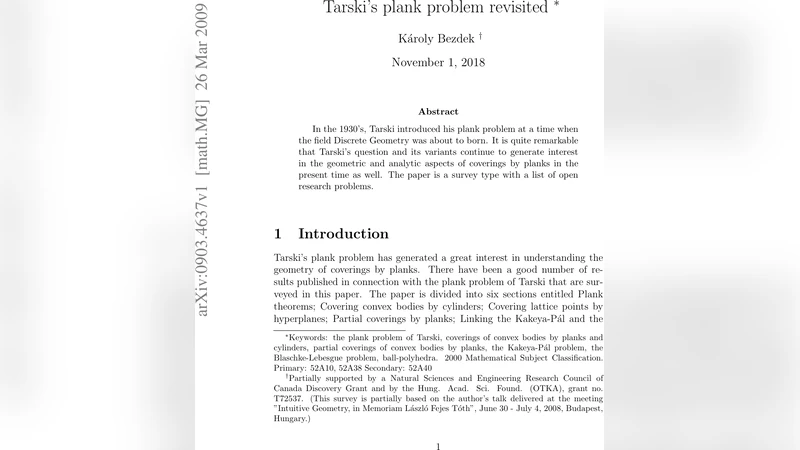
In the 1930’s, Tarski introduced his plank problem at a time when the field Discrete Geometry was about to born. It is quite remarkable that Tarski’s question and its variants continue to generate interest in the geometric and analytic aspects of coverings by planks in the present time as well. The paper is a survey type with a list of open research problems.
💡 Research Summary
The paper “Tarski’s plank problem revisited” is a comprehensive survey that traces the origins, major developments, and current open questions surrounding one of the most enduring problems in discrete geometry. The authors begin by recalling the original formulation introduced by Alfred Tarski in the 1930s: given a convex body (K) in Euclidean space, any covering of (K) by a collection of planks (the region between two parallel hyperplanes) must satisfy the inequality (\sum_i w_i \ge w(K)), where (w_i) denotes the width of the (i)-th plank and (w(K)) is the minimal width of (K) (the smallest distance between two parallel supporting hyperplanes of (K)). Tarski’s intuition was clear, but a rigorous proof was missing at the time.
The survey proceeds to the first major breakthroughs of the mid‑20th century, focusing on the work of Bang (1951) and later extensions by Ball, Rogers, and others. Bang supplied the first complete proof of Tarski’s conjecture in all dimensions, using the support function of a convex body and a clever averaging argument over directions. The authors explain Bang’s method in detail, emphasizing the role of the support function (h_K(u)=\max_{x\in K}\langle x,u\rangle) and how the inequality emerges from integrating the directional widths over the unit sphere. Subsequent refinements, such as Ball’s “plank theorem” for symmetric convex bodies and the connection to the Brunn–Minkowski theory, are presented as natural generalizations that broaden the scope of the original statement.
A substantial portion of the paper is devoted to higher‑dimensional and variant formulations. In dimensions (n\ge 2) the notion of a plank becomes the region between two parallel hyperplanes, and the width is measured along a unit direction vector (u). The authors discuss how the inequality (\sum_i w_i \ge \sup_{u\in S^{n-1}} w_u(K)) can be interpreted as a dual statement to the classical isoperimetric inequality, linking the total plank width to the volume and surface area of (K). They also explore weighted versions, where each plank carries a coefficient reflecting its orientation or multiplicity, leading to more flexible bounds that are useful in applications such as covering problems in functional analysis.
The survey does not restrict itself to convex bodies. It examines extensions to non‑convex sets, star‑shaped regions, and even fractal sets with non‑integer Hausdorff dimension. For these more general objects the authors introduce the concept of directional minimal width (w_\theta(S)) and propose weighted sum inequalities of the form (\sum_\theta \alpha_\theta w_\theta(S) \ge w(S)). Partial results are cited, showing that for star‑shaped sets the inequality holds under certain regularity assumptions, while for fractal sets the problem remains largely open.
The final section is a curated list of open problems, each accompanied by a brief discussion of known partial results and suggested methodological tools. The most prominent challenges are:
- Full dimensional proof without symmetry assumptions – while Bang’s theorem works for all convex bodies, the authors highlight subtle gaps in the existing proofs for certain classes of non‑symmetric bodies in very high dimensions, inviting new techniques from convex analysis and optimal transport.
- Optimal lower bounds for non‑convex coverings – determining whether an analogue of Tarski’s inequality exists for arbitrary measurable sets, possibly involving new notions of “effective width” that capture irregular geometry.
- Dynamic plank coverings – studying families of convex bodies (K(t)) that evolve over time and seeking algorithms that minimize the total movement or energy required to maintain a plank covering.
- Connections with optimal transport – interpreting plank widths as transport costs and exploring whether Monge–Kantorovich duality can yield stronger or more general inequalities.
- Fractal dimensions and plank coverings – establishing quantitative relationships between the sum of plank widths and the Hausdorff dimension of the covered set, a problem that sits at the intersection of geometric measure theory and discrete geometry.
Throughout the paper the authors stress the interdisciplinary nature of the plank problem. Its resolution draws on tools from convex geometry, functional analysis, measure theory, combinatorial optimization, and even probability. By assembling the historical narrative, the technical core, and a forward‑looking research agenda, the survey serves both as a reference for experts and as an invitation for newcomers to engage with a problem that continues to inspire deep mathematical inquiry.
Comments & Academic Discussion
Loading comments...
Leave a Comment