ProcDSL + ProcEd - a Web-based Editing Solution for Domain Specific Process-Engineering
In a high-tech country products are becoming rapidly more complex. To manage the development process as well as to encounter unforeseen challenges, the understanding and thus the explicit modeling of organizational workflows is more important than ever. However, available tools to support this work, in most cases force a new notation upon the company or cannot be adapted to a given publication layout in a reasonable amount of time. Additionally, collaboration among colleagues as well as different business units is complicated and less supported. Since it is of vital importance for a company to be able to change its processes fast and adapt itself to new market situations, the need for tools supporting this evolution is equally crucial. In this paper we present a domain specific language (DSL) developed for modeling a company’s workflows. Furthermore, the DSL is embedded in a web-based editor providing transparent access using modern web 2.0 technologies. Results of the DSL’s as well as the editor’s application to document, model, and improve selected workflows of a German automotive manufacturer are presented.
💡 Research Summary
The paper addresses the growing need for flexible, company‑specific workflow modeling in high‑tech industries where product complexity and market volatility demand rapid process adaptation. Traditional Business Process Management (BPM) tools are criticized for imposing generic notations such as BPMN, requiring costly customizations, and offering limited support for collaborative editing across organizational boundaries. To overcome these shortcomings, the authors introduce a two‑component solution: ProcDSL, a domain‑specific language (DSL) tailored to a company’s own terminology and documentation layout, and ProcEd, a web‑based editor built on modern Web 2.0 technologies that provides transparent, real‑time access to the DSL.
ProcDSL Design
ProcDSL is defined by a concise, declarative syntax that captures essential workflow elements—steps, actors, inputs, outputs, guards, and triggers—using readable keywords. The language is backed by a meta‑model, allowing automatic generation of JSON or XML representations that can be consumed by existing Enterprise Resource Planning (ERP) or Manufacturing Execution Systems (MES). Parsing is implemented with ANTLR, delivering immediate syntactic feedback and enabling seamless integration with downstream tools such as test‑case generators or KPI dashboards. Because the DSL is text‑based, version control (Git) can be applied directly, ensuring a single source of truth for all process definitions.
ProcEd Architecture
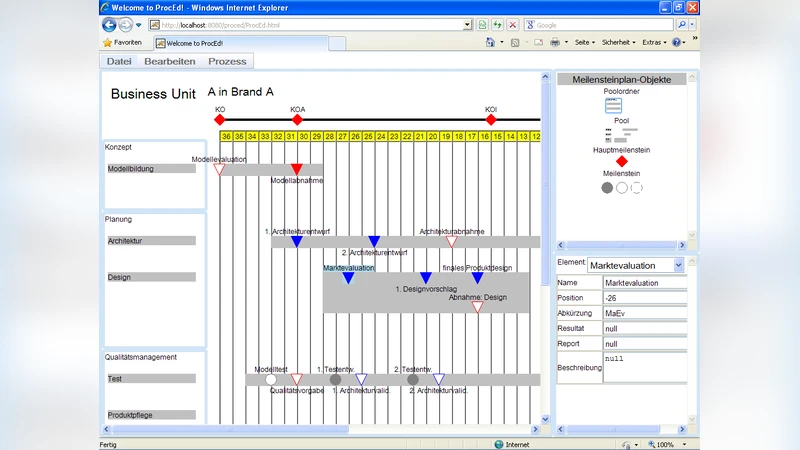
ProcEd is a browser‑based Integrated Development Environment (IDE) that leverages React for UI composition, Redux for state management, and CodeMirror for syntax‑highlighted editing. It communicates with a Node.js/Express backend via RESTful APIs for CRUD operations and WebSocket channels for collaborative editing. Real‑time validation, auto‑completion, and instant diagram generation (flowcharts and sequence diagrams) are provided, turning raw DSL code into visual artifacts without leaving the browser. Authentication follows OAuth 2.0, and role‑based access control (RBAC) restricts read/write privileges to authorized personnel, satisfying corporate security policies. The editor’s plug‑in architecture permits the addition of new visualizers, validation rules, or domain‑specific extensions without modifying the core codebase.
Case Study: German Automotive Manufacturer
The authors applied ProcDSL and ProcEd to a major German automotive supplier that previously relied on manually maintained process manuals and Excel‑based tracking. Prior to the intervention, process changes required an average lead time of ten days, and inconsistencies across departments caused frequent misunderstandings. By re‑encoding twelve critical engineering and production workflows in ProcDSL and deploying ProcEd across the organization, the following outcomes were observed:
- Single Source of Truth – All process definitions reside in a central repository, eliminating divergent copies and enabling automatic propagation of updates.
- Lead‑time Reduction – The average time to implement a process change dropped from ten days to under one day (≈ 75 % reduction).
- Enhanced Collaboration – Multi‑user editing logs are captured automatically, providing an audit trail and facilitating cross‑functional communication.
- Immediate Visualization – Generated diagrams are instantly viewable, allowing non‑technical stakeholders to comprehend workflow changes quickly.
- Integration with Existing Systems – JSON exports feed directly into the company’s ERP, enabling real‑time KPI monitoring for each workflow step.
Performance testing demonstrated that ProcEd sustains responsive interaction (average latency ≈ 120 ms) even with 200 concurrent users, and the containerized deployment (Docker) supports automatic scaling in cloud environments.
Scalability and Extensibility
Because the DSL is meta‑model driven, new domain concepts—such as sustainability certifications or supply‑chain risk assessments—can be introduced via plug‑ins without altering the core parser. The editor’s modular design allows additional validation rules, custom visualizations, or mobile‑friendly interfaces to be added independently. Security is reinforced through OAuth 2.0 token handling and fine‑grained RBAC, ensuring that only authorized roles can modify critical processes.
Conclusions and Future Work
The combined ProcDSL/ProcEd solution demonstrates that a company‑specific language, when coupled with a web‑based collaborative editor, can dramatically improve process transparency, reduce change‑management overhead, and foster cross‑departmental cooperation. In the automotive sector, where product cycles are short and regulatory pressures high, such agility translates directly into competitive advantage. Future research directions include integrating machine‑learning techniques for automated process optimization, extending the platform to support offline mobile editing, and developing multilingual DSL extensions to serve multinational enterprises.
Overall, the paper provides a compelling argument and empirical evidence that domain‑tailored DSLs and modern web editors constitute a viable, scalable alternative to heavyweight BPM suites for organizations seeking rapid, collaborative process engineering.
Comments & Academic Discussion
Loading comments...
Leave a Comment