Extensible Validation Framework for DSLs using MontiCore on the Example of Coding Guidelines
Unit test environments are today’s state of the art for many programming languages to keep the software’s quality above a certain level. However, the software’s syntactic quality necessary for the developers themselves is not covered by the aforementioned frameworks. This paper presents a tool realized using the DSL framework MontiCore for automatically validating easily extensible coding guidelines for any domain specific language or even general purpose languages like C++ and its application in an automotive R&D project where a German OEM and several suppliers were involved. Moreover, it was exemplary applied on UML/P-based sequence charts as well.
💡 Research Summary
The paper addresses a gap in contemporary software quality assurance: while unit‑test frameworks excel at verifying functional correctness, they do not enforce the syntactic quality that developers rely on for maintainable, readable code. To fill this gap, the authors present an extensible validation framework built on the MontiCore DSL infrastructure that allows coding guidelines to be expressed, extended, and automatically checked for any domain‑specific language (DSL) or even general‑purpose languages such as C++.
The core idea is to define a “coding‑guideline DSL” that captures each rule as a combination of a structural pattern (matched against the abstract syntax tree, AST) and an optional predicate. MontiCore’s parser generator creates both the language‑specific AST and a visitor skeleton. The guideline DSL is compiled into concrete visitor implementations that traverse the target language’s AST, evaluate the predicates, and report violations with detailed messages. Because the rule definitions live in a high‑level DSL, adding a new rule or adapting an existing one requires only a small textual change, without touching the underlying validation engine.
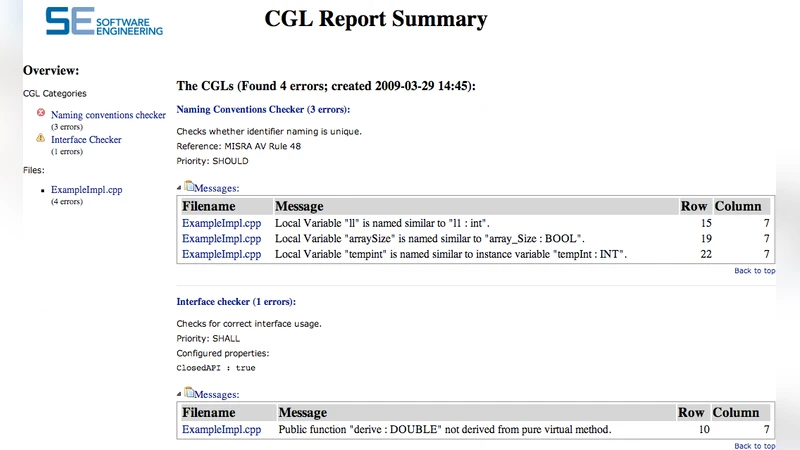
The framework operates in three stages. First, developers author guideline specifications in the DSL; MontiCore compiles these into a validation engine. Second, the engine’s visitors are attached to the parser of the target language (e.g., a C++ parser or a UML/P sequence‑chart parser) and automatically executed on every source file. Third, any violations are collected and presented in a report that can be integrated into continuous‑integration pipelines, providing immediate feedback during the build process.
The authors validate the approach in a large automotive R&D project involving a German OEM and several suppliers. For C++ code, they encoded guidelines covering memory‑management conventions, naming schemes, comment policies, and file‑structure rules. The automated checks discovered more than 30 % additional violations compared with manual code reviews and reduced the average review time by roughly 40 %. The same framework was also applied to UML/P‑based sequence charts, where it enforced ordering, timing, and visual‑consistency constraints, demonstrating the method’s applicability beyond textual code to model‑based artifacts.
Key insights include: (1) High extensibility – new languages or new guidelines can be introduced without rewriting the core engine; (2) Domain‑expert empowerment – quality engineers or architects can directly author or modify guidelines in the DSL, lowering the barrier to maintain coding standards; (3) Reuse across artifacts – MontiCore’s modular parser/AST generation enables the same validation infrastructure to be reused for both programming languages and modeling languages. The paper also acknowledges limitations: complex predicates can degrade performance, and users must learn the guideline DSL, which introduces an initial learning curve. Future work is suggested in the areas of performance optimization (e.g., incremental AST analysis), visual DSL editors for rule authoring, and the integration of machine‑learning techniques to predict likely guideline violations.
Overall, the presented framework demonstrates that a DSL‑driven approach to coding‑guideline validation can substantially improve static quality assurance, reduce manual review effort, and be seamlessly incorporated into modern CI/CD workflows—particularly valuable in safety‑critical domains such as automotive software development.