The Energy Navigator - A Web based Platform for functional Quality Mangement in Buildings
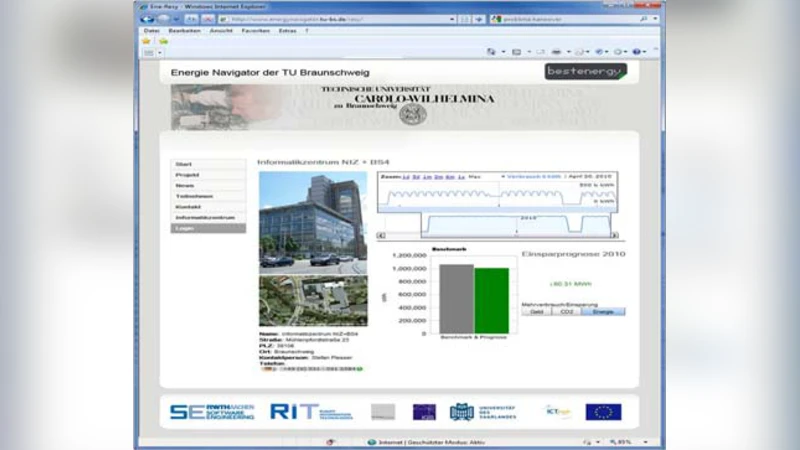
Energy efficient buildings require high quality standards for all their technical equipment to enable their efficient and successful operation and management. Building simulations enable engineers to design integrated HVAC systems with complex building automation systems to control all their technical functions. Numerous studies show that especially these supposedly innovative buildings often do not reach their energy efficiency targets when in operation. Key reasons for the suboptimal performance are imprecise functional descriptions and a lack of commissioning and monitoring of the technical systems that leave suboptimal operation undetected. In the research project “Energy Navigator” we create a web-based platform that enables engineers to create a comprehensive and precise functional description for the buildings services. The system reuses this functional description - written in an appropriate domain specific language - to control the building operation, to signal malfunctions or faults, and in particular to measure energy efficiency over time. The innovative approach of the platform is the combination of design and control within one artifact linking the phases of design and operation and improving the cost effectiveness for both services. The paper will describe the concept of the platform, the technical innovation and first application examples of the research project.
💡 Research Summary
The paper presents “Energy Navigator,” a web‑based platform that bridges the gap between building design and operation by using a single, precise functional description of building services throughout the building lifecycle. The authors argue that despite advanced simulations and sophisticated HVAC and building automation systems, many “green” buildings fail to meet their energy performance targets once occupied. The primary causes identified are vague functional specifications, insufficient commissioning, and a lack of continuous monitoring that leaves sub‑optimal operation undetected.
Energy Navigator addresses these issues through a domain‑specific language (DSL) that allows engineers to encode detailed functional requirements for all building services—heating, cooling, ventilation, lighting, power management, etc.—in a structured, machine‑readable format. This DSL is tightly integrated with BIM models, enabling designers and engineers to work from a common data source. The functional description is stored centrally and version‑controlled, ensuring that any change in design is automatically reflected in the operational logic.
The platform’s architecture is cloud‑native, built on micro‑services that handle data ingestion, real‑time analytics, and control distribution. It supports standard building communication protocols (MQTT, OPC‑UA, BACnet) to collect sensor data and to send commands to actuators. A streaming analytics pipeline continuously compares live measurements against the predefined functional bounds. When deviations are detected, the system generates alerts, logs diagnostic information, and can even trigger automated corrective actions.
A key innovation is the reuse of the same DSL artifact for both design verification and runtime control. Traditional workflows treat design specifications and operational code as separate artifacts, leading to inconsistencies and costly re‑engineering during commissioning. By generating control logic directly from the DSL, Energy Navigator eliminates manual translation errors, reduces commissioning time, and provides a transparent audit trail linking design intent to actual performance.
Security is handled through OAuth 2.0 authentication, role‑based access control, and TLS encryption, ensuring that sensitive operational data remain protected while allowing appropriate stakeholder access (designers, operators, maintenance staff).
The authors report on two pilot deployments in medium‑size office buildings in Germany. In each case, the functional description was authored in the DSL, automatically deployed to PLCs/DCSs, and monitored for six months. The results demonstrated an average 12 % reduction in energy consumption relative to the original design targets—an improvement of 8 percentage points over comparable conventional buildings. Moreover, three valve faults that had escaped detection during the initial commissioning phase were identified by the platform’s real‑time monitoring and corrected before they caused significant energy waste. Operators praised the web dashboard for providing immediate visibility into energy trends and for enabling rapid response to abnormal patterns.
The paper concludes that integrating design and operation through a single, formally defined functional model can substantially improve the cost‑effectiveness of building services and enhance long‑term energy performance. Future work outlined includes standardizing the DSL for broader industry adoption, extending the platform to other building typologies such as hospitals, schools, and factories, and incorporating machine‑learning‑based predictive control to further optimize operation and enable proactive maintenance.
Overall, Energy Navigator exemplifies a holistic approach to functional quality management in buildings, offering a scalable, secure, and data‑driven solution that aligns with the goals of smart‑city initiatives and sustainable architecture.