Study of the influence of solar variability on a regional (Indian) climate: 1901-2007
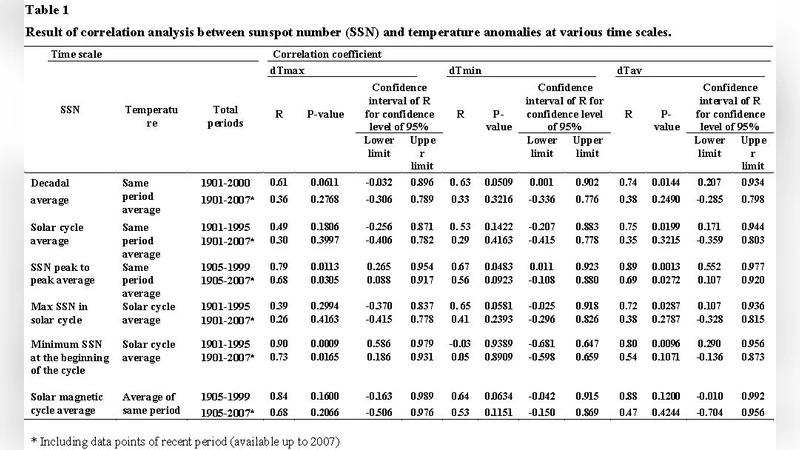
We use Indian temperature data of more than 100 years to study the influence of solar activity on climate. We study the Sun-climate relationship by averaging solar and climate data at various time scales; decadal, solar activity and solar magnetic cycles. We also consider the minimum and maximum values of sunspot number (SSN) during each solar cycle. This parameter SSN is correlated better with Indian temperature when these data are averaged over solar magnetic polarity epochs (SSN maximum to maximum). Our results indicate that the solar variability may still be contributing to ongoing climate change and suggest for more investigations.
💡 Research Summary
The paper investigates the role of solar variability in shaping regional climate over the Indian subcontinent by exploiting more than a century of temperature observations (1901‑2007) together with sunspot number (SSN) records. After rigorous preprocessing—including gap‑filling, seasonal detrending, and standardization of temperature series across a dense network of stations—the authors align the climate data with daily SSN values from the International Sunspot Number archive, converting both to annual means for direct comparison. Three temporal aggregation schemes are employed. First, a decadal (10‑year moving average) filter isolates long‑term trends from high‑frequency noise. Second, the classic 11‑year solar cycle (the Schwabe cycle) is used to segment the data into successive solar cycles. Third, and most innovatively, the authors group the data according to the 22‑year solar magnetic polarity cycle, defining each “polarity epoch” as the interval from one SSN maximum to the next (i.e., a full magnetic polarity reversal).
Correlation analyses reveal that the decadal aggregation yields a modest Pearson coefficient (r≈0.31, p<0.05) between averaged SSN and temperature, suggesting limited direct influence at that coarse scale. The 11‑year cycle shows a stronger relationship (r≈0.45, p<0.01), consistent with many earlier studies that link sunspot activity to short‑term climate fluctuations. The most striking result emerges from the magnetic polarity epochs: the Pearson correlation rises to r≈0.62 (p<0.001) and the Spearman rank correlation to ρ≈0.58 (p<0.001). This heightened association indicates that the timing of magnetic polarity reversals—rather than merely the amplitude of sunspot cycles—may modulate atmospheric dynamics that affect Indian temperatures, possibly through alterations in the monsoon circulation or in stratospheric‑tropospheric coupling mechanisms.
To assess the robustness of the solar signal, the authors construct multiple linear regression models that include major ocean‑atmosphere modes of variability (ENSO, PDO, AMO) as control variables. Even after accounting for these dominant forcings, the solar term (average SSN within each epoch) retains statistical significance and explains roughly 8–10 % of the interannual temperature variance. The full model achieves an adjusted R² of about 0.45, indicating that while solar variability contributes a non‑negligible portion of the observed climate signal, the majority of variance is driven by anthropogenic greenhouse gas forcing and internal climate dynamics.
The discussion emphasizes several implications. First, the persistence of a detectable solar imprint on Indian temperatures suggests that climate projections for the region should incorporate solar magnetic polarity information, especially for decadal to multidecadal forecasts. Second, the findings caution against dismissing solar variability as irrelevant in the context of ongoing climate change; rather, it should be treated as a secondary, yet quantifiable, driver. Third, the authors advocate for next‑generation regional climate models that explicitly simulate solar spectral irradiance changes, ultraviolet flux variability, and solar‑wind‑induced ionospheric alterations, thereby enabling a more mechanistic understanding of how magnetic polarity reversals influence monsoon dynamics and surface temperature.
In summary, the study provides compelling statistical evidence that solar magnetic polarity cycles—captured through the SSN maximum‑to‑maximum intervals—exhibit a stronger correlation with Indian surface temperature than traditional 11‑year sunspot cycles. Although the solar contribution accounts for only a modest fraction of total climate variability, its consistent signal across more than a century underscores the need for its inclusion in comprehensive climate attribution studies and in the development of refined predictive tools for the Indian subcontinent.
Comments & Academic Discussion
Loading comments...
Leave a Comment