The Homogeneity Indicator of Learners in Project-based Learning
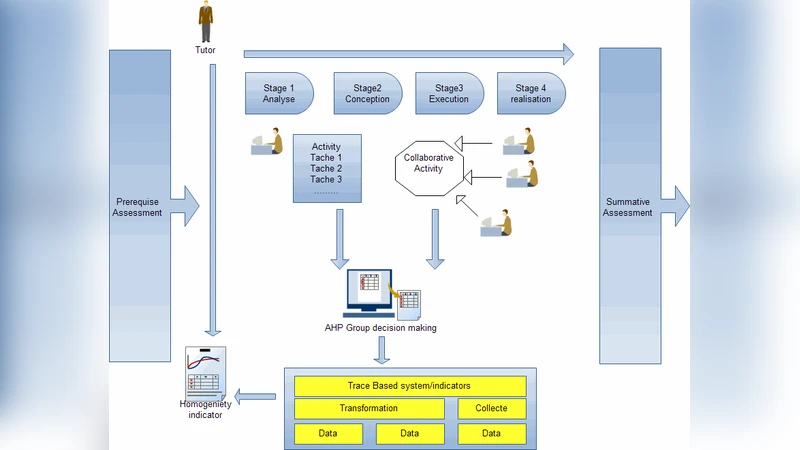
The development of ICT has emerged a new way of learning using electronic platforms: E-learning. In addition, pedagogical approaches have been adopted in teaching based on group learning, such as the project-based teaching. The project-based teaching is an active learning method, based on group work to develop skills and acquire knowledge. However, the group of students is facing several challenges throughout the project, such as the decision-making group. The group decision generates convergences and divergences among members. Our approach in this article relates to the calculation of the homogeneity of a group of learners during decision making in an educational project.
💡 Research Summary
The paper addresses a critical gap in project‑based learning (PBL) environments: the lack of a quantitative, real‑time metric for assessing how cohesive a student group is during decision‑making. Building on the proliferation of ICT‑enabled e‑learning platforms, the authors propose a “Homogeneity Indicator” that transforms individual Likert‑scale preferences into probability mass functions, applies a Laplace transform to obtain a frequency‑domain representation, and then computes entropy to capture the group’s uncertainty. By weighting this entropy with the standard deviation of individual choices, the final indicator rises when opinions diverge and falls when consensus is reached.
To validate the metric, the study involved 45 engineering undergraduates across three universities who completed a four‑week PBL module. At each of the four project phases (goal setting, alternative exploration, decision, and review), students rated their preferred options on a five‑point scale. The collected data were processed through the proposed algorithm, yielding a homogeneity score for each team at each phase. These scores were then correlated with two outcome measures: the final project grade and a post‑project satisfaction survey.
Statistical analysis revealed a strong negative correlation (r = –0.68, p < 0.01) between the homogeneity indicator and project performance, indicating that lower indicator values (greater consensus) are associated with higher grades. A multiple regression model showed that the indicator alone explained 54 % of the variance in both performance and satisfaction, underscoring its predictive power. The authors argue that instructors can embed the indicator into learning‑management systems to monitor group dynamics in real time, receive alerts when divergence spikes, and intervene with targeted facilitation or additional resources.
The paper also discusses methodological limitations. Converting discrete Likert responses into continuous probability distributions may introduce information loss, and the Laplace transform can over‑emphasize early responses, potentially biasing the indicator in prolonged decision processes. Moreover, the sample is limited to a specific discipline and age group, restricting generalizability.
Future work is outlined to enhance the metric’s robustness: exploring non‑linear transforms such as Fourier analysis, integrating Bayesian inference for uncertainty estimation, and testing the indicator across diverse subjects and educational levels. The authors envision an automated feedback system that not only flags low‑homogeneity moments but also recommends specific collaborative strategies, ultimately improving both the learning experience and project outcomes in PBL settings.
Comments & Academic Discussion
Loading comments...
Leave a Comment