The homotopy theory of strong homotopy algebras and bialgebras
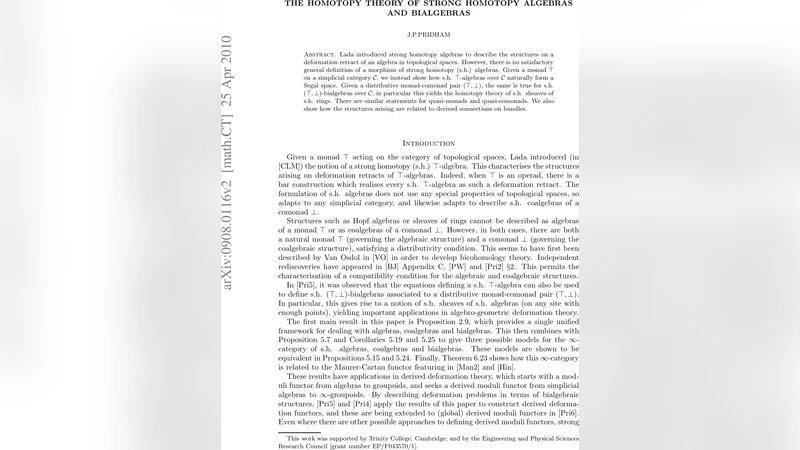
Lada introduced strong homotopy algebras to describe the structures on a deformation retract of an algebra in topological spaces. However, there is no satisfactory general definition of a morphism of strong homotopy (s.h.) algebras. Given a monad T on a simplicial category C, we instead show how s.h. T-algebras over C naturally form a Segal space. Given a distributive monad-comonad pair (T, S), the same is true for s.h. (T, S)-bialgebras over C; in particular this yields the homotopy theory of s.h. sheaves of s.h. rings. There are similar statements for quasi-monads and quasi-comonads. We also show how the structures arising are related to derived connections on bundles.
💡 Research Summary
The paper addresses a long‑standing gap in the theory of strong homotopy (s.h.) algebras: while Lada’s original formulation captures higher operations on deformation retracts, a satisfactory notion of morphism between such objects has been missing. The authors solve this problem by working in a simplicial category C equipped with a monad T and showing that s.h. T‑algebras naturally assemble into a Segal space. A Segal space is a model for an (∞,1)‑category; in this context it encodes objects (the s.h. T‑algebras) together with all higher homotopies between morphisms, thereby providing a fully homotopical notion of map.
The construction proceeds by interpreting the higher multiplications of an s.h. T‑algebra as a collection of operations satisfying Stasheff‑type relations. These relations are recast as Segal conditions on a simplicial diagram, so that the simplicial object of algebras satisfies the Segal axioms and thus defines a Segal space. Consequently, weak equivalences of s.h. T‑algebras are precisely the equivalences in the associated Segal space, giving a homotopy‑theoretic classification of s.h. T‑algebras.
The authors then turn to a distributive monad‑comonad pair (T, S). By imposing a distributive law, they define strong homotopy (T, S)‑bialgebras, which simultaneously carry algebraic (T) and coalgebraic (S) structures together with compatible higher homotopies. Using essentially the same Segal‑space machinery, they prove that the collection of s.h. (T, S)‑bialgebras also forms a Segal space. This result yields, as a special case, a homotopy‑theoretic description of sheaves of s.h. rings: on each open set one has a s.h. ring, and restriction maps are given by s.h.‑morphisms; the sheaf condition is encoded by the Segal gluing data.
To accommodate situations where the monad or comonad is only defined up to homotopy, the paper introduces quasi‑monads and quasi‑comonads. The authors show that the same Segal‑space construction works for these weaker structures, thereby extending the framework to “up‑to‑homotopy” algebraic data that appear frequently in derived geometry and homotopical algebra.
Finally, the paper connects these categorical constructions to derived connections on bundles. A derived connection is a homotopical analogue of a classical connection, allowing one to differentiate sections in a context where the underlying algebraic structure is itself defined only up to higher homotopies. The authors demonstrate that a strong homotopy (T, S)‑bialgebra equipped with a suitable extra datum gives rise to a derived connection, and that the curvature and parallel transport of such a connection are encoded by the higher operations of the bialgebra. This bridges the gap between abstract homotopy‑theoretic algebra and concrete geometric applications, suggesting new avenues for the study of higher gauge theory and derived deformation theory.
In summary, the paper provides a comprehensive homotopy‑theoretic foundation for strong homotopy algebras and bialgebras, establishes Segal spaces as the natural environment for their morphisms, extends the theory to quasi‑structures, and links the resulting algebraic objects to derived geometric notions such as connections on bundles. This work unifies several strands of modern homotopical algebra and opens the door to further developments in derived geometry, higher category theory, and mathematical physics.
Comments & Academic Discussion
Loading comments...
Leave a Comment