Geodesic and billiard flows on quadrics in pseudo-Euclidean spaces: L-A pairs and Chasles theorem
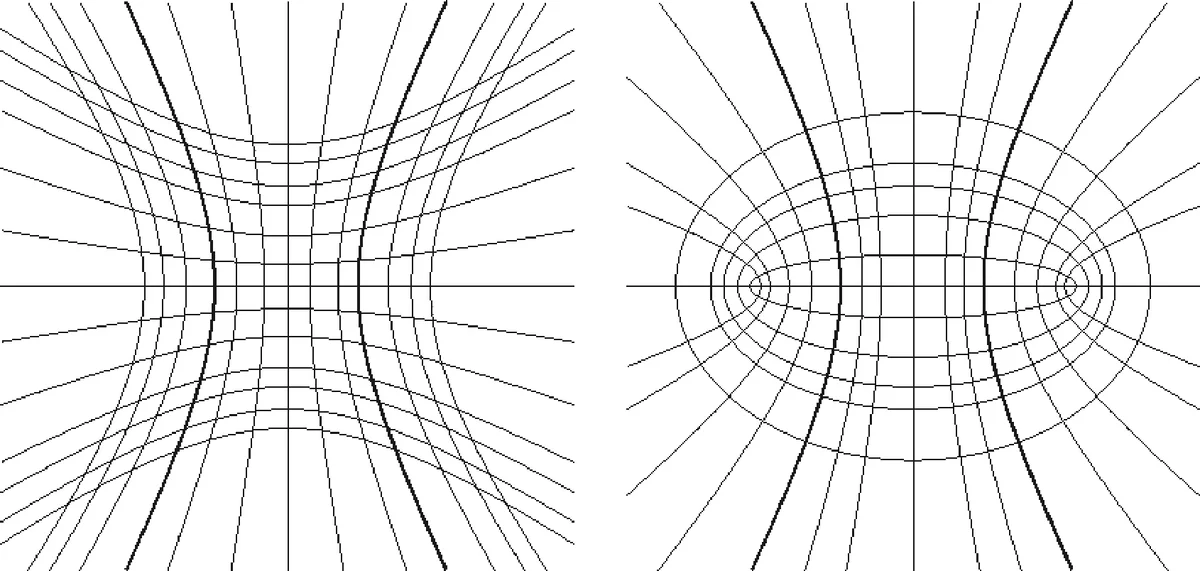
In this article we construct L–A representations of geodesic flows on quadrics and of billiard problems within ellipsoids in the pseudo–Euclidean spaces. A geometric interpretation of the integrability analogous to the classical Chasles theorem for symmetric ellipsoids is given. We also consider a generalization of the billiard within arbitrary quadric allowing virtual billiard reflections.
💡 Research Summary
The paper investigates geodesic motion on quadrics and billiard dynamics inside ellipsoids within pseudo‑Euclidean spaces (E^{k,l}) (signature ((k,l)), dimension (n=k+l)). Using a diagonal metric matrix (E=\operatorname{diag}(1,\dots ,1,-1,\dots ,-1)) and a diagonal matrix (A=\operatorname{diag}(a_1,\dots ,a_n)), the authors define the quadric (Q^{n-1}={x\in E^{k,l}\mid (A^{-1}x,x)=1}). They treat both non‑symmetric quadrics (all (\tau_i a_i) distinct) and symmetric quadrics (clusters of equal eigenvalues).
Geodesic flow.
The Lagrangian (L=\frac12\langle\dot x,\dot x\rangle) yields the Euler‑Lagrange equation (\ddot x=\mu A^{-1}x) with multiplier (\mu=-(A^{-1}\dot x,\dot x)/(EA^{-2}x,x)). Introducing (y=\dot x) gives a first‑order system
\
Comments & Academic Discussion
Loading comments...
Leave a Comment