The Energy Navigator - A Web-Platform for Performance Design and Management
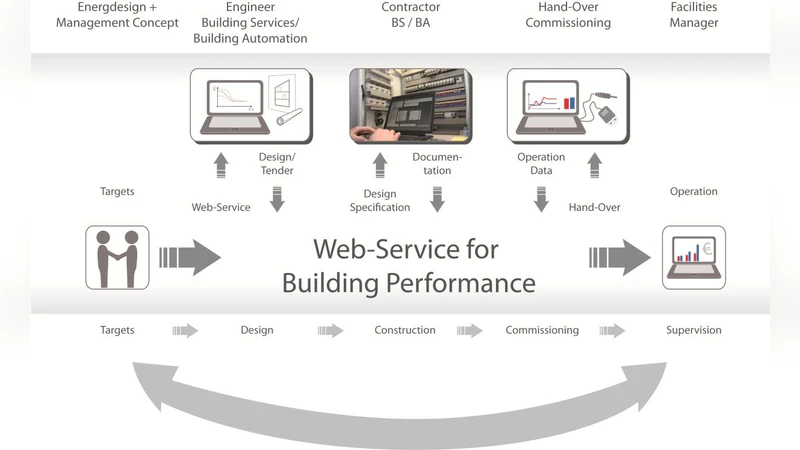
Over the last three decades comprehensive research has been carried out trying to improve commissioning processes with powerful modeling tools and methodologies for data analysis and visualization. Typically addressed application scenarios are facilities management, contracting, special consulting services and measurement & verification as part of a certification process. The results are all but convincing: Monitoring of building operation has so far not become a regular service for buildings. We have identified a lack of process integration as a significant barrier for market success. Most methodologies have so far caused additional initial invest and transaction cost: they added new services instead of improving existing ones. The Energy Navigator, developed by synavision GmbH in cooperation with leading research institutes of the Technical University Braunschweig and the RWTH Aachen University, presents a new methodology with several new approaches. Its software platform uses state graphs and a domain specific language to describe building functions offering an alternative to the software that is so far most widely used for this task: Microsoft Word. The Energy Navigators so called Active Functional Specification (AFS) is used for the technical specification of building services in the design phase. After construction it is completed by the supplier of the BMS (Building Management System) with the relevant sensors data as documentation of his service. Operation data can then automatically be checked for initial and continuous commissioning on whether it meets the criteria of the specification.
💡 Research Summary
The paper addresses the long‑standing problem that building performance monitoring has not become a routine service despite three decades of research on sophisticated modeling tools, data analysis, and visualization techniques. The authors argue that the primary obstacle is a lack of process integration: existing methodologies add new, costly services rather than improving the workflows already in place. Typical scenarios such as facilities management, contracting, consulting, and measurement‑and‑verification for certifications still rely on fragmented tools, with specifications often captured in unstructured Microsoft Word documents and sensor data processed by separate analysis platforms. This fragmentation leads to high upfront investment, additional transaction costs, and limited market adoption.
To overcome these barriers, the authors present Energy Navigator, a web‑based platform co‑developed by synavision GmbH together with research groups from the Technical University of Braunschweig and RWTH Aachen University. The system introduces two novel technical concepts. First, it models building functions as state graphs. Each node in the graph represents a distinct operational mode of a subsystem (e.g., “cooling on”, “heating standby”, “fault”), while edges encode transition conditions based on sensor readings or time‑based rules. By formalizing the dynamic behavior of HVAC, lighting, and other services, the state graph provides a shared, visual representation that bridges designers, contractors, and operators.
Second, the platform employs a domain‑specific language (DSL) to create an Active Functional Specification (AFS). The DSL allows engineers to write functional requirements in a structured, machine‑readable form, for example: “The cooling system shall maintain indoor temperature at 22 °C ± 2 °C.” The language also defines explicit mappings between these requirements and concrete sensor identifiers (e.g., “If temperature sensor T1 exceeds 24 °C, activate cooling”). Because the DSL is formally typed, the specification can be automatically validated, version‑controlled, and compiled into executable checks.
The process flow integrates design, construction, and operation into a single web‑based workflow. During the design phase, engineers author the AFS through an intuitive UI; the platform stores a versioned specification. In the construction phase, the Building Management System (BMS) supplier imports the same AFS, binds each requirement to the actual field‑installed sensors, and uploads the completed specification back to the platform. Once the building is occupied, real‑time sensor streams are continuously compared against the AFS. Any deviation from the defined criteria triggers alerts, logs the event, and contributes to an automatically generated commissioning report. This approach enables both initial commissioning and continuous performance verification without manual data extraction or ad‑hoc analysis.
From an economic perspective, Energy Navigator reduces both initial capital expenditure and ongoing transaction costs. Traditional solutions require separate licenses for modeling, data acquisition, and analytics, whereas the Navigator is offered as a SaaS platform with a subscription model, eliminating the need for on‑premise infrastructure. Moreover, the DSL‑based specifications are reusable across similar building types, allowing firms to create template AFS libraries that accelerate future projects and lower engineering effort.
The authors acknowledge several limitations. Mastering the DSL and constructing comprehensive state graphs introduces a learning curve for architects and MEP engineers, necessitating targeted training programs. For highly complex multi‑energy plants, the state graph can become large and difficult to maintain, potentially requiring automated graph reduction techniques. Data quality issues—such as sensor latency, missing values, or calibration errors—directly affect the reliability of automated checks. To mitigate these challenges, the paper proposes future work on automatic graph simplification algorithms, robust data‑preprocessing pipelines, and the integration of AI‑driven anomaly detection to predict specification violations before they manifest.
In conclusion, Energy Navigator represents a process‑centric, integrated platform that transforms static design specifications into executable digital models and couples them with live operational data for continuous verification. By eliminating the disjointed workflow that has hampered building performance monitoring for decades, the system promises significant cost savings, faster commissioning, and sustained energy efficiency improvements for building owners and facility managers alike.