SSELab: A Plug-In-Based Framework for Web-Based Project Portals
Tools are an essential part of every software engineering project. But the number of tools that are used in all phases of the software development life-cycle and their complexity is growing continually. Consequently, the setup and maintenance of current tool chains and development environments requires much effort and consumes a lot of time. One approach to counter this, is to employ web-based systems for development tasks, because centralized systems simplify the administration and the deployment of new features. But desktop IDEs play an important role in software development projects today, and will not be replaced entirely by web-based environments in the near future. Therefore, supporting a mixture of hosted tools and tools integrated into desktop IDEs is a sensible approach. In this paper, we present the SSELab, a framework for web- based project portals that attempts to migrate more software development tools from desktop to server environments, but still allows their integration into modern desktop IDEs. It supports the deployment of tools as hosted services using plug-in systems on the server-side. Additionally, it provides access to these tools by a set of clients that can be used in different contexts, either from the command line, from within IDEs such as Eclipse, or from web pages. In the paper, we discuss the architecture and the extensibility of the SSELab framework. Furthermore, we share our experiences with creating an instance of the framework and integrating various tools for our own software development projects.
💡 Research Summary
The paper introduces SSELab, a plug‑in‑based framework designed to unify web‑based project portals with traditional desktop IDE tooling. Recognizing that modern software development relies on an ever‑growing set of heterogeneous tools—ranging from version control systems and continuous integration servers to static analysis utilities—the authors argue that the administrative overhead of installing, configuring, and maintaining these tools on individual developer machines is a major productivity bottleneck. Their solution is to shift the bulk of tool execution to a centrally managed server while still offering seamless access from IDEs, command‑line scripts, and web browsers.
Architecture Overview
SSELab is organized into three logical layers. The Plug‑in Host Layer runs on the server and encapsulates each development tool as a plug‑in module. Plug‑ins declare their dependencies, configuration schema, and authentication requirements in a metadata descriptor and are loaded dynamically using a lightweight module system reminiscent of OSGi. This design enables hot‑swapping of tools without restarting the whole server. The Service Management Layer provides a web‑based administration console that maintains a plug‑in registry, orchestrates the lifecycle of service instances (install, start, stop, upgrade, delete), and exposes both RESTful and SOAP endpoints for backward compatibility. The Client Access Layer consists of three client families: a web UI, an Eclipse plug‑in, and a pure command‑line client. All clients interact with the server through a common API, ensuring that new client types can be added with minimal server changes.
Extensibility and Integration
To guarantee extensibility, every plug‑in must implement the ToolService interface, which defines a minimal set of methods such as initialize(), executeCommand(), and getStatus(). This uniform contract allows developers to wrap virtually any existing tool—whether it is a build system, a code review platform, or a custom script—inside a plug‑in wrapper. An internal event bus propagates state changes and completion notifications across plug‑ins, enabling the construction of complex workflows (e.g., commit → automated build → static analysis → review) without tight coupling.
IDE Integration
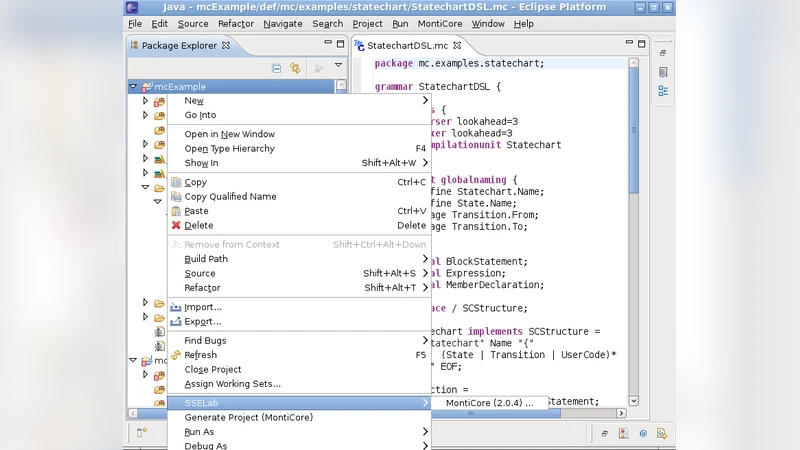
The Eclipse plug‑in acts as a thin client that translates IDE actions into server API calls. It automatically handles OAuth2 token acquisition and renewal, maps the local workspace to the server‑side repository, and presents server‑provided services (e.g., issue tracking, build status) as native Eclipse views. This approach preserves the rich editing experience of a desktop IDE while offloading heavy processing to the server.
Operational Experience
The authors deployed an instance of SSELab for their own research projects, integrating Subversion (version control), Jenkins (continuous integration), and SonarQube (static analysis) as separate plug‑ins. They report that plug‑in deployment was streamlined through Maven repository distribution and that hot‑swapping allowed updates without noticeable downtime. However, they also encountered challenges: (1) strict adherence to the plug‑in interface is required to avoid runtime incompatibilities; (2) versioning and migration scripts must be maintained to prevent cascading failures when a plug‑in’s API evolves; (3) security demands a token‑based authentication model combined with fine‑grained permission definitions per plug‑in.
Benefits and Limitations
SSELab reduces the manual effort associated with tool installation and configuration, centralizes updates, and provides a single point of control for licensing and compliance. By exposing the same services through web, IDE, and CLI clients, it accommodates diverse developer preferences and supports automation pipelines. Nevertheless, the framework introduces new responsibilities: administrators must manage plug‑in compatibility, ensure high availability of the central server (especially under heavy CI load), and implement robust monitoring to detect performance bottlenecks.
Future Work
The paper concludes with several avenues for further research: scaling the server tier into a clustered, fault‑tolerant environment; optimizing plug‑in communication for low‑latency interactions; extending the plug‑in ecosystem with automated validation and testing pipelines; and integrating more sophisticated role‑based access control (RBAC) and audit logging to satisfy enterprise security policies.
In summary, SSELab presents a pragmatic, plug‑in‑centric approach to bridging the gap between web‑based development portals and traditional desktop IDEs, offering a flexible, centrally managed ecosystem that can evolve alongside the rapidly expanding toolbox of modern software engineering.
Comments & Academic Discussion
Loading comments...
Leave a Comment