A Requirements Modeling Language for the Component Behavior of Cyber Physical Robotics Systems
Software development for robotics applications is a sophisticated endeavor as robots are inherently complex. Explicit modeling of the architecture and behavior of robotics application yields many advantages to cope with this complexity by identifying and separating logically and physically independent components and by hierarchically structuring the system under development. On top of component and connector models we propose modeling the requirements on the behavior of robotics software components using I/O! automata. This approach facilitates early simulation of requirements model, allows to subject these to formal analysis and to generate the software from them. In this paper, we introduce an extension of the architecture description language MontiArc to model the requirements on components with I/O!automata, which are defined in the spirit of Martin Glinz Statecharts for requirements modeling [10]. We furthermore present a case study based on a robotics application generated for the Lego NXT robotic platform.
💡 Research Summary
The paper addresses the growing complexity of software development for cyber‑physical robotics systems by proposing a unified modeling approach that combines architectural description with explicit behavioral requirements. The authors extend the component‑and‑connector based architecture description language MontiArc with I/O! automata, a variant of I/O automata that incorporates input, output, and internal (τ) transitions together with guards and actions. This extension enables developers to specify, at the requirements level, the exact input‑output behavior and state‑based logic of each software component.
The extended syntax introduces an automaton block inside a MontiArc component, where input, output, state, and transition keywords are used to declare ports, states, and guarded transitions. The semantics are defined by translating each automaton into an independent labeled transition system (LTS) and then composing these LTSs according to MontiArc’s connector topology. The resulting global transition system can be fed directly into simulation environments or formal model‑checking tools such as SPIN or UPPAAL, allowing early detection of deadlocks, safety violations, and timing issues before any code is written.
A tool chain built on the MontiCore framework provides a parser for the extended DSL, static type and connectivity checks, and a code generator that emits Java or C++ component skeletons. The generated code integrates with the MontiArc runtime library, preserving the defined input‑output contracts and state machines. An Eclipse‑based visual editor supports graphical editing of automata and real‑time simulation of the requirements model, giving engineers immediate feedback on system behavior.
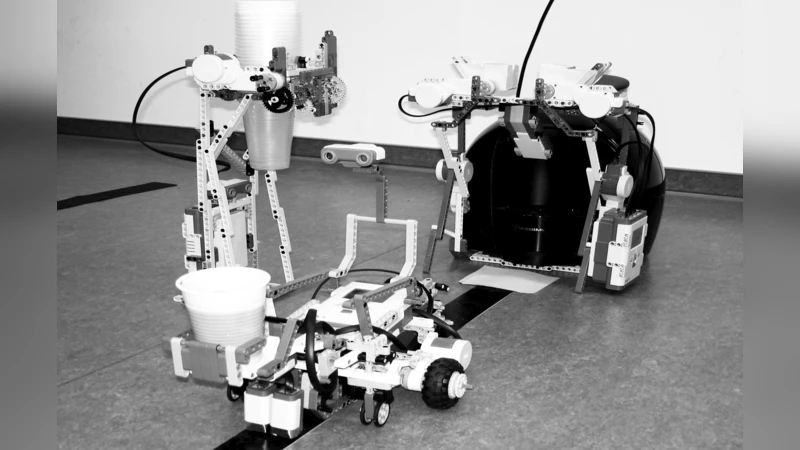
The approach is validated through a case study on the Lego NXT platform. Two components—one handling line‑sensor data and another controlling motor actuation—are modeled with I/O! automata that capture line‑following and obstacle‑avoidance logic. Simulation of the requirements model reveals a missing guard condition that would cause the robot to stall; after correcting the model, formal verification confirms that safety properties (no collision) and responsiveness constraints are satisfied. The automatically generated code is then deployed to the NXT brick, where the robot successfully follows a line and avoids obstacles, demonstrating consistency between the high‑level requirements model and the executed system.
Key advantages highlighted by the authors include: (1) early, formal validation of behavioral requirements; (2) reduction of implementation errors through automated code generation; (3) seamless integration with existing MontiArc architectural models; and (4) support for iterative development cycles where requirements can be refined and instantly re‑validated. Limitations are also discussed: the current I/O! formalism does not natively express complex real‑time deadlines or resource constraints, and scaling to large systems may require additional hierarchical composition mechanisms.
In conclusion, the paper presents a compelling method for bridging the gap between requirements engineering and component‑based architecture in robotics. By embedding I/O! automata within MontiArc, developers gain a rigorous, tool‑supported pathway from high‑level behavioral specifications to executable code. Future work is suggested in extending the formalism to capture timing and computational budgets, enhancing modular composition of automata, and applying the approach to more diverse robotic platforms and larger‑scale cyber‑physical systems.
Comments & Academic Discussion
Loading comments...
Leave a Comment