Accounting for the network in the Natura 2000 network: A response to Hochkirch et al. 2013
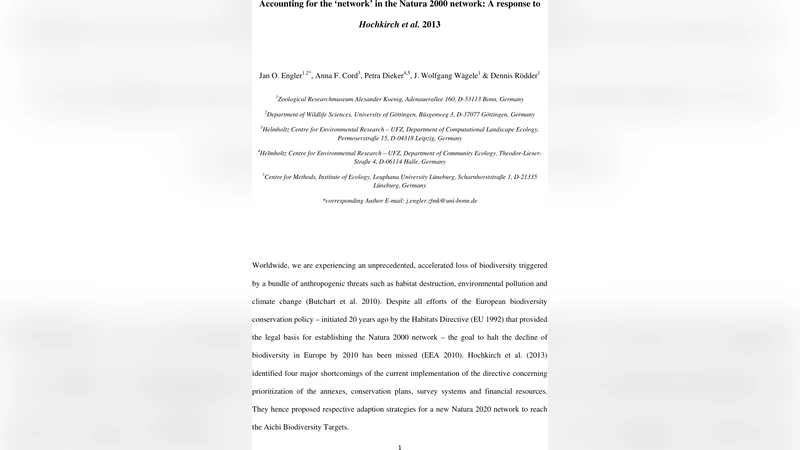
Worldwide, we are experiencing an unprecedented, accelerated loss of biodiversity triggered by a bundle of anthropogenic threats such as habitat destruction, environmental pollution and climate change. Despite all efforts of the European biodiversity conservation policy, initiated 20 years ago by the Habitats Directive that provided the legal basis for establishing the Natura 2000 network, the goal to halt the decline of biodiversity in Europe by 2010 has been missed. Hochkirch et al. (2013, Conserv. Lett. 6: 462-467) identified four major shortcomings of the current implementation of the directive concerning prioritization of the annexes, conservation plans, survey systems and financial resources. However they did not account for the intended network character of the Natura 2000 sites, an aspect of highest relevance. This response letter deals with this shortcoming as it is the prerequisite, over any other strategies, ensuring a Natura 2020 network being worth its name.
💡 Research Summary
The paper opens by reminding readers that the unprecedented loss of biodiversity worldwide has prompted the European Union to create the Natura 2000 network through the Habitats Directive twenty years ago, with the explicit aim of halting the decline of European species by 2010. Despite substantial legislative and financial effort, the target has not been met. Hochkirch et al. (2013) identified four major shortcomings in the implementation of the Directive: (1) ambiguous prioritisation of Annex I and II sites, (2) insufficiently detailed conservation plans, (3) weak monitoring and survey systems, and (4) chronic under‑funding. While these points are valid, the authors of the present response argue that they overlook the most fundamental characteristic of Natura 2000 – its intended nature as a network of ecologically linked sites rather than a collection of isolated reserves.
The authors first dissect the concept of ecological connectivity, drawing on recent meta‑analyses and GIS‑based corridor modelling studies. They explain that true network functionality requires (a) core‑periphery dynamics that allow species to persist in high‑quality habitats while using surrounding matrix, (b) functional corridors that facilitate dispersal, gene flow and range shifts, and (c) redundancy so that loss of any single site does not collapse the system. Empirical evidence is cited showing that low‑mobility taxa such as many insects, amphibians and small mammals are especially vulnerable to fragmentation; without explicit corridors, protected areas become “islands” and the network fails its purpose.
Next, the paper critiques the current EU policy architecture. Although the Biodiversity Strategy for 2030 and the Sustainable Development Goals reference overall conservation targets, they do not embed explicit connectivity metrics or obligations. Consequently, Member States are incentivised to focus on site‑level management, leaving trans‑boundary or intra‑national linkages under‑addressed. The authors also highlight a data gap: high‑resolution species distribution and movement data are scarce, and existing monitoring relies heavily on point‑based field inspections that cannot capture functional connectivity. They propose an integrated, EU‑wide monitoring platform that would combine remote sensing, citizen‑science observations, and standardized telemetry data to feed into connectivity models.
Financial analysis reveals that the bulk of the EU budget allocated to Natura 2000 is earmarked for site‑level actions (habitat restoration, management plans, enforcement) while little is reserved for corridor creation, habitat reconnection, or landscape‑scale planning. The authors recommend establishing a dedicated “connectivity grant” line, with co‑funding mechanisms that reward cross‑border projects and landscape‑level initiatives. They argue that such a targeted fund would improve cost‑effectiveness by directing resources to the network’s most influential nodes.
A central contribution of the paper is a novel prioritisation framework that moves beyond the traditional “habitat type” hierarchy. Using a multi‑criteria decision analysis (MCDA) approach, the authors integrate three quantitative layers: (i) network centrality (e.g., betweenness, eigenvector scores derived from habitat graph analyses), (ii) ecological importance (species richness, presence of threatened taxa, ecosystem services), and (iii) risk exposure (land‑use change, climate vulnerability). The resulting composite index identifies “core corridors” and “connectivity hotspots” where investment yields the greatest increase in overall network resilience. This method directly addresses the first shortcoming highlighted by Hochkirch et al. by providing a transparent, science‑based tool for allocating limited funds.
In the concluding section, the authors stress that without a concerted focus on connectivity, Natura 2000 will remain a nominal network, incapable of delivering the promised biodiversity recovery. They issue a set of actionable recommendations for policymakers, scientists and site managers: (1) embed explicit EU‑wide connectivity targets and indicators into the post‑2020 biodiversity framework, (2) create a shared high‑resolution database of species movements and habitat quality, (3) allocate a dedicated connectivity budget, (4) adopt the MCDA‑based prioritisation tool for strategic planning, and (5) foster institutional mechanisms for trans‑national cooperation and joint corridor projects. Implementing these steps, they argue, will transform Natura 2000 into a truly functional ecological network, thereby enhancing the resilience of European biodiversity in the face of ongoing anthropogenic pressures.
Comments & Academic Discussion
Loading comments...
Leave a Comment