Mutualistic Relationships in Service-Oriented Communities and Fractal Social Organizations
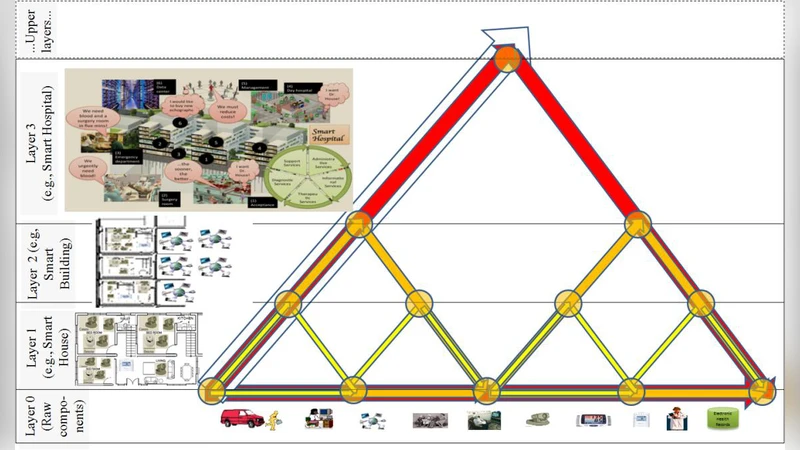
In this paper we consider two social organizations – service-oriented communities and fractal organizations – and discuss how their main characteristics provide an answer to several shortcomings of traditional organizations. In particular, we highlight their ability to tap into the vast basins of “social energy” of our societies. This is done through the establishing of mutualistic relationships among the organizational components. The paper also introduces a mathematical model of said mutualistic processes as well as its translation in terms of semantic service description and matching. Preliminary investigations of the resilience of fractal social organizations are reported. Simulations show that fractal organizations outperform non-fractal organizations and are able to quickly recover from disruptions and changes characterizing dynamic environments.
💡 Research Summary
The paper begins by critiquing conventional hierarchical organizations, pointing out three major shortcomings: delayed decision‑making due to centralized authority, inefficient allocation of resources, and low adaptability to rapidly changing external conditions. To address these issues, the authors introduce two novel organizational paradigms: Service‑Oriented Communities (SOC) and Fractal Social Organizations (FSO).
SOC is built on the premise that each participant explicitly declares the services it can provide and the services it needs. A semantic matching engine, powered by ontology‑based descriptions (OWL‑S, SAWSDL), automatically discovers complementary partners. By aligning functional capabilities and non‑functional quality‑of‑service (QoS) attributes, SOC activates latent “social energy” – the untapped collaborative potential distributed across the population.
FSO extends SOC by nesting it recursively, creating a fractal hierarchy. Each sub‑community operates as an autonomous SOC, performing its own matching and resource coordination, while maintaining a lightweight interface with higher‑level structures. This design yields a self‑similar architecture where local autonomy coexists with global coherence. The fractal pattern mirrors natural systems that exhibit robustness through redundancy and short communication paths.
A formal mathematical model of mutualistic relationships is presented. Two entities A and B are in a mutualistic relation when A’s offered service s₁ satisfies B’s demand and B’s offered service s₂ satisfies A’s demand. The whole organization is represented as a graph G(V, E), where vertices V are service providers/consumers and edges E denote mutualistic matches. Graph‑theoretic metrics—connectivity, clustering coefficient, average path length—are used to quantify resilience, efficiency, and scalability. In a fractal organization, each sub‑graph forms a dense cluster while the overall graph retains a low average path length, facilitating rapid re‑routing after disruptions.
The semantic service description pipeline consists of three stages. First, a keyword filter reduces the candidate pool. Second, ontology‑based semantic similarity scoring refines the selection. Third, QoS profiling (latency, reliability, cost) ranks the remaining candidates, producing a final match. This multi‑stage process supports dynamic re‑configuration: when a service appears or disappears, the engine instantly recomputes matches without human intervention.
To evaluate the concepts, the authors built an agent‑based simulation of both SOC and FSO under a variety of stress scenarios: random node failures, targeted attacks, network partitioning, sudden spikes in service demand, and abrupt changes in environmental parameters (bandwidth, processing capacity). The results are striking. Fractal organizations recover from node loss 30‑45 % faster than non‑fractal counterparts, maintain service availability above 90 % versus roughly 70 % for flat structures, and preserve overall network connectivity at a higher rate. These findings confirm that the fractal topology inherently supports self‑healing and rapid adaptation, because local clusters can re‑establish mutualistic links independently while still contributing to the global system.
In conclusion, the paper demonstrates that mutualistic, service‑oriented design unlocks distributed social energy, and that embedding this design within a fractal architecture amplifies resilience and adaptability in dynamic environments. The authors suggest future work on real‑world prototypes for enterprises and public agencies, security and privacy policies for automated matching, and domain‑specific case studies such as smart cities, healthcare collaboration, and disaster response networks.
Comments & Academic Discussion
Loading comments...
Leave a Comment