Public Spheres in Twitter- and Blogosphere. Evidence from the US
The political requires a forum for its deliberation and Habermas has located it in the public spheres. Originally, mass media's role was one of a facilitator of these debates. However, under the immense pressures of free market competition and mobile…
Authors: Christoph Waldhauser
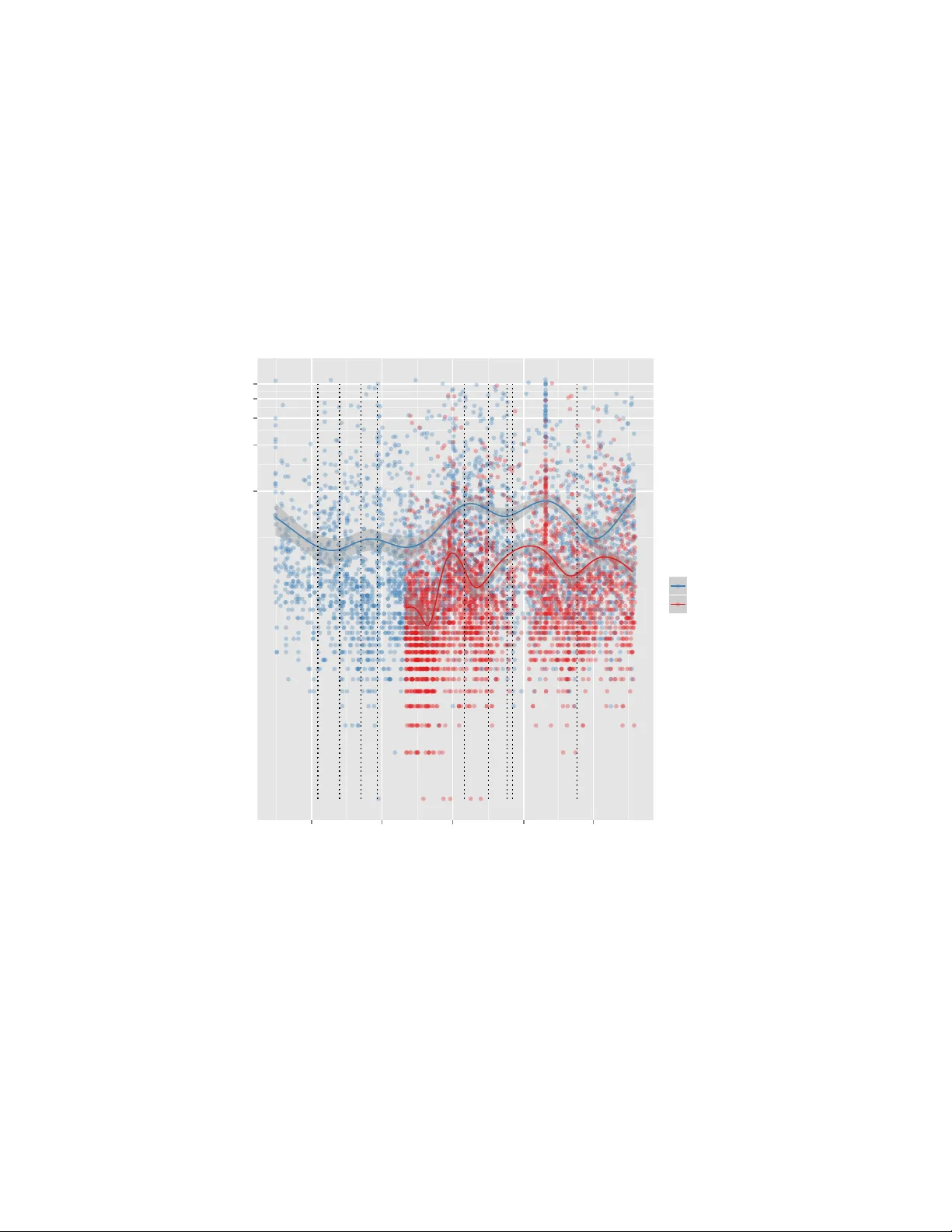
Public Spheres in T witter- and Blogosphere. Evidence from the US. Christoph W aldhauser, KDSS K Data Science Solutions P ap er presen ted at EPSA 2014 In tro duction A ma jor part of politics is the con v eying of ideas. This is the function of p olitical comm unication. Of the m ultitude of wa ys this con v eying can take place, delib eration in a public sphere is one that Hab ermas (1994) termed optimal. Both public spheres and delib erativ e demo cracy presupp ose an equality of all participan ts in a debate and the sup eriorit y of go o d arguments. Presen tly , b oth features are not eviden t. Large debates with many participants require a mediator to relay messages from one participan t to the next. T o some exten t, mass media tries to fulfill that role. Ho wev er, the use of mass media as mediator comes at a cost: under the impression of the sheer volume of messages to deliver, mass media needs to prioritize and select messages (Strömbäc k 2008). This selection heuristic, how ev er, is far from Hab ermas’ ideal: not all participants are equal and arguments not alwa ys rule (Mey er and Hinchman 2002). In contrast to mass media, so cial media—by definition—implements equality of all users from the start and also places the selection of messages under their con trol. It therefore has the p otential to deliv er on both: fulfilling a role as a public sphere and promoting the qualities of delib erative debate. In this con tribution I establish a baseline of so cial media’s role as a public sphere, using recen t T witter data. This pap er is organized as follows. I will first review the literature p ertaining to public spheres and their interaction with media, mass or otherwise. I will then turn to describ e the used data set and the employ ed analytical metho ds. The next section will present the results of m y analysis. Thereafter I will discuss these results in light of the theory review ed ab ov e and close with some concluding remarks. 1 Public Spheres & Media The original function of political communication w as to facilitate the finding of agreeable p ositions. Informed citizens were to exchange and discuss ideas in order to discov er these ideas’ applicability to realit y . As so cieties quic kly— quite literally—outgrew the practicality of round tables and forum discussions, something Habermas termed the public sphere (Habermas 1991; Hab ermas 2006) to ok ov er. 1 The concept of a public sphere is embedded in the wider framework of delib erative demo cracy . If the public sphere is the lo cation where political debates take place, delib erativ e demo cracy describ es the mo de of these debates (Hab ermas 1994). Cohen (2003) extends Hab ermas when identifying the common goo d as the aim of all delib eration in delib erativ e demo cracy . His formal definition entails five p oin ts: indep endence of asso ciation, self-referencing, equality of ideas, ro oted in realit y , and recipro cal resp ect. In his in-depth study of traces of delib erative demo cracy on the Internet, Dahlb erg (2001) uses a similar list but adds a sixth p oint to it: reflexivit y , that is the requiremen t to question one’s own standp oin ts. F rom this list it b ecomes clear, that delib erative demo cracy not only describ es a practice, but a form of institution. Obviously , it is not a role that a medium can fulfill. Even Dahlb erg (2001) had to concede, that the technology of that time simply was not up to providing for institutionalized delib erativ e demo cracy on the Internet. Ho wev er, it is still p ossible to carve out the term of delib erative practices: exc hanging ideas and ob jective, reasonable, Dahlberg (2001) calls them rational–critical, arguments in their supp ort. Thinking delib erative practices in concert with a public sphere mak es the sensible, fact-based argument its communicativ e hallmark feature. In his introduction to a collection of essa ys on delib erative demo cracy , Elster (1998) distills a common ground of contemporary definitions of the deliberative practices part of delib erativ e demo cracy: “decision making by means of arguments offered by and to partici- pan ts who are committed to the v alues of rationality and impartiality” (p. 8, emphasis in the original). It is this definition of delib erativ e practices that I will use here. Delib erative practices serve to instill life into the hollowness of a public sphere b y describing the mo de of communication that is conducive to the functioning of a public sphere. This requires reasonable arguments. As we shall see in the next section, they are to b e found in sp ecific kinds of news stories. News stories, that are not alw ays of the prev ailing kind. 1 Common features of public spheres identified in the literature are a mutual mode of communication and equally reciprocal acceptance of each other as legitimate participants (Koopmans and Erbe 2004; Risse and Steeg 2003). 2 Media In the mo dern public sphere, or spheres (Dahlgren 2005), it is still citizens directly exchanging ideas and engaging in p olitical debate. How ev er, Hab ermas’ conception was an idealized one from the b eginning. Neither did citizens ha ve the interest nor the talent or time to b e constantly engaged in debates. Rather, a mediator and a caste of professional citizens emerged, the former distilling p olitical messages of the latter into a format that allo w ed even part-time citizens to—at least on some lev el—partake in the debate. While this extends the accessibilit y of the public sphere’s debates to a larger crowd , there is also another side to that bargain: the mediator might transform the messages sent by other participan ts in a debate. And once there are more messages fed into the mediator than can reasonably b e pro cessed and relay ed to others, the mediator will start selecting messages according to its o wn rules. And this is, where trouble starts. Sc hulz (2004) and Strömbäc k (2008) summarize these troubles under the term of mediatization. Here, mass media acts as the mediator and in that role tamp ers with the p olitical system in a num b er of wa ys. F oremost, it selects messages to rela y to others by its own media logic: newspaper circulation figures and TV ratings, for example. Mass media uses these num bers to gauge the profitability of any message. Will any giv en message contribute to these figures and therefore increase the medium’s income, or not? Based on the answer to that question, a message will b e relay ed, or not. T o further increase the v alue of a message, mass media will restyle the message and p oten tially cripple its original meaning. This media logic b ecomes internalized b y p oliticians seeking to maximize their mass media presence. This leads to the interesting phenomenon of shifting political comm unication’s attention from con veying ideas to reform ulating ideas to concur with this sp ecific media logic. The regime of mediatization is not necessarily detrimen tal to the functioning of a demo cracy or even the bare exchange of ideas. As long as the media logic captures the idea correctly and do es not p enalize the complexity of ideas nor fa vor simplistic solutions, mediatization has the p otential of actually enriching public sphere debates. F or example, consider data journalism or fact-c hecking p oliticians’ claims. Both metho ds comply with a media logic that fav ors truth o ver simplicity , therefore en ticing p oliticians to communicate ideas truthfully and as complex as necessary . On the other hand, the v ast ma jorit y of mass media follows a different logic: here, shortness, en tertainment and drama are elements that are of greater imp ortance than an idea’s foundation in facts or civic vision (Iyengar and Simon 2000; Iy engar, Luskin, and Fishkin 2004; Iyengar and Kinder 2010; Ström bäck 2008). This media logic leads p oliticians to offer p opulist solutions—quick and dirty , sellable to a broad audience with short attention spans (Strömbäc k and Esser 2009; Meyer and Hinchman 2002; Hjarv ard 2008; Ström bäck 2008). This media logic cannot aptly capture ideas an ymore, and therefore leads to an erosion of the public sphere. 3 Iy engar and Kinder (2010) argue that due to the adven t of cable TV in the 1990s, mass media is sub jected to an heightened state of competition. While up to the 1980s, only three netw orks supplied largely identical news to a large audience, the exp onential growth of media outlets enabled citizens to opt-out of news. Or, if they still actively listen to news, they can now choose which news they subscrib e to. This leads to media outlets pro ducing news that is targeted sp ecifically at their (remaining) share of customers: highly partisan and app ealing to them. In a p olitical context, what exactly is app ealing to consumers of news? Iyengar, Norp oth, and Hahn (2004) answer this question clearly with “horse race’‘or episo dic news, that is news that co v er the curren t state of the campaign, and not thematic conten t on the candidates’ p ositions. They understand episo dicity and thematicit y as opp osing concepts: the more episodic a piece of news is, the less thematic it can b e. While their con tribution has numerous metho dological flaws, they convincingly put forth their argument of a decline of thematic conten t due to comp etitiv e pressure among media outlets. This argument is also in line with theory (T raugott and Lavrakas 2008), that would predict these market effects to o ccur along with intrinsic journalistic self-selection. Considering the thematic–episo dic conten t rift in terms of delib erative practices allo ws for additional insights. If mass media function as a mediator in Hab er- masian public spheres, then their debate con tributions should b e based on reason and impartiality . Iy engar, Norp oth, and Hahn (2004) give a textb o ok example for b oth kinds of contributions: a story ab out a homeless woman and her pligh t; a story intended to serve as a proxy for the fates of countless others. T ouching as the story migh t b e, it is void of reason and do es not serve to contribute to a rational debate based on facts and impartial arguments. This episo dic news story is con trasted by a thematic one: thorough researc h of facts, causes and consequences of homelessness; founded in reason and instructiv e in any search for solutions, abstracting aw a y individual stories for the sake of the bigger picture. As noted ab o ve, comp etition among media outlets has grown to tremendous prop ortions. Since all comp etitors in the mass media game are commercial en terprises and therefore immanently seeking to maximize their profit, the dominan t factor for selecting news is its mark et v alue. How ever, this v alue do es not refer to the amount a customer is willing to pay for any particular piece of news. Rather, this figure correlates directly with circulation figures or ratings as they go vern the ad premiums a media outlet can c harge. A factor that is not to b e underestimated is the vicious circle this mass media mediatization can lead to. P oliticians vying for media presence b ecome then tempted to style their own messages in a media compatible wa y . An example migh t b e the T eam Stronach’s campaign for the 2013 general election in Austria; more sp ecifically its reaction to a high-profile international custo dy battle ov er a child. There, an industrial magnate offered his priv ate jet to the A ustrian mother to facilitate her legal struggle in Denmark. This episo dic news story w orked v ery well and secured nationwide (tabloid) headlines for his part y and 4 the generous offer. How ever, any p olitical ideas on how international custo dy disputes should b e resolved in the future, any abstract argument, was either not sen t by Stronach’s sp ok esp ersons or not relay ed b y mass media. Therefore, the en tire message did not contribute to an y delib erativ e practice. In summary , there are several clues that p oint tow ards mass media communication not alwa ys b eing true to its envisioned role in public spheres and delib erative debates. The pressure from comp etition leads to mass media selecting and transforming news to adhere to a style that maximizes its mark et v alue (Blumler and Ka v anagh 1999). So cial media is p oten tially different. There, users seek to maximize their own v alue by pro viding conten t their resp ectiv e audiences find useful (Ra ymond 1999; Rheingold 1993; Pettersson and Karlström 2011). Therefore, users would b e exp ected to propagate conten t they themselves b elieve their follo wers will find in teresting. In an arena free from traditional market pressures, this could lead to users selecting thematic ov er episo dic conten t. Data & Metho d In order to test the hypothesis put forth ab ov e, the last 3200 (the maximum the T witter API would allo w) tw eets emanating from the Republican and Demo- cratic party accounts, resp ectively , were harvested on Ma y 25th, 2014. As not b oth parties generate t w eets at the same rate, co verage is pro vided starting from 2013-02-13 for Demo crats and 2013-07-31 for Republicans. Apparently , Demo crats use their account m uc h more sparingly than Republicans. Given that @Barrac kObama can also b e attributed to Demo cratic party control, this is of little surprise. In general, Demo crats enjoy more p opularity on T witter than Demo crats. This leads to Demo crat’s tw eets b eing more often retw eeted than their Republican coun terparts. On av erage, Demo cratic tw eets were retw eeted 60 times, while Republican ones only score half as man y retw eets on av erage: 28. Since the range of retw eets in enormous, with the most p opular tw eet in the data set b eing retw eeted 24,352 times 2 , the top 1 percent of ret weeted tw eets w ere considered singular and therefore excluded from all analysis 3 . Figure 1 describ es the dev elopment of t weet p opularit y ov er time. Of the 6,336 tw eets that remained in the data set, 3,592 p oin ted to resolv able w ebsites. Those were harvested as well. The texts on those websites were extracted, cleaned, normalized and fed into an LD A topic mo del algorithm. The n umber of topics, 10, w as empirically established. Figure 2 gives an o v erview of topic distribution among t w eets. 2 This tw eet was a ret weet itself of a message that W endy Da vis of T exas initially posted thanking T exans for supp ort in stopping contro versial Senate Bill 5 on abortions. 3 The top 1 p ercent of tw eets range from 534 to abov e 24,000 ret w eets. 64 t weets fell in to that range and were excluded. 5 100 200 300 400 500 Apr 2013 Jul 2013 Oct 2013 Jan 2014 Apr 2014 Date Retweet count Party Dem Rep T weets ov er time Figure 1: Developmen t of retw eets ov er time for b oth parties with GAM-based trend line and elections to House or Senate indicated by dotted verticals. 6 Figure 2: Heatmap depicting the distribution of topics across all tw eets for b oth parties. The darker the spike, the stronger the topic o ccurs in the tw eet. 7 The extracted topics w ere classified according to their asp ect as either episo dic or thematic. A third “asp ect” was necessitated b y websites that contained unparsable conten t, like pictures or con tent hidden by AJAX techniques. These topics were then not considered any further. T ables 1 and 2 give an o verview o ver the extracted topics and their rating as thematic or episo dic. T opic Con tent Asp ect 1 candidate, announcemen t episo dic 2 health insurance thematic 3 republican party p olitics episo dic 4 (unp arsable) NA 5 demo cratic call to action episo dic 6 demo cratic call for donations episo dic 7 (unp arsable) NA 8 ch urch and state separation thematic 9 demo cratic party p olitics episo dic 10 (unp arse able) NA T able 1: T opics on websites tw eeted by Demo crats. Num b er Con tent Asp ect 1 republican call to action episo dic 2 national unemploymen t thematic 3 candidate, announcement episo dic 4 obama care is unp opular thematic 5 republican call to action episo dic 6 obama care is exp ensive thematic 7 republican call for donations episodic 8 (unp arsable) NA 9 arguments against obamacare thematic 10 republican call for supp ort episo dic T able 2: T opics on websites tw eeted by Republicans. 8 As LD A pro vides posterior probabilities of belonging to each topic for eac h w ebsite ( M ), as depicted in Figure 2, thematicity and episo dicit y scores were computed for each tw eet linking to a website. This episo dicit y (thematicity) score was obtained by summing up those elements m ik of M where k is an elemen t of the set of all episo dic (thematic) topics K : e i = P k ∈ K m ik Therefore, episo dicity (thematicity) scores range from 0 to 1 with 0 b eing a w ebsite without any episo dic (thematic) topics and 1 a website containing solely episo dic (thematic) topics. The developmen t of episo dicit y and thematicity ov er time for b oth parties is given in Figure 3. It b ecomes evident that party strategies with resp ect to the prev alence of are not only divergen t but also changing ov er time. Starting from these descriptive observ ations, I will now present a mo del linking episo dicit y and thematicity with the reshare count. Results In order to establish any asso ciation b et w een episo dicity , thematicity and the reshare count of a message, a generalized linear mo del is considered. Based the findings in Ho chreiter and W aldhauser (2013), the mo del contains con trol v ariables for time of day and message length. An additional control v ariable relating to the distance from a tw eet’s posting to the closest election is also included in the mo del. 4 As count-based mo dels require constan t observ ational frames, an offset term computed from the n umber of follow ers for the resp ectiv e part y account ( n p ) times the age of the message ( a ) was included as well: o = n p × a The initial mo del contained the first order terms for party mem b ership, episo dic- it y , thematicity , time of day , message length and the election proximit y . All these terms were complemen ted with interactions with the party v ariable. Finally , thematicit y and episo dicit y interactions with part y were included as well. Starting with this complete mo del, insignificant interactions were remov ed, one at a time. This led to the remov al of the party—message length and party— thematicit y interactions. T able 3 con tains the test results from the mo del selection step. 4 In order to stabilize the variance in that distance, the square root of the term w as considered. 9 Figure 3: The developmen t of the prev alence of episo dic and thematic con tent o ver time for b oth parties. T rend lines are GAM-based and elections to House or Senate are indicated by dotted verticals. 10 2 x log-lik. T est df LR stat. Pr( χ 2 ) -33964 1 vs 2 1 1.95 0.1626 -33963 2 vs 3 1 0.8676 0.3516 T able 3: Likelihoo d ratio tests confirming dropping of party— message length and party—thematicit y interactions from the model. Owing to the count nature of the dep endent v ariable, Poisson regression or a negativ e-binomial model must b e used. Based on a lik eliho o d-ratio test comparing the Poisson and negative binomial versions of the mo del, χ 2 (14 , N = 3592) = 138 , 045 . 92 , p = 0 , equality of conditional mean and v ariance cannot b e assumed and a negativ e binomial mo del is therefore more appropriate. The final mo del’s estimates, standard errors and p-v alues are given in T able 4. β i SE p-v alue (In tercept) -14.45 0.139 0 P art y (1=R) -0.142 0.095 0.136 Episo dicit y -1.132 0.125 0 Thematicit y -0.73 0.134 0 Ret w eet (1=Y es) 1.526 0.164 0 Time of Day 0.039 0.009 0 Message Length 0.003 0.001 0 √ P r oxi. 0.229 0.02 0 Episo dicit y (Rep) 0.241 0.089 0.007 Ret w eet (Rep) -1.104 0.218 0 Time of Day (Rep) -0.029 0.012 0.017 Episo dicit y × √ P r oxi. -0.079 0.024 0.001 Thematicit y × √ P r oxi. -0.11 0.026 0 T able 4: Final mo del co efficients. 11 Discussion Akin to the more familiar o dds ratios from logistic regression, count data sp orts incidence rate ratios as interpretation of its exp onentiated co efficien ts. These IRRs can b e found in T able 5. exp β i (In tercept) 0 P art y (1=R) 0.867 Episo dicit y 0.322 Thematicit y 0.482 Ret w eet (1=Y es) 4.599 Time of Day 1.04 Message Length 1.003 √ P r oxi. 1.257 Episo dicit y (Rep) 1.272 Ret w eet (Rep) 0.332 Time of Day (Rep) 0.972 Episo dicit y × √ P r oxi. 0.924 Thematicit y × √ P r oxi. 0.896 T able 5: Incidence rate ratios for the mo del co efficients reflecting the exp ected change in retw eet rates for one unit increases. F rom these results, I am going to discuss the more remarkable ones here. 1. There is a quite strong difference b etw een reshares Republican and Demo crats can exp ect, even when controlling for different user base sizes: for a tw eet that would hav e generated 100 reshares if it had originated with the Demo crats, the Republicans can only exp ect 87. Ob viously , Demo crats lead so cial media usage not only by the num ber of follo wers but also b y their (the follow ers’) dedication to the medium. 2. Episo dic and thematic conten t enjoy virtually the same p opularity . It is also evident, that the less thematic or episo dic a message is, the higher the exp ected reshare count. While surprising at first, this is an artifact in tro duced by unparsable con ten t on the w ebsites. It is entirely conceiv able 12 that images – for their simplicit y and easy to understand punc hlines – are more p opular all together than textual conten t. When comparing textual conten t directly , it b ecomes eviden t that thematic con tent is almost 150 p ercent as p opular as episo dic conten t. Interestingly , this difference is only to b e found in Demo cratic t weets and all but disap- p ears for tw eets sent from the Republican account. These differences are con trary to the predictions of Iyengar, Norp oth, and Hahn (2004). There, consumers would want episodic, horserace news. In this data set, how ev er, users in general don’t like textual con tent. Among textual conten t they do prefer thematic ov er episo dic news. 3. Finally , there are interesting effects dependent on the proximit y of a message to election day . In general, the exp ected reshare count increases b y 25 p ercen t for every additional square ro ot da y aw ay from an election. This effect is toned done somewhat for episo dic or thematic conten t. Conclusion In this pap er I hav e b een lo oking at the w ay b oth US p olitical parties make use of so cial media. The example case for this study was T witter and I analyzed the last 3,200 tw eets that originated from the main party accounts along with an y websites they might p oint to. I’v e concentrated on tracing how thematic and episo dic con tent is b eing distributed (differently) via T witter. T o that end, I’v e text-mined any websites that were mentioned in those tw eets and used LD A topic mo dels to extract the topics that occur in these w ebsites. Using Iy engar’s definition of episo dic or horserace news, I classified all (parsable) topics to b e either episo dic or thematic. Finally , generalized linear models are used to mo del the relationship betw een the ret weets a message receives and episo dicity , thematicit y and some controlling co v ariates. The results in parts con tradict what theory would hav e predicted, in that thematic news is more p opular than episo dic one. Iyengar, Norp oth, and Hahn (2004) argue that mass media fo cuses on episodic news, b ecause that is what consumers demand. I, therefore, ten tativ ely conclude that so cial media w ould ha ve a p oten tial as a public sphere, supp orting arguments in p olitical delib eration. While these results are only preliminary and from a very limited data set, they are informativ e in the sense that they lead us to question the long-held assumption that market forces lead to episo dic news cov erage. Clearly , more in-depth and broader analysis is needed to grow confidence in this challenge. 13 References Blumler, Jay G, and Dennis Kav anagh. 1999. “The Third Age of Political Comm unication: Influences and F eatures. ” Politic al Communic ation 16 (3): 209–230. Cohen, Joshua. 2003. “Delib eration and Demo cratic Legitimacy . ” In Deb ates in Contemp or ary Politic al Philosophy. an A ntholo gy , edited by Derek Matra vers and Jon Pik e, 342–360. New Y ork: Routledge. Dahlb erg, Lincoln. 2001. “The Internet and Demo cratic Discourse: Exploring the Prosp ects of Online Delib erativ e F orums Extending the Public Sphere. ” Information, Communic ation & So ciety 4 (4): 615–633. Dahlgren, P eter. 2005. “The Internet, Public Spheres, and Political Com- m unication: Disp ersion and Delib eration. ” Politic al Communic ation 22 (2): 147–162. Elster, Jon, ed. 1998. Delib er ative Demo cr acy . Cam bridge; New Y ork; Mel- b ourne: Cambridge Universit y Press. Hab ermas, Jürgen. 1991. The Structur al T r ansformation of the Public Spher e: A n Inquiry into a Cate gory of Bour ge ois So ciety . MIT Press. ———. 1994. “Three Normative Mo dels of Democracy . ” Constel lations: A n International Journal of Critic al and Demo cr atic The ory 1 (1): 1–10. ———. 2006. “Political Comm unication in Media So ciety: Do es Demo cracy Still Enjo y an Epistemic Dimension? The Impact of Normativ e Theory on Empirical Researc h. ” Communic ation The ory 16 (4): 411–426. Hjarv ard, Stig. 2008. “The Mediatization of So ciety: A Theory of the Media as Agen ts of So cial and Cultural Change. ” Nor dic om R eview: Nor dic R ese ar ch on Me dia & Communic ation 29 (2): 105–134. Ho c hreiter, Ronald, and Christoph W aldhauser. 2013. “A Sto c hastic Simulation of the Decision to Retw eet. ” In A lgorithmic De cision The ory , 221–229. Springer. Iy engar, Shan to, and Donald R Kinder. 2010. News That Matters: T elevision and A meric an Opinion . Chicago, Illinois: Universit y of Chicago Press. Iy engar, Shan to, and A dam F Simon. 2000. “New Perspectives and Evidence on P olitical Communication and Campaign Effects. ” A nnual R eview of Psycholo gy 51 (1): 149–169. Iy engar, Shan to, Rob ert C Luskin, and James Fishkin. 2004. “Delib erativ e Public Opinion in Presidential Primaries: Evidence from the Online Delib erativ e P oll. ” Iy engar, Shanto, Helmut Norp oth, and Kyu S Hahn. 2004. “Consumer Demand for Election News: The Horserace Sells. ” Journal of Politics 66 (1): 157–175. 14 K o opmans, Ruud, and Jessica Erb e. 2004. “T o w ards a Europ ean Public Sphere? V ertical and Horizontal Dimensions of Europ eanized Political Communication. ” Innovation: The Eur op e an Journal of So cial Scienc e R ese ar ch 17 (2): 97–118. Mey er, Thomas, and Lewis P Hinchman. 2002. Me dia Demo cr acy: How the Me dia Colonize Politics . Cambridge: Polit y Press. P ettersson, David, and Petter Karlström. 2011. “Reputation as a Pro duct: P oliticians in So cial Media. ” Ra ymond, Eric. 1999. “The Cathedral and the Bazaar. ” K now le dge, T e chnolo gy & Policy 12 (3): 23–49. Rheingold, Ho ward. 1993. The V irtual Community: Homeste ading on the Ele ctr onic F r ontier . Reading, Massach usetts: Addison-W esley Longman. Risse, Thomas, and Marianne V an de Steeg. 2003. “An Emerging Europ ean Public Sphere? Empirical Evidence and Theoretical Clarifications. ” Sc hulz, Winfried. 2004. “Reconstructing Mediatization as an Analytical Concept. ” Eur op e an Journal of Communic ation 19 (1): 87–101. Ström bäck, Jesp er. 2008. “F our Phases of Mediatization: An Analysis of the Mediatization of Politics. ” The International Journal of Pr ess/Politics 13 (3): 228–246. Ström bäck, Jesp er, and F rank Esser. 2009. “Shaping Politics: Mediatization and Media In terv entionism: Concept, Changes, Consequences. ” In Me diatization , edited b y Knut Lundb y , 205–224. New Y ork: Peter Lang. T raugott, Michael W, and Paul J La vrakas. 2008. The V oter’s Guide to Ele ction Pol ls . New Y ork: Rowman & Littlefield. 15
Original Paper
Loading high-quality paper...
Comments & Academic Discussion
Loading comments...
Leave a Comment