Virtual Observatory Publishing with DaCHS
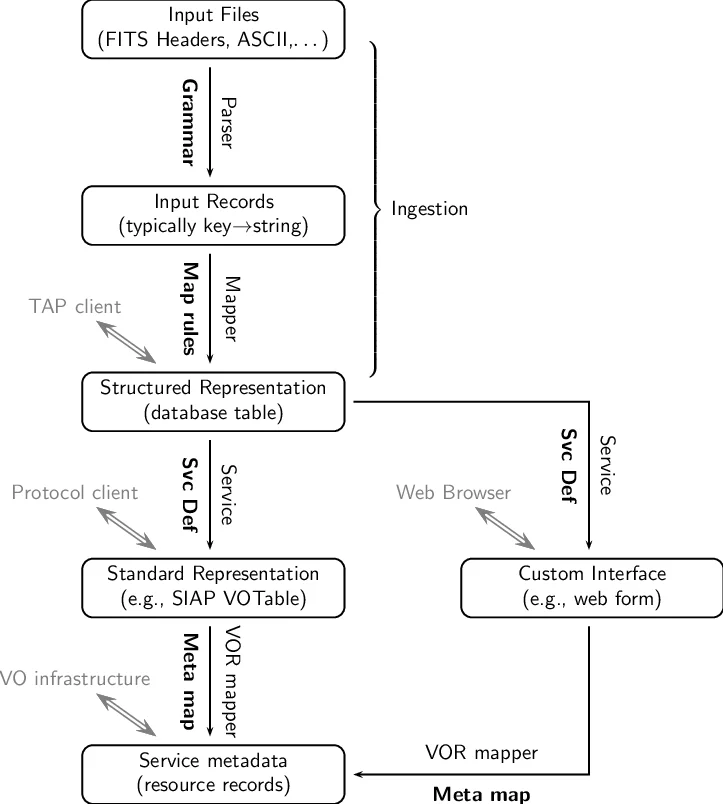
The Data Center Helper Suite DaCHS is an integrated publication package for building Virtual Observatory (VO) and Web services, supporting the entire workflow from ingestion to data mapping to service definition. It implements all major data discovery, data access, and registry protocols defined by the VO. DaCHS in this sense works as glue between data produced by the data providers and the standard protocols and formats defined by the VO. This paper discusses central elements of the design of the package and gives two case studies of how VO protocols are implemented using DaCHS’ concepts.
💡 Research Summary
The paper presents the Data Center Helper Suite (DaCHS), an integrated publishing framework designed to lower the barrier for astronomical data providers to expose their datasets through Virtual Observatory (VO) standards. DaCHS covers the entire lifecycle from raw data ingestion to service definition, protocol implementation, and registration in the VO Registry. The authors emphasize two guiding principles: (1) use declarative specifications wherever feasible, and (2) keep each piece of metadata in a single location. These principles are realized through a single XML‑based Resource Descriptor (RD) that encapsulates table schemas, ingestion grammars, row‑mapping logic, service endpoints, and VOResource metadata.
A central concept is the “mixin,” a reusable block that bundles columns, indices, and metadata required by a specific VO protocol (e.g., //scs#q3cindex for Simple Cone Search, //siap#pgs for Simple Image Access). By referencing a mixin, operators obtain protocol‑compliant tables without manually crafting SQL schemas. Ingestion proceeds in two stages. First, a parser (Grammar) reads various input formats—FITS, CSV, VOTable, or custom binary files—and produces flat key‑value dictionaries (rawdicts). Second, a rowmaker transforms rawdicts into typed rowdicts, handling type conversion, unit conversion, value normalization, derived column calculation, and null detection. The rowmaker can use plain Python expressions, predefined procedures, or fully custom Python functions, providing both simplicity and flexibility.
Service definitions are declared within the RD using
Operationally, DaCHS offers a command‑line tool (gavo) and a web‑based console. Ingestion is triggered by “gavo imp” which reads the RD, executes the defined grammars and rowmakers, and populates a PostgreSQL database (optionally using Q3C or pgSphere extensions for spatial indexing). Because the ingestion rules reside in the RD, re‑ingestion after data updates or bug fixes requires only a single command, preserving reproducibility. For very large collections, DaCHS supports “direct grammar” external binaries to accelerate parsing, mitigating the performance bottleneck of Python‑based processing.
Two case studies illustrate the framework. The first implements the Simple Spectral Access Protocol (SSAP), showing how spectral metadata is normalized, wavelength ranges are derived from filter information, and VOResource entries are automatically created. The second demonstrates TAP/Datalink integration, covering ADQL query handling, asynchronous job management via UWS, and the generation of data‑link URLs that point to ancillary files. Both examples highlight how mixins, declarative RD definitions, and the parser‑rowmaker pipeline enable rapid, standards‑compliant service deployment.
In conclusion, DaCHS provides a cohesive, declarative environment that abstracts the complexities of VO protocol compliance, allowing small research groups and data centers to publish interoperable services with minimal effort. Its design ensures that metadata is maintained consistently across ingestion, service operation, and registry publication, and its modular mixin system facilitates reuse and future protocol extensions. This integrated approach significantly lowers the entry threshold to the VO ecosystem while preserving the ability to evolve services as standards change.
Comments & Academic Discussion
Loading comments...
Leave a Comment