Mouvement et origine du calcul infinitesimal : Theorisation du mouvement et infinitesimaux
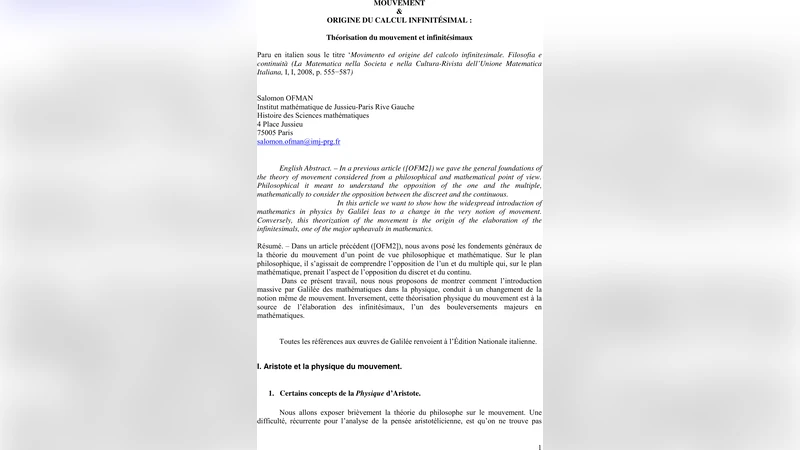
In a previous article we gave the general foundations of the theory of movement considered from a philosophical and mathematical point of view. Philosophical it meant to understand the opposition of the one and the multiple, mathematically to consider the opposition between the discreet and the continuous. In this article we want to show how the widespread introduction of mathematics in physics by Galilei leas to a change in the very notion of movement. Conversely, this theorization of the movement is the origin of the elaboration of the infinitesimals, one of the major upheavals in mathematics.
💡 Research Summary
The paper revisits the historical and philosophical roots of the concept of motion and demonstrates how Galileo’s systematic introduction of mathematics into physics fundamentally altered the way motion was understood, thereby seeding the development of infinitesimals. It begins by outlining the ancient philosophical dichotomy between the one and the many, and between the discrete and the continuous, which framed early attempts to describe change. Prior to Galileo, motion was treated qualitatively or through static geometric ratios, lacking a rigorous quantitative framework. Galileo’s breakthrough was to decompose motion into independent horizontal and vertical components, to treat time as a continuous variable, and to express distance as a function of time. In doing so he implicitly employed a limiting process: the familiar formula “velocity = distance / time” was understood as the average over an infinitesimally small time interval, even though the notion of an actual infinitesimal was not yet formalized.
The author argues that this hidden reliance on infinitesimally small intervals sparked the mathematical community’s interest in the concepts of limits and infinitesimals. When Newton later codified the calculus, he made the limiting process explicit through the differential and integral operators, while Leibniz introduced the symbolic infinitesimals (dx) and (dy). Both systems can be seen as direct extensions of Galileo’s methodological impulse to dissect motion into ever‑smaller temporal slices.
Crucially, the paper emphasizes a feedback loop: the need to quantify physical change drove the creation of infinitesimal calculus, and the availability of that calculus, in turn, allowed physicists to model motion with unprecedented precision. This reciprocal relationship underlies the broader shift from a qualitative, Aristotelian view of nature to the quantitative, mathematically grounded paradigm that characterizes modern science. By tracing this intellectual trajectory, the article positions Galileo’s re‑theorisation of motion as the historical catalyst for the infinitesimal revolution, thereby linking the evolution of physics with the parallel transformation in mathematics.