Implicit Lyapunov Control for the Quantum Liouville Equation
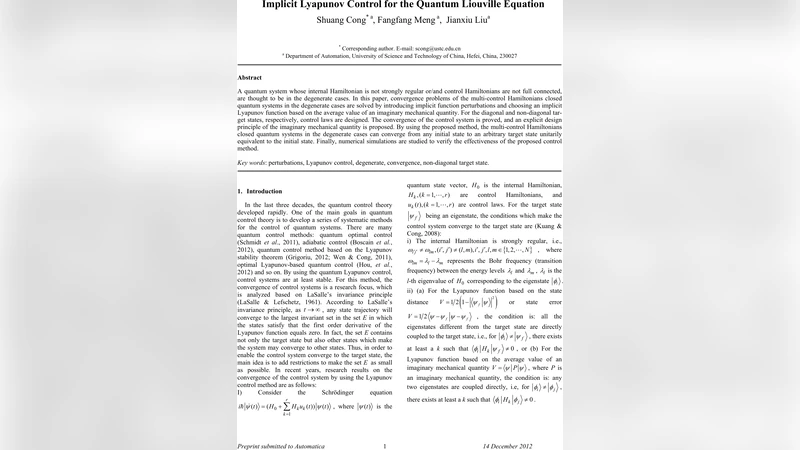
A quantum system whose internal Hamiltonian is not strongly regular or/and control Hamiltonians are not full connected, are thought to be in the degenerate cases. In this paper, convergence problems of the multi-control Hamiltonians closed quantum systems in the degenerate cases are solved by introducing implicit function perturbations and choosing an implicit Lyapunov function based on the average value of an imaginary mechanical quantity. For the diagonal and non-diagonal tar-get states, respectively, control laws are designed. The convergence of the control system is proved, and an explicit design principle of the imaginary mechanical quantity is proposed. By using the proposed method, the multi-control Hamiltonians closed quantum systems in the degenerate cases can converge from any initial state to an arbitrary target state unitarily equivalent to the initial state. Finally, numerical simulations are studied to verify the effectiveness of the proposed control method.
💡 Research Summary
The paper addresses the longstanding difficulty of steering closed quantum systems described by the Liouville–von Neumann equation when the internal Hamiltonian is not strongly regular and/or the available control Hamiltonians do not form a fully connected set. In such “degenerate” situations the conventional Lyapunov‑based feedback designs fail to guarantee convergence because the Lie algebra generated by the drift and control Hamiltonians lacks sufficient rank, and the standard Lyapunov functions cannot be made strictly decreasing along all trajectories.
To overcome this obstacle the authors introduce two complementary ideas. First, they embed a small, state‑dependent perturbation into each control input, denoted (\varepsilon_k(\rho)). These perturbations are not physical actuators; rather, they are mathematical devices that modify the closed‑loop dynamics so that the effective drift‑control pair becomes non‑degenerate. The perturbations are chosen to be smooth, vanish asymptotically, and be sufficiently small so as not to alter the original physical model in any measurable way.
Second, they construct an “implicit” Lyapunov function based on the expectation value of an imaginary mechanical quantity (Q):
\
Comments & Academic Discussion
Loading comments...
Leave a Comment