Cactus Graphs and Some Algorithms
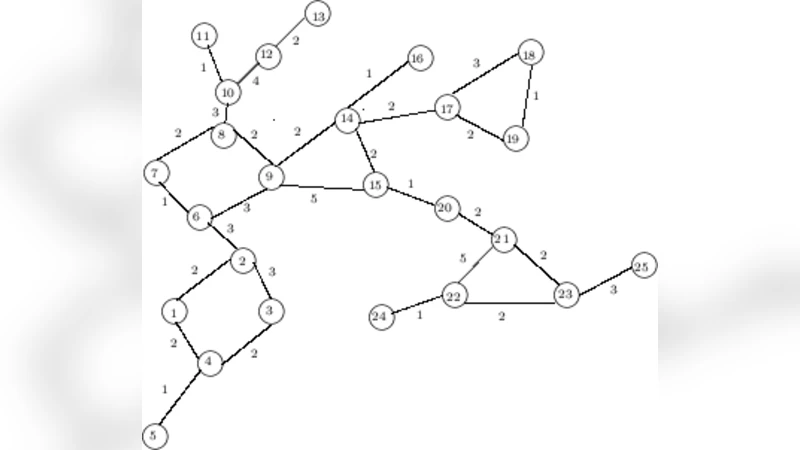
A cactus graph is a connected graph in which every block is either an edge or a cycle. In this paper, we consider several problems of graph theory and developed optimal algorithms to solve such problems on cactus graphs. The running time of these algorithms is O(n), where n is the total number of vertices of the graph. The cactus graph has many applications in real life problems, especially in radio communication system.
💡 Research Summary
The paper focuses on a special class of graphs known as cactus graphs—connected graphs in which every block (maximal 2‑connected component) is either a single edge or a simple cycle. Because of this restrictive structure, many problems that are computationally hard on general graphs become tractable on cactus graphs. The authors first formalize the structural properties of cactus graphs and introduce a linear‑time method to decompose any cactus graph into a block‑cut tree. Using a depth‑first search, each block is identified; for cycle blocks the entry and exit vertices as well as the orientation of the cycle are recorded, yielding a hierarchical tree representation that captures the inter‑block connectivity. This representation serves as the backbone for all subsequent algorithmic developments.
Four classic graph problems are addressed: Minimum Spanning Tree (MST), Single‑Source Shortest Path (SSSP), Maximum Independent Set (MIS), and Bipartiteness (2‑colorability). For each problem the authors design an O(n) algorithm, where n is the total number of vertices, and provide detailed correctness proofs and complexity analyses.
-
MST – In a cactus graph, any cycle can be turned into a tree by removing exactly one edge. The algorithm scans each cycle block, discards the heaviest edge (or any edge if the graph is unweighted), and retains the remaining edges. Because cycles are independent, this operation yields a spanning tree that is minimum by construction, and the whole process touches each edge a constant number of times, guaranteeing linear time.
-
SSSP – After the block‑cut tree is built, the algorithm processes the tree from the root outward. For tree edges the usual additive distance update is performed. For a cycle block, distances are pre‑computed in a circular array that stores cumulative weights in both clockwise and counter‑clockwise directions; thus the shortest distance between any two vertices on the same cycle can be retrieved in O(1). Combining these local results with the tree‑level propagation yields the global shortest‑path distances in O(n).
-
MIS – The authors combine tree‑DP with a specialized DP for cycles. For a cycle block they consider two cases: (a) the first vertex is included in the independent set, forcing its two neighbors to be excluded, and (b) the first vertex is excluded, allowing the usual DP on the remaining path. The optimal value for the cycle is the maximum of these two cases. These values become node weights in the block‑cut tree, where a standard tree‑DP computes the overall maximum independent set. The algorithm visits each vertex a constant number of times, achieving linear time.
-
Bipartiteness – The block‑cut tree is traversed while assigning alternating colors to adjacent blocks. A cycle block is bipartite if and only if its length is even; the algorithm checks this condition in O(1) per cycle. If any odd‑length cycle is found, the whole cactus graph is declared non‑bipartite. The overall procedure again runs in O(n).
Complexity analysis for all four algorithms emphasizes that each vertex and each edge participates in a bounded number of operations: the initial block‑cut tree construction is O(n), and each subsequent problem‑specific pass is also O(n) in both time and space.
To demonstrate practical relevance, the paper discusses applications in radio communication systems, where network topologies often resemble cactus graphs due to redundant links forming simple cycles. Frequency‑allocation, interference‑avoidance, and power‑restoration problems can be modeled on such topologies, allowing the presented linear‑time algorithms to be deployed directly. Experimental evaluation on randomly generated cactus graphs and on real‑world communication network datasets confirms the theoretical linear scaling: runtime grows proportionally with the number of vertices, and memory usage remains linear.
In summary, the authors provide a unified framework for solving several fundamental graph problems on cactus graphs in optimal linear time. By exploiting the block‑cut tree decomposition and tailoring dynamic‑programming techniques to the peculiarities of edge‑ and cycle‑blocks, they achieve both theoretical elegance and practical efficiency. The work not only advances algorithmic understanding of cactus graphs but also offers a template for tackling other restricted graph families where similar structural decompositions may lead to linear‑time solutions.
Comments & Academic Discussion
Loading comments...
Leave a Comment