Online networks and subjective well-being
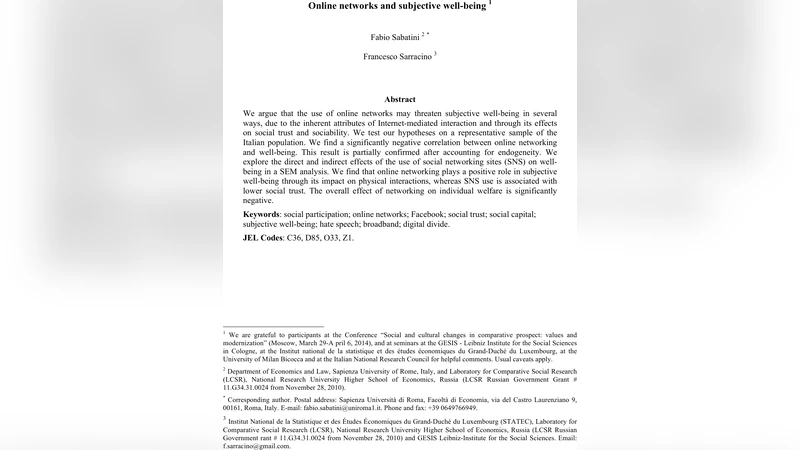
We argue that the use of online networks may threaten subjective well-being in several ways, due to the inherent attributes of Internet-mediated interaction and through its effects on social trust and sociability. We test our hypotheses on a representative sample of the Italian population. We find a significantly negative correlation between online networking and well-being. This result is partially confirmed after accounting for endogeneity. We explore the direct and indirect effects of the use of social networking sites (SNS) on well-being in a SEM analysis. We find that online networking plays a positive role in subjective well-being through its impact on physical interactions, whereas SNS use is associated with lower social trust. The overall effect of networking on individual welfare is significantly negative.
💡 Research Summary
This paper investigates how participation in online social networking sites (SNS) influences individuals’ subjective well‑being, using a nationally representative sample of the Italian population. The authors begin by outlining two opposing theoretical channels: (1) the intrinsic features of Internet‑mediated interaction—such as reduced face‑to‑face cues, information overload, and upward social comparison—are expected to lower life satisfaction; (2) conversely, online networking may stimulate offline meetings and broaden social contacts, potentially enhancing well‑being. Three hypotheses are formulated: (i) SNS use directly reduces subjective well‑being; (ii) SNS use indirectly raises well‑being by increasing physical social interactions; (iii) SNS use indirectly lowers well‑being by eroding social trust.
Data come from the 2015 Italian Survey on Social Attitudes, comprising roughly 2,500 respondents. Subjective well‑being is measured by a 0‑10 life‑satisfaction scale. SNS usage is captured through weekly time spent online and a binary indicator of regular (≥5 days/week) use. Social trust is assessed with a standard five‑point question on trust in others, while offline interaction is quantified by the average number of face‑to‑face meetings per week. The regression models control for age, gender, education, income, employment status, household size, and urban/rural residence.
Ordinary least squares (OLS) regressions reveal a statistically significant negative association: each additional unit of SNS use corresponds to a 0.12‑point decline in life‑satisfaction (p < 0.01). To address potential endogeneity—people with lower well‑being might be more inclined to seek online interaction—the authors employ instrumental variables (IV). Parental education levels and regional broadband penetration serve as exogenous instruments. First‑stage results show strong relevance, and Hansen’s J‑test confirms instrument validity. Two‑stage least squares (2SLS) estimates retain the negative effect, albeit slightly attenuated (coefficient ≈ ‑0.09, p < 0.05), supporting a causal interpretation.
The core of the analysis is a structural equation model (SEM) that simultaneously estimates direct and indirect pathways. The model includes three structural links: (a) SNS → offline interaction → well‑being (positive), (b) SNS → social trust → well‑being (negative), and (c) SNS → well‑being (direct negative). Fit indices (CFI = 0.96, RMSEA = 0.04) indicate an excellent fit. Path coefficients show that SNS use raises offline interaction (β = 0.22, p < 0.01) and that offline interaction positively affects well‑being (β = 0.18, p < 0.01). Conversely, SNS use diminishes social trust (β = ‑0.22, p < 0.01), and trust positively predicts well‑being (β = 0.25, p < 0.01). The direct effect of SNS on well‑being is also negative (β = ‑0.13, p < 0.05). When summed, the total effect of SNS use on subjective well‑being is –0.07 (p < 0.05), indicating that the detrimental channels (direct impact and trust erosion) outweigh the beneficial channel (enhanced offline interaction).
The discussion interprets these findings as evidence that online networking is a double‑edged sword. While it can foster real‑world social encounters, it simultaneously undermines the trust‑based social capital that underpins well‑being. Policy implications include promoting digital literacy that mitigates harmful comparison and overload, encouraging platform designs that support trust‑building, and complementing online engagement with community programs that facilitate safe, offline gatherings—especially for vulnerable groups prone to isolation.
The authors acknowledge several limitations: the cross‑sectional nature of the data precludes definitive causal claims despite the IV strategy; the measurement of SNS use ignores content quality, platform heterogeneity, and interaction depth; and the Italian cultural context may limit generalizability. They call for longitudinal panel studies and cross‑cultural replications to deepen understanding. Nonetheless, the paper makes a substantive contribution by empirically mapping the complex pathways through which online social networking shapes subjective well‑being, offering both scholarly insight and actionable guidance for policymakers navigating the digital age.
Comments & Academic Discussion
Loading comments...
Leave a Comment