Social Influences in Opinion Dynamics: the Role of Conformity
We study the effects of social influences in opinion dynamics. In particular, we define a simple model, based on the majority rule voting, in order to consider the role of conformity. Conformity is a central issue in social psychology as it represents one of people’s behaviors that emerges as a result of their interactions. The proposed model represents agents, arranged in a network and provided with an individual behavior, that change opinion in function of those of their neighbors. In particular, agents can behave as conformists or as nonconformists. In the former case, agents change opinion in accordance with the majority of their social circle (i.e., their neighbors); in the latter case, they do the opposite, i.e., they take the minority opinion. Moreover, we investigate the nonconformity both on a global and on a local perspective, i.e., in relation to the whole population and to the social circle of each nonconformist agent, respectively. We perform a computational study of the proposed model, with the aim to observe if and how the conformity affects the related outcomes. Moreover, we want to investigate whether it is possible to achieve some kind of equilibrium, or of order, during the evolution of the system. Results highlight that the amount of nonconformist agents in the population plays a central role in these dynamics. In particular, conformist agents play the role of stabilizers in fully-connected networks, whereas the opposite happens in complex networks. Furthermore, by analyzing complex topologies of the agent network, we found that in the presence of radical nonconformist agents the topology of the system has a prominent role; otherwise it does not matter since we observed that a conformist behavior is almost always more convenient. Finally, we analyze the results of the model by considering that agents can change also their behavior over time.
💡 Research Summary
This paper introduces an agent‑based opinion dynamics model that explicitly incorporates the psychological concept of conformity. Each agent holds a binary opinion (s = ±1) and is assigned one of two behavioral types: conformist or non‑conformist. Conformist agents adopt the majority opinion of their immediate neighbors, while non‑conformist agents adopt the opposite (the minority) opinion. The authors distinguish two hypotheses for non‑conformity. Hypothesis a (“local non‑conformity”) assumes that a non‑conformist follows the minority in its local neighborhood but still prefers to align with the global majority of the whole population. Hypothesis b (“global non‑conformity”) assumes a more radical stance: a non‑conformist seeks an opinion opposite to the global majority.
To evaluate the relative advantage of each behavior, three scores are defined. The local score P increases by +1 when an agent’s opinion has the same sign as the total sum S(t) = ∑i si(t) (or decreases by −1 when signs differ); it is unchanged when S(t)=0. The global scores Pc (for non‑conformists) and Pa (for conformists) are defined analogously but reward a non‑conformist only when its opinion is opposite to S(t). These scores allow the authors to quantify whether it is more beneficial to act conformist or non‑conformist under each hypothesis.
Simulations are performed on three network topologies: a fully‑connected graph (N = 1000), a scale‑free network (N = 10⁴, average degree ≈ 6) generated by the Barabási‑Albert model, and a small‑world network (N = 10⁴, average degree ≈ 6) generated by the Watts‑Strogatz model with rewiring probability β = 0.1. The primary control parameter is the initial fraction of conformist agents, ρa, varied from 0 to 1.
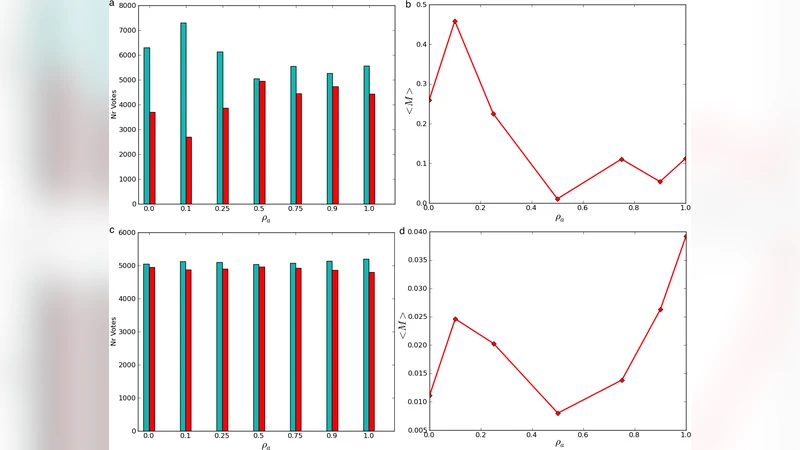
In the fully‑connected case, increasing ρa reduces the amplitude ΔS of the oscillations of S(t); when ρa = 1 the system quickly reaches a static state. However, the average magnetization
In contrast, on complex networks the dynamics are richer. For low ρa, S(t) tends to stay positive, reflecting a transient dominance of one opinion; as ρa increases, S(t) fluctuates around zero. Scale‑free networks exhibit a pronounced early surge in S(t) for ρa < 0.5, driven by highly connected hub nodes that quickly align with the majority rule. Small‑world networks display similar qualitative behavior but with smaller fluctuations.
Score analysis reveals divergent incentives. Under hypothesis a (local non‑conformity), the local score P is generally higher for non‑conformist agents, except when ρa ≈ 1 (a situation agents cannot detect). This suggests that, when non‑conformity is only locally defined, adopting the minority stance is often more rewarding. Under hypothesis b (global non‑conformity), the global scores Pc and Pa show topology‑dependent patterns. In scale‑free networks, conformist behavior is advantageous at very low and very high ρa, while non‑conformist behavior gains a slight edge at intermediate ρa. In small‑world networks, non‑conformity is mostly advantageous, with only a narrow intermediate ρa range where conformity competes.
The authors further extend the model to allow agents to switch behavior over time. At each time step, agents compare their own opinion with the global sum S(t). In hypothesis a, an agent flips its behavior whenever its opinion disagrees with S(t); in hypothesis b, a non‑conformist flips only when its opinion aligns with S(t), while a conformist flips when its opinion disagrees with S(t). Simulations with this adaptive rule show that, over long runs, the population tends to converge toward a higher proportion of conformists, especially when the initial ρa is moderate to high. When the initial non‑conformist fraction is large, frequent behavior switches sustain opinion diversity and prevent full consensus.
Overall, the study demonstrates that the proportion of non‑conformist agents critically determines system stability and the emergence of consensus. In mean‑field (fully‑connected) settings, conformity stabilizes the dynamics, whereas in heterogeneous networks (scale‑free, small‑world) non‑conformity can act as a destabilizing force, especially under the global non‑conformity hypothesis where network topology becomes a decisive factor. Allowing agents to adapt their behavior further highlights a natural tendency toward conformity, aligning with social‑psychological theories that view conformity as a mechanism for social cohesion. The work thus bridges opinion dynamics modeling with empirical insights from social psychology, offering a versatile framework for exploring how individual behavioral rules and network structure jointly shape collective opinion outcomes.
Comments & Academic Discussion
Loading comments...
Leave a Comment