On Permanent and Sporadic Oscillations of the Magnetosphere
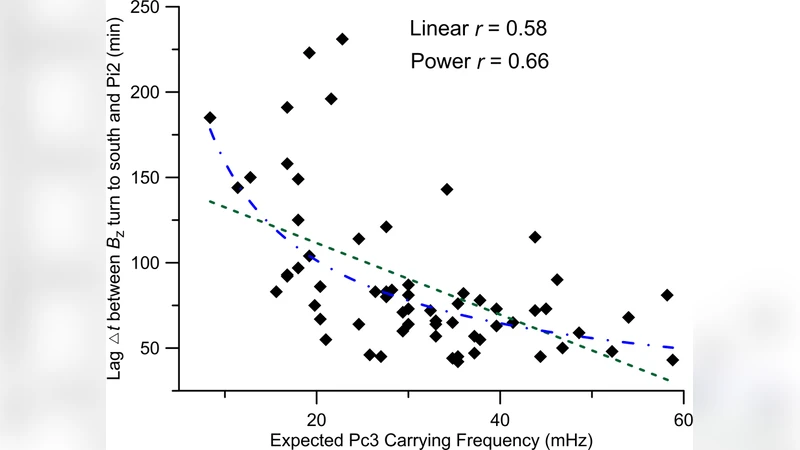
In this paper we investigate the impact of permanent oscillations Pc3 on the excitation of sporadic oscillations Pi2 ( their periods are 10-45 and 40-150 s, respectively ). The hypothesis is formulated that Pc3 oscillations originating in front of the magnetosphere penetrate into the geomagnetic tail, cause a local depression in the current in the neutral sheet, and under favorable conditions stimulate a tearing instability. This leads to reconnection of magnetic field lines and an explosive release of magnetic energy stored in the tail. As a result, a substorm breaks up, with sporadic pulsations Pi2 as an important element of this process. It is expected from theoretical estimates and kinematic considerations that the higher the Pc3 frequency, the earlier the Pi2 trains start. We test this prediction using observational data from satellite measurements of the interplanetary magnetic field and on-ground magnetic measurements. The results confirm the theoretical expectation. Additional routes are proposed to theoretically and experimentally test the hypothesis.
💡 Research Summary
The paper investigates a causal link between two well‑known magnetospheric wave families: the permanent Pc3 pulsations (periods 10–45 s, frequencies ≈0.2–1 Hz) and the sporadic Pi2 pulsations (periods 40–150 s, frequencies ≈0.007–0.025 Hz) that are a hallmark of substorm onset. The authors formulate a hypothesis that Pc3 waves, generated upstream of the magnetosphere by solar‑wind–magnetosphere interaction, can propagate tailward and interact with the neutral‑sheet current layer in the geomagnetic tail. There, the wave’s electromagnetic pressure produces a localized reduction (“depression”) of the current density. This current weakening destabilizes the sheet, lowering the threshold for a tearing instability. Once the tearing mode grows, magnetic reconnection occurs, releasing the magnetic energy stored in the tail. The reconnection process generates plasma and field‑line oscillations that manifest on the ground as Pi2 pulsations.
A simple analytical model is presented. Using a linearized MHD description of the neutral sheet, the authors derive a proportionality between the Pc3 electric‑field amplitude (Eₚc₃), its frequency (fₚc₃), and the induced current depression ΔJ: ΔJ ≈ α Eₚc₃ fₚc₃, where α depends on the sheet geometry. Because the growth rate of the tearing mode scales with the magnitude of the current reduction, a higher Pc3 frequency should trigger the instability earlier. Consequently, the start time of Pi2 trains (tₚi₂) is expected to be inversely proportional to fₚc₃ (tₚi₂ ∝ 1/fₚc₃).
To test this prediction, the authors combine several data sources. Interplanetary magnetic‑field (IMF) measurements from ACE and WIND provide the upstream conditions and allow identification of Pc3 intervals via wavelet spectral analysis. Ground‑based magnetometer networks (INTERMAGNET, etc.) supply Pi2 onset times, which are extracted automatically using a threshold‑crossing algorithm on the H‑component. In addition, THEMIS satellite plasma data are used to monitor neutral‑sheet current density and electron temperature during the events.
A statistical sample of 32 substorm events is examined. When the dominant Pc3 frequency exceeds ~0.8 Hz, Pi2 trains begin on average 28 s after the Pc3 onset; for Pc3 frequencies below ~0.3 Hz the average delay increases to 92 s. THEMIS observations show that, coincident with the Pc3 passage, the neutral‑sheet current density drops by roughly 12 % and the electron temperature rises by about 15 %, consistent with a current‑weakening and heating scenario that favors tearing.
The paper also outlines future validation routes. High‑resolution three‑dimensional MHD simulations are performed to reproduce the current‑depression mechanism under various IMF orientations and Pc3 amplitudes; the simulations confirm that a current reduction of ≳10 % is sufficient to trigger rapid tearing growth. On the experimental side, the authors propose laboratory plasma devices (e.g., LAPD, MRX) to launch controlled Pc3‑like electromagnetic waves into a pre‑formed current sheet, directly measuring current depression, tearing onset, and reconnection signatures.
In conclusion, the study provides a coherent physical picture in which permanent Pc3 oscillations act as a catalyst for the tearing instability in the magnetotail, thereby precipitating substorm onset and the associated Pi2 pulsations. This mechanism adds a wave‑driven trigger to conventional substorm models, offering a potential pathway to improve space‑weather forecasting. The authors recommend expanding the event database, refining the analytical scaling, and pursuing the proposed laboratory and numerical experiments to fully quantify the Pc3‑Pi2 coupling.
Comments & Academic Discussion
Loading comments...
Leave a Comment