A converse to the Second Whitehead Lemma
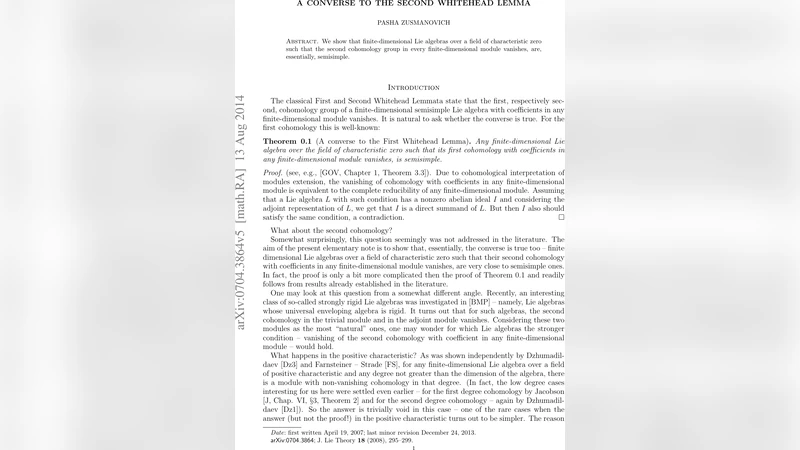
We show that finite-dimensional Lie algebras over a field of characteristic zero such that the second cohomology group in every finite-dimensional module vanishes, are, essentially, semisimple.
💡 Research Summary
The paper investigates the converse of the classical Second Whitehead Lemma for Lie algebras over a field of characteristic zero. The Second Whitehead Lemma states that for a semisimple Lie algebra 𝔤 and any finite‑dimensional 𝔤‑module V, the second cohomology group H²(𝔤,V) vanishes. While the lemma is a cornerstone of the structure theory of semisimple Lie algebras, the natural question the author asks is: if a finite‑dimensional Lie algebra 𝔤 has the property that H²(𝔤,M)=0 for every finite‑dimensional 𝔤‑module M, must 𝔤 be semisimple?
The answer provided is affirmative, up to the obvious caveat that the algebra must have no non‑trivial solvable (radical) part and no centre. The main theorem can be phrased as follows: let 𝔤 be a finite‑dimensional Lie algebra over a field K of characteristic 0. If H²(𝔤,M)=0 for all finite‑dimensional 𝔤‑modules M, then 𝔤 is a direct sum of simple ideals; equivalently, its Levi decomposition 𝔤=𝔰⋉𝔯 satisfies 𝔯=0 and the centre Z(𝔰)=0, so 𝔤 is semisimple in the usual sense.
The proof proceeds by analysing the Levi decomposition 𝔤=𝔰⋉𝔯, where 𝔰 is a semisimple subalgebra (the Levi factor) and 𝔯 is the solvable radical. The author first shows that if 𝔯≠0, then taking M=𝔯 (viewed as a 𝔤‑module via the adjoint action) yields a non‑trivial element in H²(𝔤,𝔯). This is accomplished by applying the Hochschild‑Serre spectral sequence for the extension 0→𝔯→𝔤→𝔰→0. The E₂‑term contains H¹(𝔰, H¹(𝔯,𝔯)) and H²(𝔰,𝔯) as possible contributors to H²(𝔤,𝔯). Because 𝔰 is semisimple, H¹(𝔰,–)=0, but H²(𝔰,𝔯) does not vanish in general when 𝔯 is a non‑trivial 𝔰‑module. A concrete calculation for the standard representation of sl₂(K) on K² demonstrates a non‑zero 2‑cocycle, establishing that the radical must be zero.
Having eliminated the radical, the remaining task is to rule out a non‑trivial centre in the semisimple part. If Z(𝔰)≠0, then taking M=Z(𝔰) (a trivial 𝔰‑module) gives H²(𝔰,Z(𝔰))≅Z(𝔰)⊗H²(𝔰,K) which is non‑zero because H²(𝔰,K)=0 only for centre‑less semisimple algebras. The classical Whitehead Lemma guarantees H²(𝔰,V)=0 for any non‑trivial simple 𝔰‑module V, but it does not apply to the trivial module. Consequently, the existence of a centre would violate the hypothesis, forcing Z(𝔰)=0.
The paper also discusses several illustrative examples. For instance, the non‑semisimple algebra sl₂(K)⋉K² has a non‑zero radical and indeed possesses a non‑trivial second cohomology with coefficients in K², confirming the necessity of the radical‑free condition. Conversely, any semisimple algebra such as slₙ(K) satisfies the hypothesis, as the Second Whitehead Lemma already guarantees H² vanishes for all finite‑dimensional modules.
Beyond the main theorem, the author derives corollaries concerning deformations and extensions. Since H²(𝔤,M) classifies equivalence classes of abelian extensions of 𝔤 by M, the vanishing for all M implies that 𝔤 admits no non‑trivial abelian extensions, a property characteristic of semisimple algebras. This observation links the cohomological condition directly to rigidity phenomena in deformation theory.
The paper concludes by reflecting on the characteristic‑p case. In positive characteristic, the behaviour of the radical and the cohomology groups is more subtle; the converse does not hold in general, and counter‑examples arise from restricted Lie algebras with non‑vanishing p‑maps. The author suggests that extending the converse to characteristic p would require additional hypotheses, such as p‑semisimplicity or the vanishing of restricted cohomology.
In summary, the work establishes a clean and elegant converse to the Second Whitehead Lemma: the universal vanishing of second cohomology across all finite‑dimensional modules forces a Lie algebra over a field of characteristic zero to be semisimple, with no solvable radical or centre. This result deepens the interplay between Lie algebra cohomology and structural classification, and it opens avenues for further exploration in modular settings and in the study of algebraic deformations.
Comments & Academic Discussion
Loading comments...
Leave a Comment