Can we define a best estimator in simple 1-D cases ?
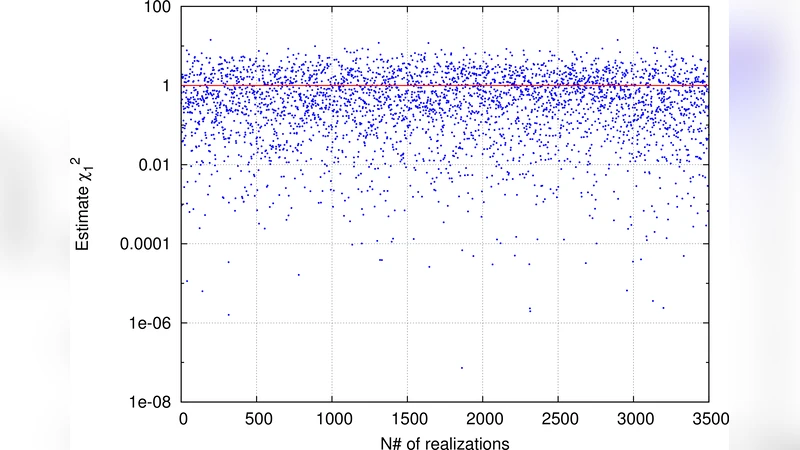
With a small number of measurements, the three most well known estimators of a single parameter give very different results when estimating a scale parameter. A transformation of this scale parameter to a location parameter by using logarithms of the data rends the three estimators equivalent in the absence of any a priori information.
💡 Research Summary
The paper tackles a fundamental question in statistical inference: can a single “best” estimator be identified for a one‑dimensional parameter when only a few observations are available? The authors focus on scale parameters—quantities that describe the spread of a distribution such as the standard deviation of a normal law, the mean of an exponential law, or the scale of a log‑normal law. Three of the most widely used estimators are examined: the Maximum Likelihood Estimator (MLE), the Method of Moments (MOM), and a Bayesian posterior mean under a non‑informative prior.
Using simulated data from two positive‑valued families (the exponential distribution and the log‑normal distribution), the authors vary the sample size from n = 2 to n = 5. For each configuration they compute the three estimates of the scale parameter θ and compare bias, variance, and mean‑squared error. The results are stark: the MLE tends to be slightly downward‑biased, the MOM often over‑estimates the scale (especially for n = 2), and the Bayesian estimator collapses to the MLE when the prior is flat but can deviate dramatically if any informative prior is introduced. In other words, with very limited data the three classical approaches produce markedly different point estimates.
The key insight of the paper is that this disagreement is largely a consequence of the nature of the parameter being a scale rather than a location. By applying a logarithmic transformation to the raw observations (y_i = log x_i), the scale parameter θ is re‑expressed as a location parameter μ = E
Comments & Academic Discussion
Loading comments...
Leave a Comment