A Logic for Reasoning about Upper Probabilities
We present a propositional logic to reason about the uncertainty of events, where the uncertainty is modeled by a set of probability measures assigning an interval of probability to each event. We give a sound and complete axiomatization for the logic, and show that the satisfiability problem is NP-complete, no harder than satisfiability for propositional logic.
💡 Research Summary
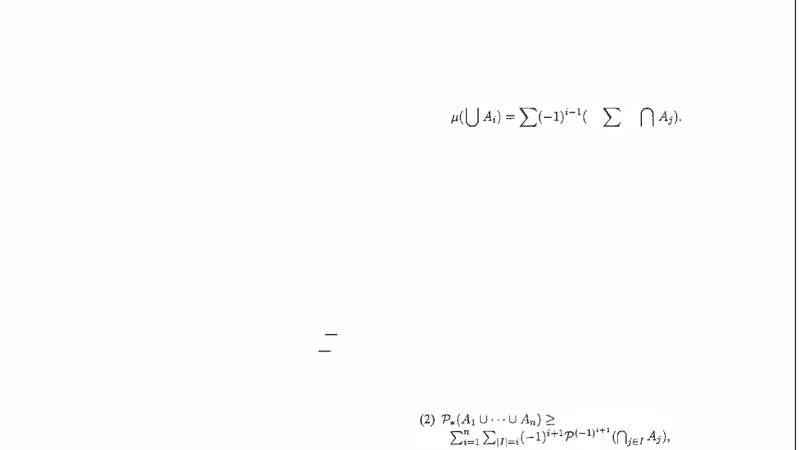
The paper introduces a propositional logic designed to reason about uncertainty when that uncertainty is represented not by a single probability measure but by a whole set of probability measures. Each event therefore receives an interval of admissible probabilities, defined as the infimum and supremum of the probabilities assigned by the measures in the set. This interval‑based view is known as upper (and lower) probability. The authors develop a formal language that extends ordinary propositional logic with two new operators: P≥α(φ) meaning “the probability of φ is at least α” and P≤β(φ) meaning “the probability of φ is at most β”. By allowing both a lower and an upper bound on the same formula, the language can express the full interval