Seeing Earths Orbit in the Stars: Parallax and Aberration
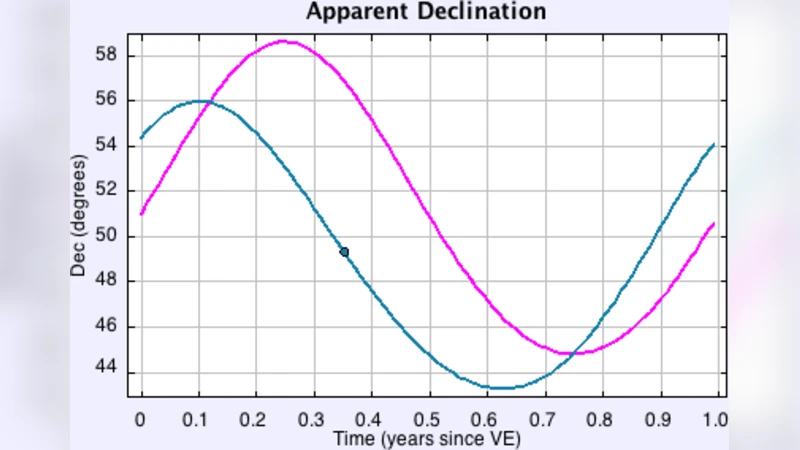
During the 17th century the idea of an orbiting and rotating Earth became increasingly popular, but opponents of this view continued to point out that the theory had observable consequences that had never, in fact, been observed. Why, for instance, had astronomers failed to detect the annual parallax of the stars that must occur if Earth orbits the Sun? To address this problem, astronomers of the 17th and18th centuries sought to measure the annual parallax of stars using telescopes. None of them succeeded. Annual stellar parallax was not successfully measured until 1838, when Friedrich Bessel detected the parallax of the star 61 Cygni. But the early failures to detect annual stellar parallax led to the discovery of a new (and entirely unexpected) phenomenon: the aberration of starlight. This paper recounts the story of the discovery of stellar aberration. It is accompanied by a set of activities and computer simulations that allow students to explore this fascinating historical episode and learn important lessons about the nature of science.
💡 Research Summary
The paper traces the historical quest to detect Earth’s orbital motion through the annual parallax of the stars, a key prediction of the Copernican‑Keplerian system that remained elusive for more than two centuries. In the 17th and early 18th centuries, astronomers such as Thomas Hooke, Johannes Kepler, and later James Bradley and Heinrich Havell attempted to measure the tiny shift in stellar positions that should occur as Earth moved from one side of its orbit to the other. Their instruments—early refracting telescopes with resolutions of several arc‑seconds—were simply not capable of detecting the sub‑arc‑second parallaxes of even the nearest stars. Consequently, repeated “null” results became a major argument for geocentrists, who pointed to the absence of observable parallax as evidence against Earth’s motion.
Bradley’s 1728 discovery of the aberration of starlight turned this failure into a breakthrough. By recognizing that the apparent direction of incoming light is altered by the vector sum of Earth’s orbital velocity (≈30 km s⁻¹) and the finite speed of light (c≈3×10⁸ m s⁻¹), Bradley derived an apparent annual wobble of about 20.5 arcseconds—exactly the value predicted by v/c. This phenomenon, later termed “stellar aberration,” provided the first direct, quantitative confirmation that (a) Earth does indeed travel around the Sun and (b) light propagates at a finite, measurable speed. Importantly, aberration is a purely kinematic effect and does not depend on the distance to the star, allowing it to be observed for all stars regardless of their true parallaxes.
The paper then contrasts aberration with true parallax. Parallax arises from the geometric baseline of Earth’s orbit and scales inversely with stellar distance; aberration, by contrast, is independent of distance and follows a sinusoidal pattern tied to Earth’s orbital phase. The authors explain how 19th‑century astronomers, most notably Friedrich Bessel in 1838, finally succeeded in measuring stellar parallax (61 Cygni, 0.314 arcseconds) by carefully correcting for aberration and employing more precise instruments (meridian circles, heliometers). Bessel’s achievement demonstrated that the earlier null results were due to technological limits rather than a flaw in heliocentrism.
Beyond the historical narrative, the paper offers a suite of pedagogical tools: hands‑on activities, computer simulations, and data‑analysis exercises that let students model Earth’s orbit, generate synthetic stellar positions, and toggle aberration and parallax on and off. By adding realistic noise, atmospheric refraction, and instrumental errors, learners experience the challenges faced by early astronomers and appreciate how systematic error can masquerade as a scientific signal. The authors argue that this case study exemplifies the nature of scientific progress—how failed experiments can lead to unexpected discoveries, how hypotheses are refined through iterative testing, and how quantitative reasoning ultimately resolves long‑standing debates.
In sum, the article recounts the transition from the early, unsuccessful attempts to detect annual parallax, through the serendipitous discovery of stellar aberration, to the eventual triumph of parallax measurement in the 19th century. It highlights the intertwined development of observational technique, theoretical insight, and the conceptual shift that solidified the heliocentric model, while providing educators with concrete resources to bring this pivotal episode of scientific history into the classroom.
Comments & Academic Discussion
Loading comments...
Leave a Comment