Orbit Spaces of Gradient Vector Fields
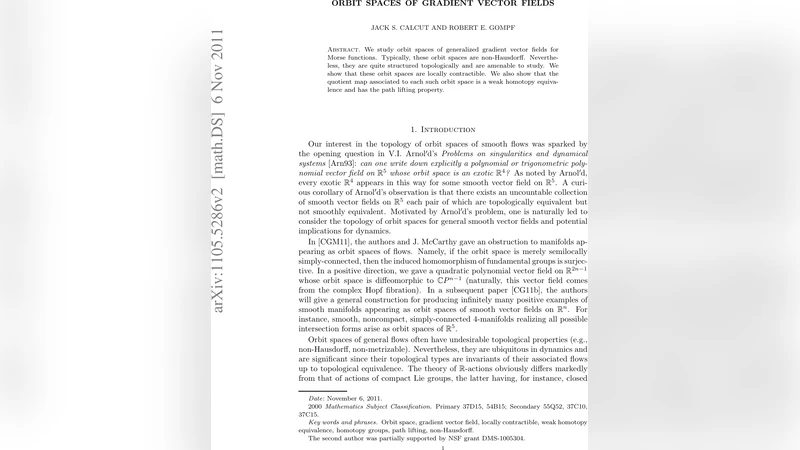
We study orbit spaces of generalized gradient vector fields for Morse functions. Typically, these orbit spaces are non-Hausdorff. Nevertheless, they are quite structured topologically and are amenable to study. We show that these orbit spaces are locally contractible. We also show that the quotient map associated to each such orbit space is a weak homotopy equivalence and has the path lifting property.
💡 Research Summary
The paper investigates the orbit spaces that arise from generalized gradient vector fields associated with Morse functions on smooth manifolds. A Morse function (f:M\to\mathbb{R}) has isolated non‑degenerate critical points, and its classical gradient flow (with respect to a Riemannian metric) yields a well‑behaved quotient space: the set of flow lines (orbits) equipped with the quotient topology is Hausdorff and often carries a manifold structure. The authors, however, relax the metric requirement and consider any vector field (X) satisfying the “generalized gradient” condition (df(X)>0) away from critical points. Such fields need not be complete, need not be orthogonal to level sets, and may generate orbit spaces that fail to be Hausdorff. Despite this pathological possibility, the authors prove three fundamental structural results about the quotient (M/X).
1. Local contractibility.
For every point (p\in M) there exists a neighbourhood (U) such that the restriction of the quotient map (\pi:U\to\pi(U)) is a homeomorphism onto its image and (\pi(U)) is contractible. The proof splits into two cases. If (p) is a regular point, a standard flow‑box argument provides a product neighbourhood ((- \varepsilon,\varepsilon)\times V) where the flow moves only in the first factor; the quotient collapses the first factor, leaving a copy of (V), which is contractible after shrinking. If (p) is a critical point of index (k), a Morse chart identifies a neighbourhood with (\mathbb{R}^k\times\mathbb{R}^{n-k}) and the generalized gradient flow has the form ((x,y)\mapsto (e^{-t}x, e^{t}y)). The orbit space in this chart is homeomorphic to a cone over a sphere, which is contractible. By patching these local models, the authors obtain a globally locally contractible quotient.
2. Weak homotopy equivalence of the quotient map.
The map (\pi:M\to M/X) induces isomorphisms on all homotopy groups: (\pi_*:\pi_n(M)\to\pi_n(M/X)) for every (n\ge0). The argument uses the local contractibility from (1) to construct a cellular approximation of (\pi). One shows that each cell of a CW‑decomposition of (M) is sent by (\pi) onto a contractible subspace of the quotient, preserving attaching maps up to homotopy. Consequently, the induced maps on homotopy groups are bijective, and by the Whitehead theorem the quotient has the same weak homotopy type as the original manifold. As a corollary, singular homology and cohomology groups of (M) and (M/X) coincide.
3. Path‑lifting property.
Even though (M/X) may be non‑Hausdorff, the quotient map enjoys the path‑lifting property: given a continuous path (\gamma:
Comments & Academic Discussion
Loading comments...
Leave a Comment