A Polling Model with Reneging at Polling Instants
In this paper we consider a single-server, cyclic polling system with switch-over times and Poisson arrivals. The service disciplines that are discussed, are exhaustive and gated service. The novel contribution of the present paper is that we consider the reneging of customers at polling instants. In more detail, whenever the server starts or ends a visit to a queue, some of the customers waiting in each queue leave the system before having received service. The probability that a certain customer leaves the queue, depends on the queue in which the customer is waiting, and on the location of the server. We show that this system can be analysed by introducing customer subtypes, depending on their arrival periods, and keeping track of the moment when they abandon the system. In order to determine waiting time distributions, we regard the system as a polling model with varying arrival rates, and apply a generalised version of the distributional form of Little’s law. The marginal queue length distribution can be found by conditioning on the state of the system (position of the server, and whether it is serving or switching).
💡 Research Summary
The paper studies a single‑server cyclic polling system with switch‑over times and Poisson arrivals, extending the classical model by allowing customers to abandon (reneging) synchronously at the exact moments when the server starts or finishes a visit to any queue. The abandonment probability for a customer waiting in queue i depends both on the queue and on the server’s current state (whether it is beginning or ending a visit, or starting a switch‑over). To handle the fact that a customer may have several opportunities to abandon, the authors introduce customer sub‑types based on their arrival epoch and track the moment of abandonment.
A key observation is that, after removing all customers that eventually abandon, the remaining “served” customers can be modeled as a polling system with state‑dependent arrival rates – a so‑called “smart customers” model. This transformation enables the use of the branching property, which holds for both exhaustive and gated service disciplines. By splitting each visit and each switch‑over period into an instantaneous abandonment phase (a) and a genuine service phase (b), the authors derive recursive relations for the joint queue‑length probability generating functions (PGFs) at the beginnings of all sub‑periods. These recursions lead to explicit expressions for the Laplace‑Stieltjes transforms (LSTs) of the cycle time, visit times, and, crucially, the waiting‑time distribution of customers that are actually served.
Because the standard distributional form of Little’s law does not apply when arrival rates depend on the server state, the paper employs a generalized version developed for smart‑customer polling systems. This yields the LST of the waiting‑time distribution for each customer type. The marginal queue‑length distributions, however, must incorporate the abandoning customers; the authors obtain these by conditioning on the server’s position and whether it is serving or switching.
Stability is shown to depend only on the load contributed by customers that are eventually served; the abandonment process does not affect the stability condition. The authors also treat the special case of a single queue with exhaustive service, recovering known results for the queue‑length PGF and providing new compact formulas for the cycle time and total sojourn time (including abandoning customers).
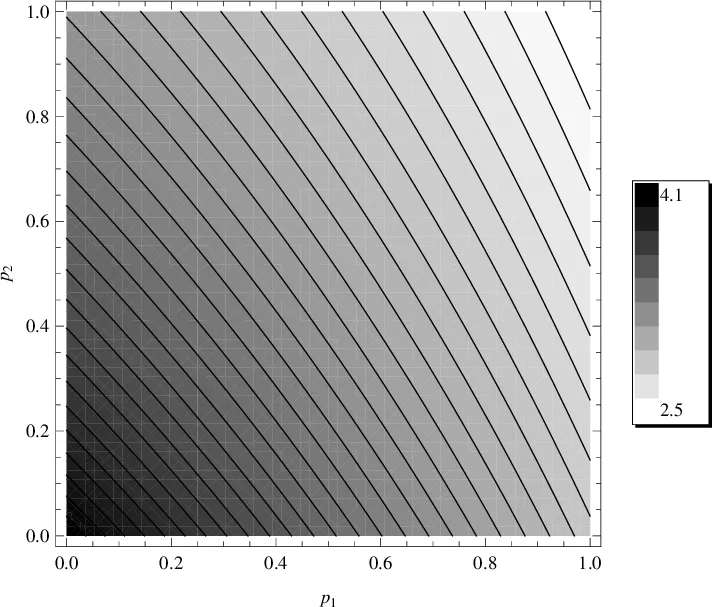
A numerical example illustrates typical system behavior: higher abandonment probabilities reduce the mean waiting time of served customers but increase the overall time customers spend in the system when abandonments are counted. The paper thus offers the first comprehensive analytical treatment of synchronized reneging in multi‑queue polling systems, extending earlier single‑queue work, accommodating both exhaustive and gated service, and delivering explicit performance measures through innovative use of smart‑customer techniques.
Comments & Academic Discussion
Loading comments...
Leave a Comment