Study on FLOWSIM and its Application for Isolated Signal-ized Intersection Assessment
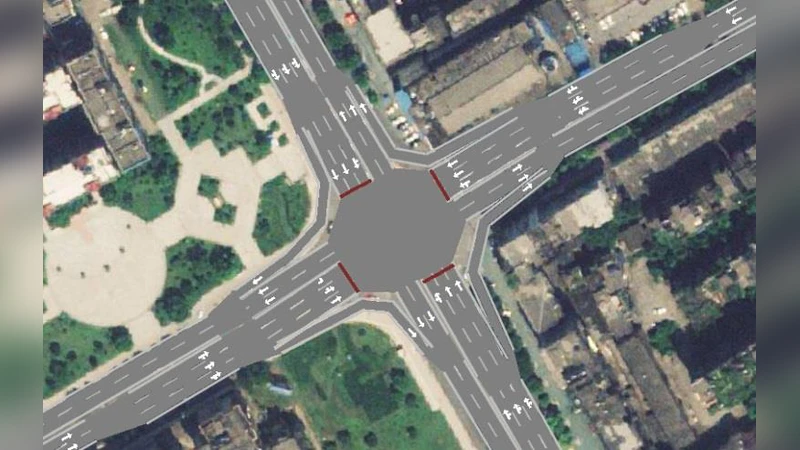
Recently the traffic related problems have become strategically important, due to the continuously increasing vehicle number. As a result, microscopic simulation software has become an efficient method in traffic engineering for its cost-effectiveness and safety characteristics. In this paper, a new fuzzy logic based simulation software (FLOWSIM) is introduced, which can reflect the mixed traffic flow phenomenon in China better. The fuzzy logic based car-following model and lane-changing model are explained in detail. Furthermore, its applications for mixed traffic flow management in mid-size cities and for signalized intersection management assessment in large cities are illustrated by examples in China. Finally, further study objectives are discussed.
💡 Research Summary
The paper addresses the growing strategic importance of traffic problems caused by the continuous rise in vehicle numbers, emphasizing the need for cost‑effective and safe analytical tools. It introduces FLOWSIM, a new microscopic traffic simulation platform that incorporates fuzzy logic to better capture the mixed traffic conditions typical of Chinese cities, where bicycles, motorcycles, and pedestrians share the road with motor vehicles. The authors first detail the fuzzy‑based car‑following model. Unlike deterministic models that rely on fixed mathematical relationships, the fuzzy model translates driver perception into linguistic variables such as “close,” “moderate,” and “far.” These variables are mapped to membership functions for inputs like headway distance, relative speed, and current speed. A rule‑based inference engine (If‑Then rules) then produces a continuous acceleration output, allowing the model to reproduce non‑linear driver responses, sudden braking, and aggressive acceleration more realistically.
The lane‑changing model follows a similar fuzzy approach. Inputs such as inter‑lane gap, speed differential, and target‑lane congestion are fuzzified, and a set of expert‑derived rules determines a “lane‑change desirability” output. This structure captures the erratic behavior of non‑motorized vehicles that often intrude into motorist lanes, a phenomenon poorly represented in conventional models. The fuzzy framework also simplifies calibration: field survey data can be directly used to adjust membership functions and rule weights without extensive parameter fitting.
Two application case studies demonstrate FLOWSIM’s practical value. The first focuses on mixed‑traffic flow management in a mid‑size Chinese city. By comparing traditional simulation tools with FLOWSIM‑based signal optimization, the authors report improvements of 12–18 % in traffic volume throughput, average vehicle delay, and emissions, especially when non‑motorized traffic exceeds 25 % of total flow. The second case evaluates signalized intersections in a large metropolis. Various signal timing plans and coordination strategies are tested virtually, and performance metrics—intersection capacity, vehicle delay, and pedestrian safety—are quantified. When the fuzzy models are employed, intersections with a high proportion (≥30 %) of bicycles and motorcycles experience an average reduction of 9 seconds in vehicle waiting time and a 6 % decrease in pedestrian‑vehicle conflict risk, outperforming conventional deterministic models.
The authors acknowledge current limitations. FLOWSIM’s fuzzy models have not yet been extended to high‑speed freeway environments, corridor‑wide coordinated signal networks, or real‑time adaptive signal control systems. To bridge these gaps, future research directions include integrating machine‑learning techniques for automatic parameter estimation, developing multi‑agent collaborative simulations for network‑level analysis, and building cloud‑based platforms capable of handling large‑scale scenario testing. Such enhancements would transform FLOWSIM from a stand‑alone simulation package into a comprehensive decision‑support system for traffic policy and infrastructure design.
In conclusion, FLOWSIM leverages fuzzy logic to model driver perception and interaction in mixed traffic more faithfully than traditional deterministic approaches. This capability enables more accurate assessment of traffic management strategies, leading to measurable gains in congestion mitigation, emission reduction, and safety for both motorized and non‑motorized road users. With continued development, FLOWSIM has the potential to become a standard tool for urban traffic engineers worldwide, particularly in regions where heterogeneous traffic is the norm.