Vertex 2-coloring without monochromatic cycles
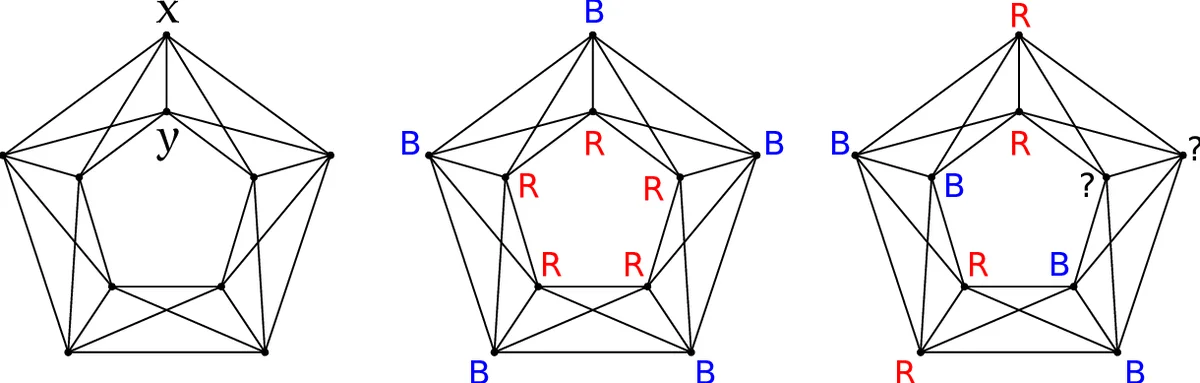
In this paper we study a problem of vertex two-coloring of undirected graph such that there is no monochromatic cycle of given length. We show that this problem is hard to solve. We give a proof by presenting a reduction from variation of satisfiability (SAT) problem. We show nice properties of coloring cliques with two colors which plays pivotal role in the reduction construction.
💡 Research Summary
The paper investigates the decision problem (2,k‑COL): given an undirected, unweighted graph G and an integer k ≥ 3, does there exist a vertex coloring with two colors (red and blue) such that no cycle of length exactly k is monochromatic? Formally, a coloring c:V→{r,b} is valid if for every cycle Q of length k there exist two vertices u,v∈Q with c(u)≠c(v). The authors prove that (2,k‑COL) is NP‑complete for every fixed k ≥ 3.
The proof proceeds by a polynomial‑time reduction from the Not‑All‑Equal SAT variant (k‑NAE‑SAT), where each clause contains at most k literals and must have at least one true and one false literal. For a given formula φ in k‑CNF, the reduction builds a graph G_φ that encodes variables, clauses, and special “super‑edge” gadgets. The construction has three types of gadgets:
- Variable gadget – two vertices labeled x and ¬x connected by a super‑edge. The super‑edge forces the two vertices to receive opposite colors in any valid coloring.
- Clause gadget – for k=3 a triangle, for k=4 a square, and for larger k a cycle of length k. The vertices of a clause gadget correspond to the literals appearing in that clause.
- Super‑edge gadget – a small subgraph with a distinguished edge {x,y} such that (i) the subgraph admits a valid 2‑coloring without monochromatic cycles of length k, and (ii) in every such coloring the endpoints x and y receive different colors. This gadget is the core of the reduction; it translates the logical “¬(x↔y)” constraint into a purely graph‑theoretic one.
For k=3 the authors first present a simple super‑edge based on a K₄ (complete graph on four vertices). By exploiting the fact that coloring two vertices of K₄ the same forces the other two to be opposite, they chain several K₄’s into an odd‑length “string”. Closing the string into a loop yields a gadget where the chosen edge must be bichromatic; otherwise a monochromatic triangle would appear. Using this gadget, each variable gadget’s two vertices are forced opposite, and each clause triangle is forced to contain both colors, which exactly mirrors the NAE condition.
For k=4 the construction becomes more intricate. The authors design a gadget built from a K₆ (complete graph on six vertices) that is transformed into a “reverse‑V” component. By arranging these components into a full binary tree of height 4 and connecting all leaves back to the root, they guarantee that any valid coloring must assign opposite colors to the root’s two distinguished vertices; otherwise a monochromatic square would be forced. Clause gadgets are now squares, and the same reasoning as for k=3 applies.
To handle arbitrary fixed k ≥ 5, the binary‑tree gadget is scaled: the tree height is set to 4·⌈k/2⌉, and nodes at depths that are multiples of 4 are designated “cycle‑inducing”. Additional edges are added between consecutive layers of cycle‑inducing nodes, forming a “donut” structure. If the root and a leaf share the same color, the induced subgraph on the cycle‑inducing nodes contains a monochromatic cycle of length k, contradicting validity. Hence any valid coloring forces the root’s two distinguished vertices to be opposite, satisfying the required super‑edge property.
The reduction is polynomial because k is a constant; the size of the super‑edge gadget grows exponentially with k but remains bounded for any fixed k. The authors also discuss implementation details: they show via brute‑force search that no super‑edge gadget exists with eight or fewer vertices, and they propose a “necklace” optimization that places all variable gadgets on a single odd‑length loop, reducing the total number of vertices and edges.
Having established that (2,k‑COL) is in NP (a coloring can be verified in polynomial time) and that it is NP‑hard via the reduction, the paper concludes that (2,k‑COL) is NP‑complete for every k ≥ 3. The work highlights a novel use of clique coloring properties to enforce logical constraints and opens avenues for further research on restricted graph families, approximation algorithms, or tighter gadget constructions.
Comments & Academic Discussion
Loading comments...
Leave a Comment