Reasoning about Expectation
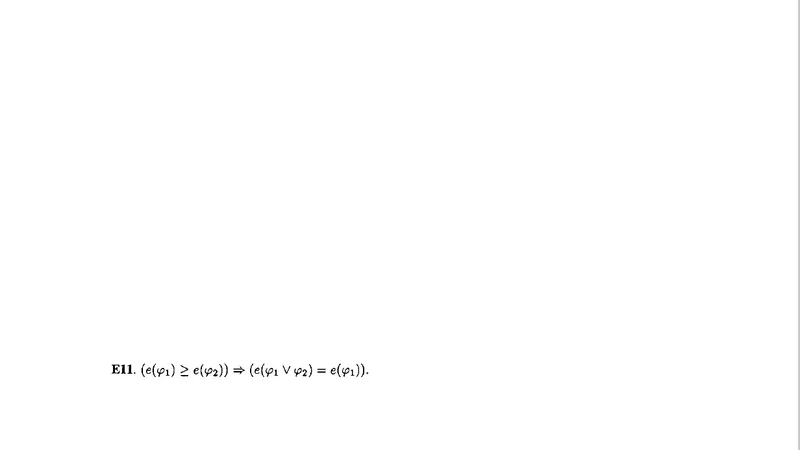
Expectation is a central notion in probability theory. The notion of expectation also makes sense for other notions of uncertainty. We introduce a propositional logic for reasoning about expectation, where the semantics depends on the underlying representation of uncertainty. We give sound and complete axiomatizations for the logic in the case that the underlying representation is (a) probability, (b) sets of probability measures, (c) belief functions, and (d) possibility measures. We show that this logic is more expressive than the corresponding logic for reasoning about likelihood in the case of sets of probability measures, but equi-expressive in the case of probability, belief, and possibility. Finally, we show that satisfiability for these logics is NP-complete, no harder than satisfiability for propositional logic.
💡 Research Summary
The paper introduces a propositional logic specifically designed for reasoning about expectation, a fundamental concept traditionally rooted in probability theory but also meaningful in broader uncertainty frameworks. The authors call this system “Expectation Logic” (E‑Logic). Its syntax extends ordinary propositional formulas with a new operator E