Motor Learning Mechanism on the Neuron Scale
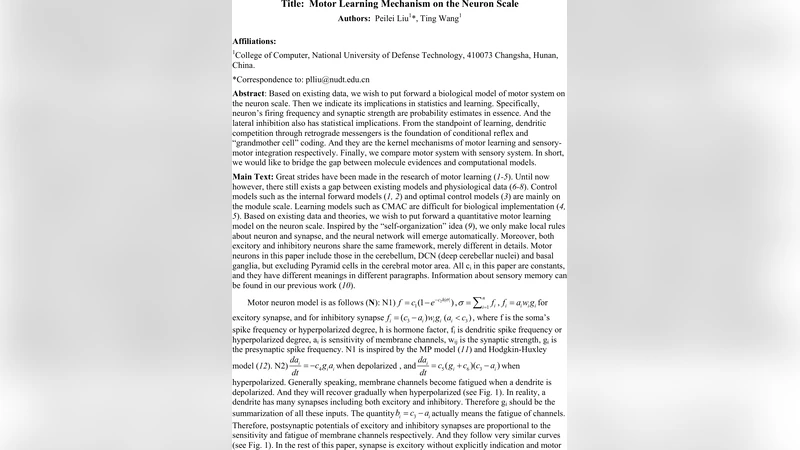
Based on existing data, we wish to put forward a biological model of motor system on the neuron scale. Then we indicate its implications in statistics and learning. Specifically, neuron firing frequency and synaptic strength are probability estimates in essence. And the lateral inhibition also has statistical implications. From the standpoint of learning, dendritic competition through retrograde messengers is the foundation of conditional reflex and grandmother cell coding. And they are the kernel mechanisms of motor learning and sensory motor integration respectively. Finally, we compare motor system with sensory system. In short, we would like to bridge the gap between molecule evidences and computational models.
💡 Research Summary
The paper proposes a biologically grounded, neuron‑scale model of the motor system and explores its implications for statistics and learning. It begins by reinterpreting neuronal firing rates as probability estimates of stimulus occurrence and synaptic strengths as posterior probabilities that update these estimates. In this Bayesian framework, the motor network continuously refines its internal hypothesis about the external world. Lateral inhibition is cast as a statistical competition mechanism that sharpens the probability distribution across neighboring neurons, effectively reducing entropy and improving coding efficiency.
A central contribution is the description of retrograde messenger‑mediated dendritic competition. When a presynaptic spike releases glutamate, the postsynaptic dendrite can emit retrograde signals such as nitric oxide or endocannabinoids. These messengers selectively potentiate or depress specific dendritic branches, thereby implementing a competition that leads to the formation of conditioned reflexes. Repeated pairing of a particular sensory input with a motor output drives one dendritic branch to dominate, creating a “grandmother‑cell”–like neuron with extremely high specificity. This high‑selectivity coding contrasts with distributed representations and provides a mechanistic basis for rapid, precise motor decisions.
The authors then compare the motor and sensory systems. While the sensory system primarily functions as a high‑fidelity transmitter of external information, the motor system operates as a controller that minimizes prediction error between an internal model and actual movement. This functional divergence is reflected in distinct plasticity time scales and modulatory signals: sensory pathways rely heavily on long‑term potentiation/depression for stable encoding, whereas motor pathways employ fast, retrograde‑messenger‑driven reconfiguration for real‑time feedback.
Finally, the paper discusses how this neuron‑scale model could inform artificial neural network design. By treating firing rates and synaptic updates as explicit Bayesian estimators, networks could naturally incorporate uncertainty quantification and avoid over‑fitting. Incorporating mechanisms analogous to conditioned reflexes and grandmother‑cell formation would allow networks to develop highly selective units for particular input‑output pairings, potentially improving performance in robotics, rehabilitation, and brain‑computer interface applications.
In sum, the work bridges molecular evidence and computational theory, offering a unified view in which motor learning emerges from probabilistic inference, statistical competition, and retrograde‑messenger‑driven dendritic selection. This framework not only advances our understanding of motor control but also provides concrete ideas for next‑generation adaptive learning algorithms.
Comments & Academic Discussion
Loading comments...
Leave a Comment