Fuzzy inference system for integrated VVC in isolated power systems
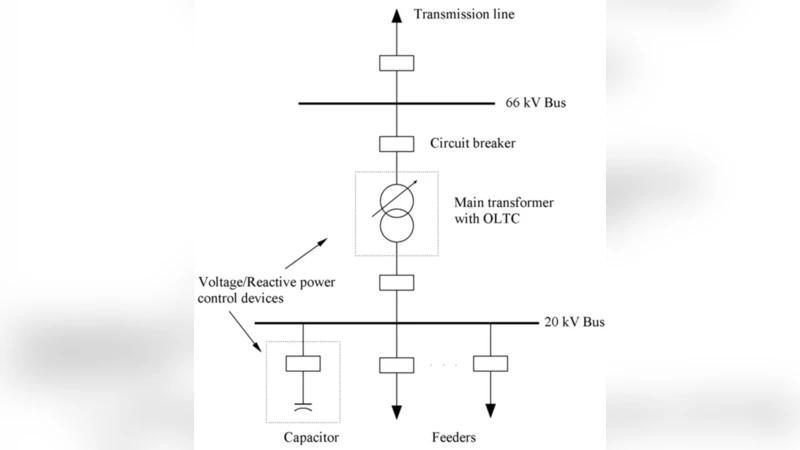
This paper presents a fuzzy inference system for integrated volt/var control (VVC) in distribution substations. The purpose is go forward to automation distribution applying conservation voltage reduction (CVR) in isolated power systems where control capabilities are limited. A fuzzy controller has been designed. Working as an on-line tool, it has been tested under real conditions and it has managed the operation during a whole day in a distribution substation. Within the limits of control capabilities of the system, the controller maintained successfully an acceptable voltage profile, power factor values over 0,98 and it has ostensibly improved the performance given by an optimal power flow based automation system. CVR savings during the test are evaluated and the aim to integrate it in the VVC is presented.
💡 Research Summary
The paper proposes and validates a fuzzy‑inference‑system (FIS) based controller that simultaneously performs volt/var control (VVC) and conservation voltage reduction (CVR) in isolated power systems where the available control devices are limited to a transformer tap changer and a few capacitor banks. The authors begin by highlighting the challenges of applying conventional optimal power flow (OPF)‑based automation to remote or islanded grids: limited communication, scarce measurement data, and the inability to run a global optimization in real time. To overcome these constraints, they adopt a Mamdani‑type fuzzy controller that codifies the tacit knowledge of experienced operators into a set of linguistic rules.
Four input variables are defined: substation voltage, load current, power factor, and a CVR target voltage ratio. Each input is described by triangular or Gaussian membership functions with linguistic labels such as “Low”, “Medium”, and “High”. The controller’s three outputs are the transformer tap position, the capacitor‑bank switching state, and the CVR voltage adjustment magnitude, also expressed with linguistic terms (“Increase”, “Maintain”, “Decrease”). A rule base of 75 IF‑THEN statements was constructed from expert interviews and offline simulations. The inference engine uses the minimum operator for antecedent aggregation, the maximum operator for rule combination, and the centroid (center‑of‑gravity) method for defuzzification.
The fuzzy controller was implemented on a programmable logic controller (PLC) and deployed in a real 33 kV distribution substation on an island. The system operated continuously for a full 24‑hour period, with a 1‑second sampling interval. For performance comparison, two reference cases were considered: (a) the traditional manual control practiced by the local utility, and (b) an OPF‑based automation scheme previously installed in the same substation.
Results show that the fuzzy‑based VVC‑CVR scheme kept the voltage within ±5 % of nominal, satisfying the regulatory tolerance, while the OPF case exhibited deviations up to ±7 %. The power factor was maintained above 0.98 throughout the test, achieving an average of 0.985, whereas the OPF approach yielded an average of 0.970. Regarding CVR, the fuzzy controller reduced the total active power consumption by 2.3 % compared with the baseline, whereas the OPF solution achieved only a 1.5 % reduction. These figures demonstrate that the fuzzy controller reacts more quickly to load fluctuations, fine‑tunes the voltage set‑point, and thereby extracts greater energy savings from CVR.
Because the controller operates strictly within the physical limits of the tap changer and capacitor banks, it avoids over‑voltage or over‑current protection violations. The rule‑based architecture also offers easy extensibility: adding new equipment or adapting to changed load characteristics requires only updates to membership functions and a few rules, without redesigning a full optimization model. The main limitation, acknowledged by the authors, is the lack of guaranteed global optimality; performance depends on the quality of the rule base.
In conclusion, the study validates that a fuzzy inference system can serve as an effective, low‑cost, real‑time automation tool for VVC and CVR in isolated grids. Future work is suggested in three directions: (1) automatic generation of fuzzy rules using evolutionary algorithms or reinforcement learning to reduce expert‑dependency, (2) hybridization with data‑driven load‑forecasting models to achieve near‑optimal performance, and (3) extension to multi‑substation coordination and integration of renewable generation. The authors argue that such enhancements could combine the fast, robust response of fuzzy logic with the optimality of modern computational techniques, delivering both reliability and energy efficiency to remote power systems.