Algorithm for the maximum likelihood estimation of the parameters of the truncated normal and lognormal distributions
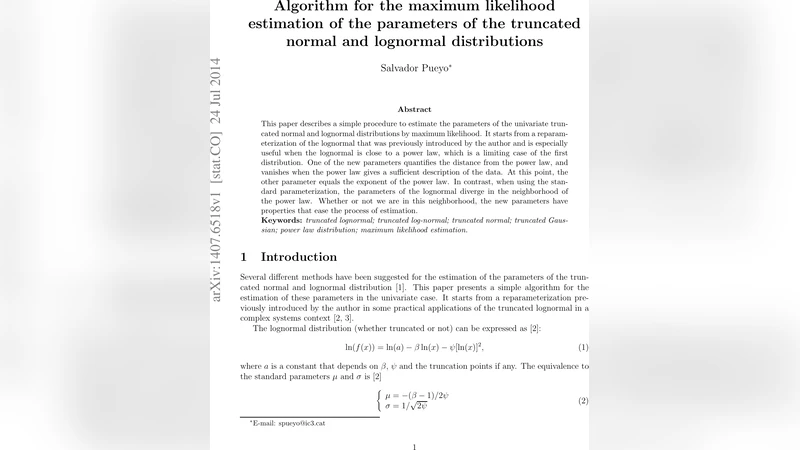
This paper describes a simple procedure to estimate the parameters of the univariate truncated normal and lognormal distributions by maximum likelihood. It starts from a reparameterization of the lognormal that was previously introduced by the author and is especially useful when the lognormal is close to a power law, which is a limiting case of the first distribution. One of the new parameters quantifies the distance from the power law, and vanishes when the power law gives a sufficient description of the data. At this point, the other parameter equals the exponent of the power law. In contrast, when using the standard parameterization, the parameters of the lognormal diverge in the neighborhood of the power law. Whether or not we are in this neighborhood, the new parameters have properties that ease the process of estimation.
💡 Research Summary
The paper presents a straightforward iterative algorithm for maximum‑likelihood estimation (MLE) of the parameters of univariate truncated normal and log‑normal distributions. The key innovation is a re‑parameterization of the log‑normal distribution in terms of two parameters, β and ψ, rather than the conventional mean (µ) and standard deviation (σ). In this formulation β corresponds to the exponent of a power‑law limit, while ψ measures the deviation from that limit; when ψ = 0 the distribution reduces exactly to a power law, and β becomes the power‑law exponent. This representation remains well‑behaved even when the log‑normal is close to a power law, a regime where µ and σ tend to diverge.
By taking the natural logarithm of the data (y = ln x), the log‑normal becomes a normal distribution with density
ln f(y) = a − α y − ψ y², where α = β − 1.
When the data are truncated between y_min and y_max, the normalized density is given by equation (4) in the paper, and the expectations E(y) and E(y²) must be evaluated by numerical integration because closed‑form expressions are unavailable.
The MLE problem is to maximize the log‑likelihood Λ = ∑_{i=1}^N ln f(y_i | α,ψ). Setting the partial derivatives ∂Λ/∂α = 0 and ∂Λ/∂ψ = 0 yields two equations that equate the sample moments (ȳ, ȳ²) with their theoretical expectations under the current parameter values. Since these expectations depend on α and ψ in a non‑linear way, the solution must be found iteratively.
The author derives a linear update rule for the parameters. At iteration j, the changes Δα and Δψ are expressed as a linear combination of the residuals (ȳ − E(y|α_j,ψ_j)) and (ȳ² − E(y²|α_j,ψ_j)):
Δα = a η (ȳ − E(y)) + b η (ȳ² − E(y²))
Δψ = b η (ȳ − E(y)) + c η (ȳ² − E(y²))
The coefficients a, b, c are computed from the sample moments up to the fourth order (ȳ, ȳ², ȳ³, ȳ⁴) according to equations (10) and (11). The scalar η (0 < η < 1) acts as a learning rate: larger η accelerates convergence but increases the risk of divergence; the author recommends η ≈ 0.33 and suggests reducing it if overflow occurs.
The algorithm proceeds as follows:
- Initialize α₀ and ψ₀ (e.g., using method‑of‑moments or reasonable guesses).
- Compute E(y) and E(y²) for the current parameters by numerical integration over the truncated interval.
- Evaluate Δα and Δψ using the linear formulas above.
- Update α_{j+1} = α_j + Δα, ψ_{j+1} = ψ_j + Δψ.
- Repeat steps 2‑4 until |Δα| and |Δψ| fall below predefined tolerances, indicating convergence.
After convergence, the original normal parameters µ and σ are recovered from α and ψ via the inverse of the re‑parameterization (µ = −(β − 1)/(2ψ), σ = 1/√(2ψ)).
The method works for any type of truncation—lower, upper, or both—because the likelihood formulation directly incorporates the truncation limits. Its main advantage lies in the stability of β and ψ near the power‑law boundary, where traditional µ‑σ based MLE becomes numerically unstable. The paper also notes practical considerations: accurate numerical integration is essential for reliable expectations, and adaptive adjustment of η can improve robustness.
In summary, the author provides a practical, computationally light algorithm that enables reliable MLE of truncated normal and log‑normal distributions, especially in regimes where the distribution is close to a power law. The approach is applicable to a wide range of empirical fields, including economics (e.g., modeling contraction magnitudes), ecology (size‑distribution laws), and any discipline where data are naturally bounded and may exhibit heavy‑tailed behavior.
Comments & Academic Discussion
Loading comments...
Leave a Comment