Requirements engineering current practice and capability in small and medium software development enterprises in New Zealand
This paper presents research on current industry practices with respect to requirements engineering as implemented within software development companies in New Zealand. A survey instrument is designed
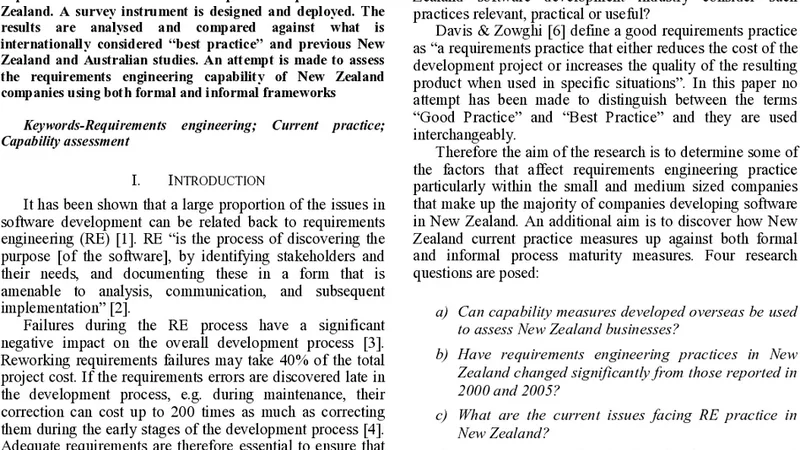
This paper presents research on current industry practices with respect to requirements engineering as implemented within software development companies in New Zealand. A survey instrument is designed and deployed. The results are analysed and compared against what is internationally considered “best practice” and previous New Zealand and Australian studies. An attempt is made to assess the requirements engineering capability of New Zealand companies using both formal and informal frameworks.
💡 Research Summary
The paper investigates the current state of requirements engineering (RE) practices and capabilities within small and medium‑sized software development enterprises in New Zealand. Drawing on prior New Zealand and Australian surveys as well as internationally recognised RE best‑practice frameworks (e.g., IEEE 830, ISO/IEC 29148, CMMI, ISO/IEC 29110), the authors designed a comprehensive questionnaire that covered organisational demographics, RE activities (elicitation, analysis, validation, management, traceability), tooling, training, and quality metrics such as change frequency and rework cost.
A random sample of 40 registered firms was drawn; 30 responded (73 % response rate), representing an average staff size of 68 and annual revenue of approximately NZ $1.2 million. The survey combined Likert‑scale items with open‑ended questions, and the data were analysed using descriptive statistics, cross‑tabulations, and non‑parametric tests (Kruskal‑Wallis) in SPSS, while qualitative responses were coded through content analysis.
Key findings are as follows:
- Partial Adoption of Core RE Activities – Most firms perform basic elicitation and documentation, but formal validation, approval, and change‑control processes are largely informal or absent. Over 60 % of respondents reported no clearly assigned RE owner.
- Low Tool Utilisation – Only 35 % of companies use dedicated RE management tools; the majority rely on spreadsheets, plain text files, or email, limiting traceability and consistency.
- Size‑Related Capability Gap – Companies with more than 50 employees tend to have higher RE capability scores, often employing a dedicated RE specialist. These larger firms experience 12 % fewer requirement changes and an 18 % reduction in rework costs compared with smaller counterparts.
- Customer Collaboration as a Critical Success Factor – Projects with limited client involvement exhibit 2.8‑times more requirement changes and 1.9‑times higher defect rates, underscoring the importance of early and continuous stakeholder engagement.
Capability assessment was performed using two informal maturity models. The CMMI‑derived scale placed most firms at Level 1 (Initial) or Level 2 (Managed). The ISO/IEC 29110 “lightweight” model highlighted particularly low scores for traceability (2.1/5) and validation (2.4/5).
The discussion links these results to structural constraints typical of New Zealand SMEs: limited budgets, pressure for rapid delivery, and a lack of systematic RE training. Compared with international best practice, the deficiencies in change management and traceability are identified as primary risk factors for project overruns and quality problems.
The authors conclude with actionable recommendations. Government agencies should consider subsidies for RE tools, certification‑based training programs, and incentives for adopting standard RE processes. Industry associations are urged to develop a shared RE guideline, facilitate case‑study exchanges, and promote community‑driven best‑practice adoption. Future research directions include longitudinal studies of RE maturity evolution and in‑depth case analyses to quantify the impact of RE improvements on project outcomes.
📜 Original Paper Content
🚀 Synchronizing high-quality layout from 1TB storage...