L(2,1)-labelling of Circular-arc Graph
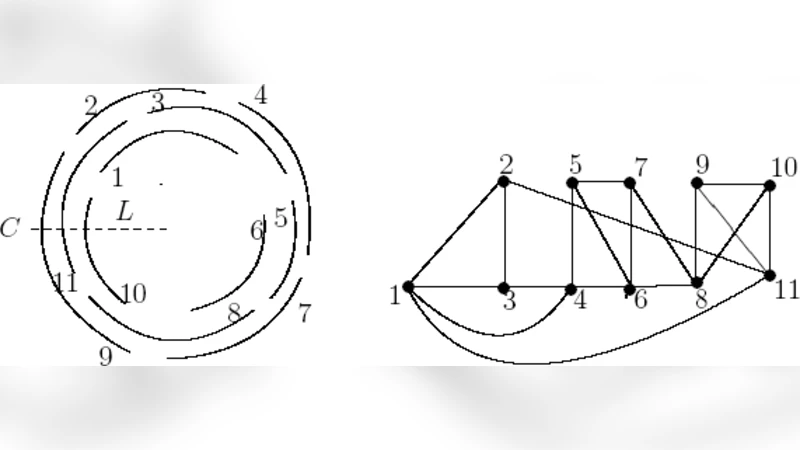
An L(2,1)-labelling of a graph $G=(V, E)$ is $\lambda_{2,1}(G)$ a function $f$ from the vertex set V (G) to the set of non-negative integers such that adjacent vertices get numbers at least two apart, and vertices at distance two get distinct numbers. The L(2,1)-labelling number denoted by $\lambda_{2,1}(G)$ of $G$ is the minimum range of labels over all such labelling. In this article, it is shown that, for a circular-arc graph $G$, the upper bound of $\lambda_{2,1}(G)$ is $\Delta+3\omega$, where $\Delta$ and $\omega$ represents the maximum degree of the vertices and size of maximum clique respectively.
💡 Research Summary
The paper investigates the L(2, 1)-labeling problem on circular‑arc graphs, a class of intersection graphs where each vertex corresponds to an arc on a circle and two vertices are adjacent precisely when their arcs intersect. An L(2, 1)-labeling is a mapping f : V → ℕ₀ such that (i) adjacent vertices receive labels that differ by at least two, and (ii) vertices at graph distance two receive distinct labels. The objective is to minimize the span, i.e., the difference between the largest and smallest used labels; this minimum span is denoted λ₂,₁(G).
The authors begin by reviewing known results for related graph families. For ordinary interval graphs (the linear counterpart of circular‑arc graphs) it is established that λ₂,₁(G) ≤ Δ + ω, where Δ is the maximum vertex degree and ω is the size of a maximum clique. However, the cyclic nature of circular‑arc graphs introduces additional complications: a maximum clique may wrap around the cut point, and the degree distribution can be more irregular.
To overcome these difficulties, the authors propose a constructive method that first “breaks” the circle at a carefully chosen point. The break is placed so that at least one maximum clique is intersected, guaranteeing that after the cut each resulting component is an interval graph whose maximum degree does not exceed Δ and whose maximum clique size remains ω. This reduction allows the use of interval‑graph techniques while preserving the essential parameters Δ and ω.
Next, the interval representation obtained after the cut is colored with at most ω colors. The coloring is performed in linear time (O(|V| + |E|)) using a greedy scheme that respects the circular ordering, ensuring that no two vertices belonging to the same clique share a color. Once a proper ω‑coloring is available, the authors assign a block of integer labels to each color class. A naïve assignment would allocate the i‑th color the interval
Comments & Academic Discussion
Loading comments...
Leave a Comment