A Parametric Analysis of Project Management Performance to Enhance Software Development Process
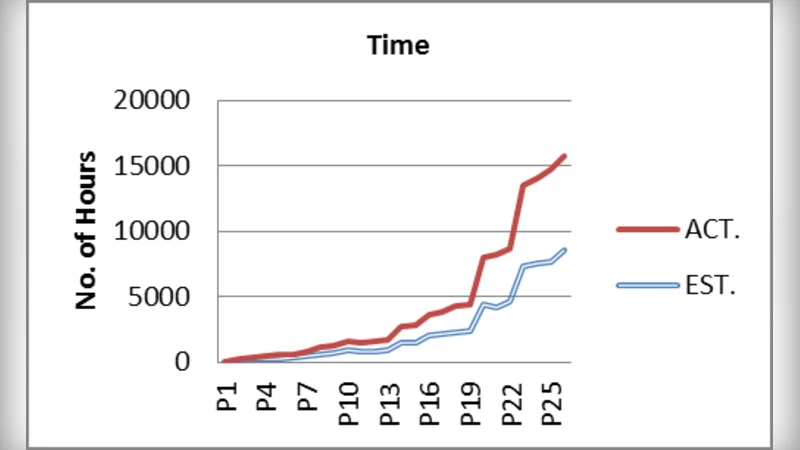
Project Management process plays a significant role in effective development of software projects. Key challenges in the project management process are the estimation of time, cost, defect count, and subsequently selection of apt developers. Therefore precise estimation of above stated factors decides the success level of a project. This paper provides an empirical study of several projects developed in a service oriented software company in order to comprehend the project management process. The analysis throws light on the existence of variation in the aforementioned factors between estimation and observed results. It further captures the need for betterment of project management process in estimation and allocation of resources in the realization of high quality software product. The paper therefore aims to bring in an improved awareness in software engineering personnel concerning the magnitude and significance of better estimation and accurate allocation of resources for developing successful project.
💡 Research Summary
The paper investigates the accuracy of project‑management estimations in software development and proposes a parametric approach to improve planning and resource allocation. Using an empirical dataset drawn from twelve medium‑to‑large projects carried out by a service‑oriented software firm, the authors compare initial estimates of schedule, budget, defect count, and developer assignment against the actual outcomes recorded during execution. Each project spans six to eighteen months and involves teams of eight to twenty‑five engineers, providing a diverse sample of real‑world development environments.
The authors first quantify estimation error as a percentage deviation (the “error rate”) for each key metric. Statistical analysis—including Pearson correlation and multiple linear regression—reveals systematic patterns: schedule errors average 23 % and surge to over 35 % when requirements change frequently; cost errors average 18 % and are driven primarily by discrepancies between assumed hourly rates and actual labor hours; defect‑count errors average 30 % and are linked to insufficient testing effort and weak defect‑tracking processes; and the alignment between developers’ experience/skill set and project needs, while generally beneficial, fails to offset productivity loss when novel technologies are introduced without adequate preparation.
These findings expose the limitations of traditional static estimation techniques, which typically rely on historical averages and ignore dynamic project conditions. To address this gap, the paper proposes a dynamic, parameter‑driven estimation framework. The framework continuously updates key parameters using Bayesian inference and machine‑learning regression models as new project data become available, thereby refining predictions in real time. In parallel, the authors introduce an “competency matrix” for staffing decisions, quantifying the match between a developer’s technical profile and the specific demands of a project phase. An automated decision‑support tool leverages this matrix to generate optimal team configurations, aiming to reduce both schedule and cost overruns while improving defect quality.
The study acknowledges several constraints: the data originate from a single organization, limiting external validity; the sample size, though sufficient for exploratory analysis, restricts the statistical power of some conclusions; and the analysis does not fully capture interactions among parameters such as how schedule pressure might exacerbate defect rates. Consequently, the authors call for future research that aggregates multi‑company, multi‑domain datasets and employs hierarchical modeling techniques to capture complex inter‑dependencies.
In conclusion, the paper demonstrates that significant gaps exist between estimated and actual project outcomes in software development. By adopting a dynamic, data‑driven estimation process and a systematic, competency‑based staffing strategy, organizations can markedly improve the reliability of their project plans, reduce wasteful expenditures, and deliver higher‑quality software products. The proposed methodology offers a practical roadmap for practitioners seeking to elevate project‑management performance in an increasingly competitive and fast‑moving software industry.