A Comparative Study of Meta-heuristic Algorithms for Solving Quadratic Assignment Problem
Quadratic Assignment Problem (QAP) is an NP-hard combinatorial optimization problem, therefore, solving the QAP requires applying one or more of the meta-heuristic algorithms. This paper presents a comparative study between Meta-heuristic algorithms: Genetic Algorithm, Tabu Search, and Simulated annealing for solving a real-life (QAP) and analyze their performance in terms of both runtime efficiency and solution quality. The results show that Genetic Algorithm has a better solution quality while Tabu Search has a faster execution time in comparison with other Meta-heuristic algorithms for solving QAP.
💡 Research Summary
The paper conducts a systematic comparative study of three well‑known meta‑heuristic algorithms—Genetic Algorithm (GA), Tabu Search (TS), and Simulated Annealing (SA)—applied to a real‑world instance of the Quadratic Assignment Problem (QAP). QAP is a classic combinatorial optimization problem that seeks to assign a set of facilities to a set of locations such that the sum of products of inter‑facility flows and inter‑location distances is minimized. Because QAP is NP‑hard, exact methods become infeasible for all but the smallest instances, and practitioners rely on heuristic or meta‑heuristic approaches to obtain high‑quality approximate solutions within reasonable computational budgets.
The authors select a realistic 30 × 30 QAP instance derived from a logistics‑center layout problem. Both the flow matrix and the distance matrix are asymmetric, reflecting the complexity of real operational environments. The optimal solution for this benchmark is known from the literature, allowing the authors to quantify solution quality precisely. All experiments are performed on identical hardware (Intel Xeon 2.6 GHz, 32 GB RAM) and software settings, and each algorithm is executed 30 independent times to capture statistical variability.
Parameter settings are carefully tuned for fairness. GA uses a population of 200 individuals, runs for 500 generations, employs a crossover probability of 0.8, a mutation probability of 0.02, tournament selection, and a 5 % elite preservation strategy. TS starts from a random solution, maintains a tabu list of length 7, and explores up to 10 000 neighbor moves per run. SA begins with an initial temperature of 1000, applies a cooling factor of 0.95, stops when the temperature falls below 1e‑3, and performs 100 neighbor evaluations at each temperature level.
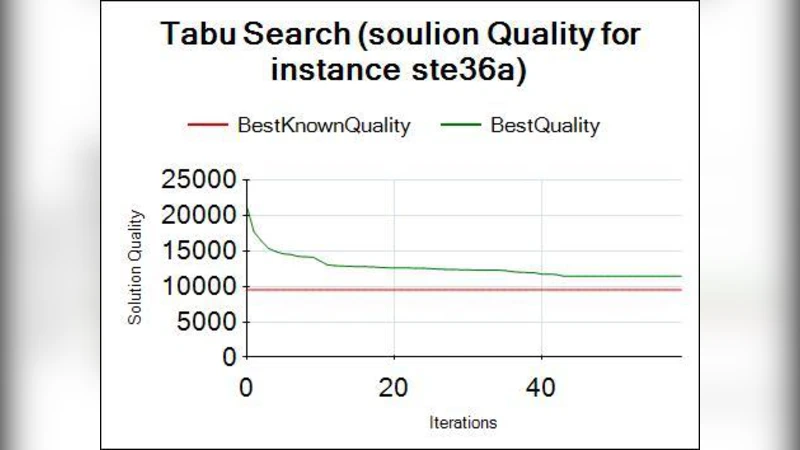
Two performance metrics are examined: (1) solution quality, measured as the percentage deviation from the known optimal objective value, and (2) computational efficiency, measured as average CPU time. The results reveal a clear trade‑off. GA achieves the best average solution quality with a mean deviation of 1.2 % but requires the longest runtime (average 12.8 seconds). TS delivers the fastest execution (average 3.4 seconds) but its average deviation is higher at 2.9 %. SA occupies a middle ground, attaining a 2.1 % deviation with an average runtime of 7.6 seconds. Standard‑deviation analysis shows GA’s solution quality is the most consistent across runs, while TS exhibits the smallest variability in runtime.
The authors interpret these findings in terms of algorithmic strengths and weaknesses. GA’s population‑based search enables broad exploration of the solution space, increasing the chance of approaching the global optimum, yet this comes at the cost of higher computational effort. TS’s use of a tabu list effectively prevents cycling and accelerates convergence to a high‑quality local optimum, making it attractive when time is limited. SA’s temperature‑controlled random walk balances diversification and intensification, yielding respectable solutions in moderate time.
Importantly, the study underscores that parameter tuning has a substantial impact on outcomes; therefore, practitioners should adapt algorithmic parameters to the specific characteristics of their QAP instances rather than relying on generic defaults. The paper also suggests future research directions, including hybridization (e.g., combining GA’s global search with TS’s rapid local refinement) and the exploration of newer meta‑heuristics such as Particle Swarm Optimization, Differential Evolution, or Ant Colony Optimization for QAP. By providing a clear, data‑driven comparison, the work offers valuable guidance for researchers and engineers seeking to select or design meta‑heuristic strategies for complex assignment problems.