Delineating Intra-Urban Spatial Connectivity Patterns by Travel-Activities: A Case Study of Beijing, China
Travel activities have been widely applied to quantify spatial interactions between places, regions and nations. In this paper, we model the spatial connectivities between 652 Traffic Analysis Zones (TAZs) in Beijing by a taxi OD dataset. First, we unveil the gravitational structure of intra-urban spatial connectivities of Beijing. On overall, the inter-TAZ interactions are well governed by the Gravity Model $G_{ij} = {\lambda}p_{i}p_{j}/d_{ij}$, where $p_{i}$, $p_{j}$ are degrees of TAZ $i$, $j$ and $d_{ij}$ the distance between them, with a goodness-of-fit around 0.8. Second, the network based analysis well reveals the polycentric form of Beijing. Last, we detect the semantics of inter-TAZ connectivities based on their spatiotemporal patterns. We further find that inter-TAZ connections deviating from the Gravity Model can be well explained by link semantics.
💡 Research Summary
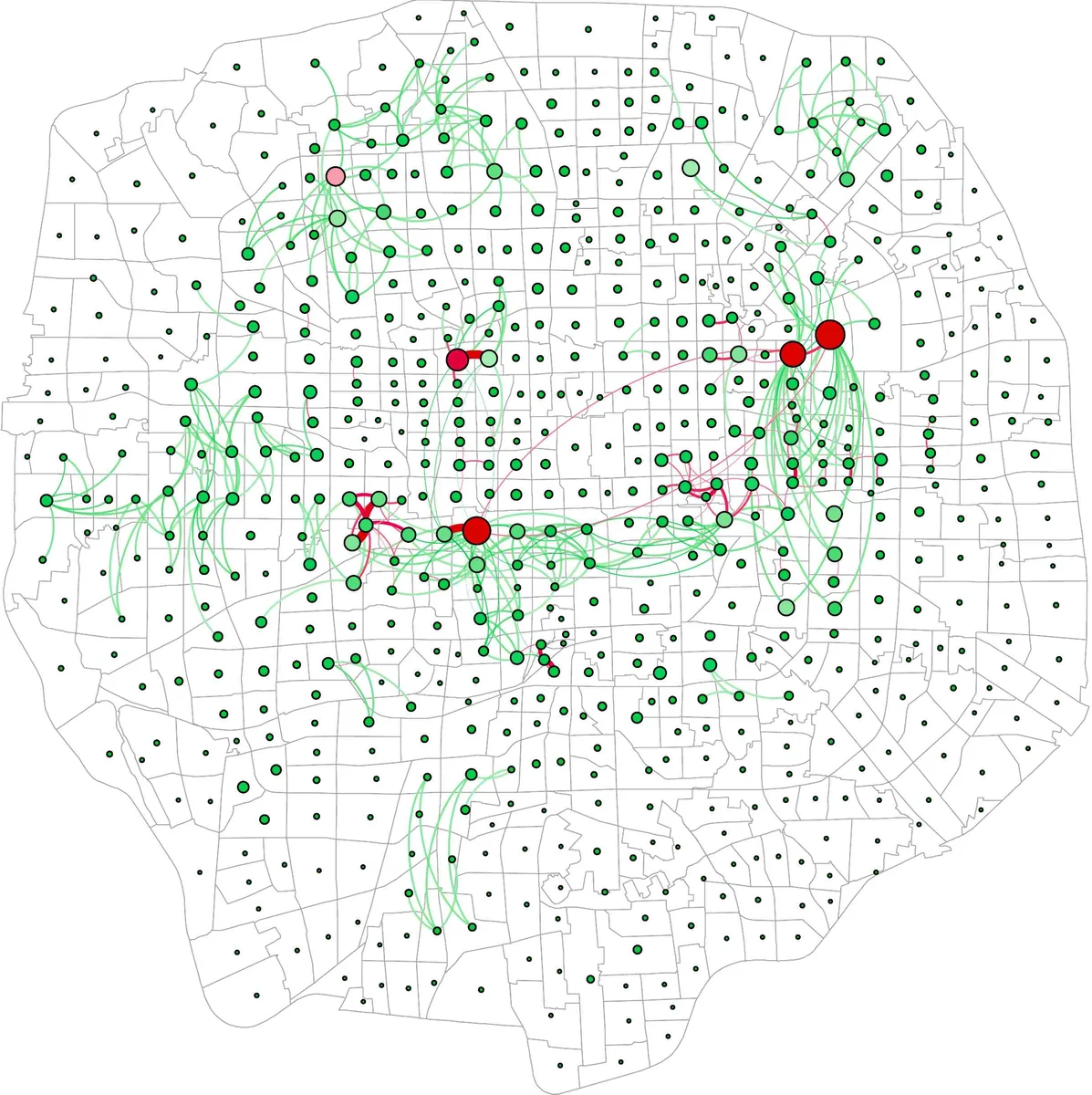
This paper investigates intra‑urban spatial connectivity in Beijing by exploiting a massive taxi GPS dataset collected throughout November 2012. The raw data comprise trajectories of 12,000 taxis, recording pick‑up and drop‑off locations, timestamps, and the intermediate path at roughly 10‑second intervals. After aggregating pick‑up and drop‑off points into the 652 Traffic Analysis Zones (TAZs) that lie within the fifth ring road, the authors construct two directed weighted networks: one for weekdays (22 days) and one for weekends (8 days). In the weekday network (N1) there are 348,065 directed edges, an average weighted degree of 45,125 and a clustering coefficient of 0.686; the weekend network (N2) contains 279,409 edges, an average degree of 13,548 and a clustering coefficient of 0.535.
The first analytical step is to test whether the observed inter‑TAZ flows follow a classic gravity model of the form
Gij = λ Pi Pj / dij^β
where Pi and Pj are the “attractions” of the origin and destination zones, dij is the Euclidean distance between zone centroids, β is a distance‑decay exponent, and λ is a scaling constant. Because linear programming is computationally prohibitive for a 652‑node system, the authors adopt an algebraic approximation method. By iterating β from 0 to 2 in steps of 0.1, they find the best fit at β = 1 and λ ≈ 1. The model reproduces the observed flows with Pearson correlation coefficients of 0.824 for weekdays and 0.783 for weekends, indicating a good overall fit (Goodness‑of‑Fit ≈ 0.8). Moreover, the estimated attractions Pi are almost perfectly linearly correlated with the observed node degrees pi (PCC ≈ 0.976), allowing the gravity model to be simplified to
Gij = λ pi pj / dij
without loss of explanatory power.
Next, the authors explore the polycentric structure of Beijing by applying community detection (the COMBO algorithm) to the weighted network. Fourteen spatially cohesive communities are identified (modularity = 0.281). By cross‑referencing with known land‑use patterns, these communities are grouped into four functional types: commercial‑dominant (clusters C1‑C3, corresponding to Zhongguancun, Xidan, and Guomao), transport‑dominant (clusters C4, C5, C6, C11, aligned with major railway stations and subway hubs), residential‑dominant (clusters C7, C8, C9, C12, C14 on the periphery), and leisure‑dominant (cluster C10, the Sanlitun bar district). The intra‑community links dominate the network, confirming a polycentric urban form where each functional hub interacts strongly within its own cluster and more weakly with others.
The third contribution concerns “link semantics.” For each directed OD pair, the authors build a 24‑dimensional signature Sij =
Comments & Academic Discussion
Loading comments...
Leave a Comment