Spin-state responses to light impurity doping in low-spin perovskite LaCoO$_{3}$
We studied the spin-state responses to light impurity doping in low-spin perovskite LaCoO$_{3}$ (Co^3+: d^6) through magnetization and X-ray fluorescence measurements of single-crystal LaCo$_{0.99}$$M
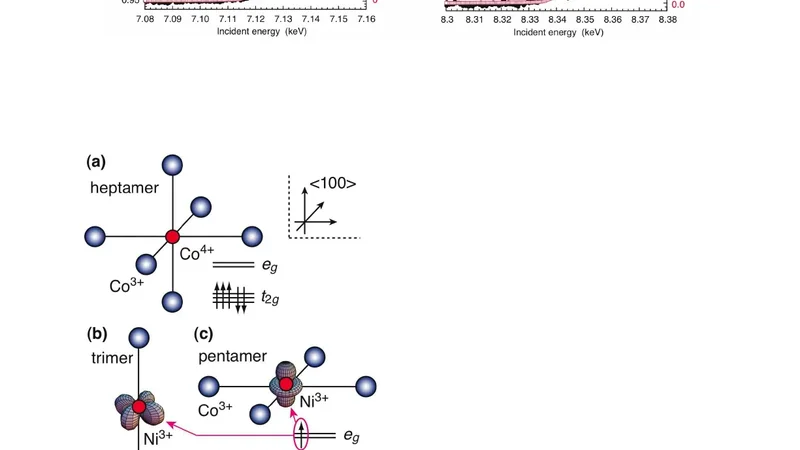
We studied the spin-state responses to light impurity doping in low-spin perovskite LaCoO${3}$ (Co^3+: d^6) through magnetization and X-ray fluorescence measurements of single-crystal LaCo${0.99}$$M_{0.01}$O$_{3}$ ($M$ = Cr, Mn, Fe, Ni). In the magnetization curves measured at 1.8 K, a change in the spin-state was not observed for Cr, Mn, or Fe doping but was observed for Ni doping. Strong magnetic anisotropy along the [100] easy axis was also found in the Ni-doped sample. The fluorescence measurements revealed that the valences were roughly estimated to be Cr^3+, Mn^4+, Fe^(3+delta)+, and Ni^3+. From the observed chemical trends, we propose that the chemical potential is a key factor in inducing the change of the low-spin state. By expanding a model of the ferromagnetic spin-state heptamer generated by hole doping, we discuss the emergence of highly anisotropic ferromagnetic spin-state clusters induced by low-spin Ni^3+ with Jahn-Teller activity. We also discuss applicability of the present results to mantle materials and impurity-doped pyrites with Fe (d^6).
💡 Research Summary
The authors investigate how minute impurity doping influences the spin state of low‑spin LaCoO₃, a perovskite in which Co³⁺ (d⁶) ions normally adopt a non‑magnetic t₂g⁶ (S = 0) configuration at low temperature. Single crystals of LaCo₀.₉₉M₀.₀₁O₃ (M = Cr, Mn, Fe, Ni) were prepared, and magnetization measurements were performed at 1.8 K with the magnetic field applied along several crystallographic directions. X‑ray fluorescence spectroscopy was used to determine the valence states of the dopants.
The magnetic data show that Cr, Mn, and Fe substitution do not induce any detectable change in the Co spin state: the M–H curves remain essentially linear, with no hysteresis or saturation, indicating that the host lattice stays in the low‑spin regime. In contrast, the Ni‑doped crystal displays a pronounced ferromagnetic‑like response, a clear hysteresis loop, and a strong magnetic anisotropy with the
📜 Original Paper Content
🚀 Synchronizing high-quality layout from 1TB storage...