VR-Stepper: A Do-It-Yourself Game Interface For Locomotion In Virtual Environments
Compared to real world tasks, completing tasks in a virtual environment (VE) seldom involves the whole spectrum of skills the human body offers. User input in a VE is commonly accomplished through simple finger gestures, such as walking in a scene by…
Authors: Denys J.C. Matthies, Felix M. Manke, Franz M"uller
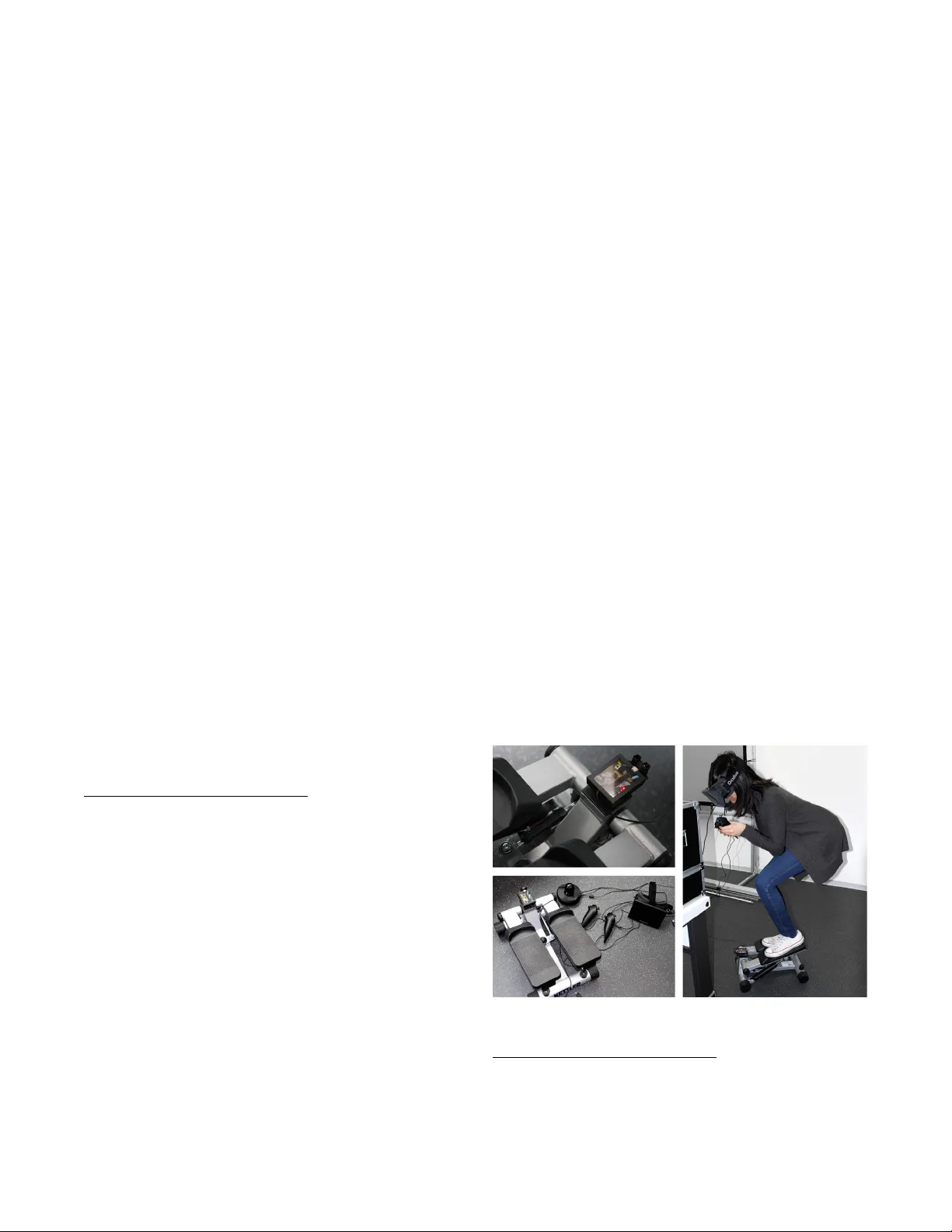
VR-Stepper: A Do-It-Yourself Game Interface For Locomotion In Virtual Environments Denys J.C. Matthies University of Munich (LMU) Geschwister-Scholl-Platz 1 80539 Munich, Germany matthies@cip.ifi.lmu.de Felix M. Manke University of Munich (LMU) Geschwister-Scholl-Platz 1 80539 Munich, Germany manke@cip.ifi.lmu.de Franz Müller University of Munich (LMU) Geschwister-Scholl-Platz 1 80539 Munich, Germany muellerfr@campus.lmu.de Charalampia Makri University of Munich (LMU) Geschwister-Scholl-Platz 1 80539 Munich, Germany c.makri@campus.lmu.de Christoph Anthes Leibniz Supercomputing Center (LRZ) Boltzmannstr. 1 85748 Garching, Germany christoph.anthes@lrz.de Dieter Kranzlmüller University of Munich (LMU) MNM-Team Oettingerstr. 67, 80538 Munich, Germany kranzlmueller@ifi.lmu.de ABSTRACT Compared to real world tasks, completin g tasks in a virtual environment (VE) seldom involves the w hole spectrum of skills the human bo dy offers. User input in a V E is commonly accomplished through simple finger g estures, suc h as walking in a scene by simply pressing a button, even if this kind of interaction is not very suitable. In order to create a more intuitive and natural interaction , diverse projects try to tackle the problem of locomoti on in VE’s by trying to enab le a natural walking movement, which is also supposed to incre ase the le vel of imm ersion. Existing solutions su ch as treadmills are still expensive and need additional fixation of the body. In this paper, w e describ e a simple and inexpensive way to build a usef ul loco motion interface using a conventional sports stepper and an Arduin o . This d evice enable s control in a V E by walking - in - place and withou t the nee d f or any additional fixation gadget s . We condu cte d a user study with 10 participants to evaluate the imp ression on the joy and ease of use, immersio n and rel iability in com parison to other in terfaces used for locom otion, s uch as the Wii Balance B oard a nd a Wand Joys ti ck. We foun d out that the stepper is experienced slightly better in terms of im mersion and j oy of use . Further more , found that p ressing buttons on a Joystick was perceived to be more reliabl e . Author Key words I nput device, phy sical interface , foot input, locom otion, interaction method, hands - free , VR . ACM Classi ficati on Keyword s H.5.2 [Inf ormati o n interf aces and presentat ion]: User Interfaces — Input devices and stra tegies, I nteraction styl es. INTROD UCTION Technology consistently evolves, thus products as the Oculus Rift 1 , which conceptually came from the rese arch field of virtual reality (VR) , fina lly reached a leve l of being socially acceptable and available to the co nsumer market . Advert isemen ts for suc h products and especially comp uter games show fascinating gr aphic al 3D - environments , whi ch promise th e user a totally new experience of VR . In scie ntific contexts this ca pturing of senses, diving into a n un real world and feeling a real depth of presence is also called immersion [9] . Nowadays , games and hardware developers often deliver application program ming interfaces ( APIs ) or whole software devel opment kits ( SDK s) with their products , so user s are enable d to mod ify and design their own experienc e . Because these tools became much easier to use, build ing own 3D vir tual worlds doesn’ t req uire advanced so ftware engineer ing skills anymore . Moreove r ide as of physical devices can be built m ore easily . Today , s pecial materials, which used to be available only for research ins titutes or b ig indu stry enterprises, are also accessible for end consumers. G ood example s wou ld be Sugru 2 , a high ly flexible and resistant 1 Oculus Rift HMD by Ocul us VR http://www.oculusvr. com [last access: 03/1 2/2013] 2 Sugru by FORMFORMFORM http://www.sugru.com [last access: 03/12/2013] Perm ission to make digital or hard copies of part or all of this work for personal or classroom use is granted without fee provided that copies are not made or distributed for profit or commercial advantage and that copies bear this notice and the full citatio n on the first page. Copyrights for third - party components of this work must be honored. For all other use s, contact the owner/author(s ). Copyright is held by the author/owner( s). arXiv Human - Computer Interac tion (cs.HC) , July 1 5 , 2014. modeli ng clay , or low - cost 3D printers 3 for an affordable manufac turi ng of own product series . Technology has never been that close to the consumer as it is today . Ano ther example for that is the Arduino 4 , a board with a microc ontro ller that allows b ringing objects to life. It became very famous because of its simplici ty in usage and its large variety o f functions. Ad ditional tools suc h as Fritzing 5 enable an easy learning an d understanding of electronics and ci rcuits for not tech - savvy u sers as well. Beyond this, it is possible to exchang e ideas and relate d technical solutions on th e basis of the se docum entations. The Internet offer s a big and gr owing pool of ideas, hacks and tutorials (e.g. Instructables 6 , H ack a Day 7 ), wh ich are designed by users fo r users. Hacking a devic e and b uilding things on the users o wn becam e a great c ulture, since everything became much easier throu gh the acce ssible technolog y 8 . Following the se trend s , this paper also wa nts to contribu te a do - it - yourself (DIY) solution for a low - cost locomotio n inter face for virtual environment s. RELATED WORK Virtual envi ronments One of t h e main goal s of a virtual environment (VE) i s t o create an a s high level of depth of presence as possible , also called immersio n [8 ]. In 1992 , Cruz - Neira et al. [3 ] buil t a so called CA VE – an audio visual env ironment , which is basically a small room consisting of display walls, where a virtual 3D scene is displayed. Locomotion in these environments is mostly performed with finger - interaction and t racking of body parts. P hysical movement such as natural walking is hardly feasible since spa ce is limited by walls . Als o the phys ical rota tion of the user is often problematic since most CAVE - like insta llations do not have a back screen. Both discoveries have already been stated by Cirio et al. [ 2] . Therefore , another approach would be to have the display very close to the human eyes , w hich would mostl y be attached to the human head – called head mounted displ ay (H MD). A s mentioned , the Oculus Rif t 3 About.c om, Li st of 3D Printe rs Under $1000 - Ready To Use , http://3d.about .com/od/3d - Electron ics/tp/ List - Of - 3d - Printers - Under - 1000 - Ready - To - Use.ht m [l.a.: 03/12/2013] 4 Arduino orig inal ly by Smart Proj ects Elect roni cs http://www.arduino.cc [last access: 03/12/2013] 5 Fritzing or iginall y by FH: - P, now: I XDS Berlin http://www.frit zing.org [last access: 03/12/2013] 6 Instructables orig inally: MIT Media L ab, now: Squid Labs http://www. instructable s .c om [last access: 04/1 2/2013] 7 Hack a Day or igin ally by Jason Calacanis http://www.hackaday.com [last access: 04/12/2013] 8 Wett ach. R. ( 2009 , No vemb er) TED Talk - TEDx Berlin http://www.t edxberlin.de/t edxberlin - 2009 - reto - wettach - bodies - secrets [last access: 03/12/2 013] became one of the most popular H MD in recent histo ry. So t he rotation problem has been overcome , but other problems have appeared, for instance the level of cyb er sickness has bec o me an e ven greater issu e, since user s are often not able to see a reference point (e.g. their body parts such as their fe et) when th e display of the HMD surround s the whole field of view ( FOV) . Other issu e s are la tency, as stated by LaViola [ 5 ]. When being blind for reality, locomotio n thr ough physical walking is lim ited to walki ng - in - place only . Fo r th is kind of setup , gadgets are often installed to hold the user in position, as for the Omni 9 : a locomotio n interface that hold s the user in ring g adgetry above a sl ipper y bowl t o enable free walking . Fu nctions include: walking/runnin g, turn ing an d jumping. One of the main disadvant ages is t hat the us er has to learn a spec ial kind of w alking . O therwise , he will b e exhausted very quickly. C rouching and strafing are not supported yet. Use of St epper in Research Using a stepper as a locomotion interface for VR applications could provide a solution , wh ich w as also employed by Wiegand a nd Broo ks [9 ], who modifi ed a stepper fo r a military traini ngs applicati on. Hamano et al . [4] used a stepper for rehabilitation support . Still , the technical solution s demonstrated were expensive and not sufficient. Inspired by works such as th e ones from Pausch [7 ] or Basu et al. [ 1], we w anted to design a much cheaper and mor e technically simple solution , which is also usable for any 3D applications. VR - STEPPER The VR - Stepper is a sports stepper modified with an attached Arduino board to make it usable as a n input device for a personal computer. We demonstrate two ways to turn it into an interactive device connected to a computer, with different le vel s of difficulty for each way . Fi gure 1 . Crouching User i n a VE (Half - Life 2) wit h the VR - Stepper, Razor Hydra and wearing Oculus Rif t. 9 Omni by Virt uix http://www.virtui x.com [last access: 03/12/20 13] Feature s of the Stepper The V R Stepper enabl es its user to move in th e VE’s . A constant motion of the pedals causes a straight forward movement , as if the u ser was rea lly walking. By l owerin g one pedal until it touc hes the ground, the user can turn around or strafe laterally ( based on the setup ) . A dditionally, crouching on the stepper also results i n crouching in a VE . Simple DIY Version Basic features of the device (walking str aight and rotatio n) can be achieved with the sim ple DIY version that does not require much knowledge in e lectronics and no soldering. This min imal v ersion requires the following items : 10 Sports S tepper (used: $ 5- 10 new: $39 ) Arduino (Uno : $18 / Nano: $10 ) Potentiometer ( slide or t urn : $1 -2) Glue & Tape & Wi res (4 $) Figure 2. Finding suitable position s for the poten tiomet er . A : attac hed to the rod b elow t he pe dal. B: tu rn pot enti ometer attac hed at a pi vot to mea sure the ch anging angl e. The main challenge is to attach the pote ntiometer to a suitable position where the actual motion of the peda ls can be measured. Figure 2 demonst rates tw o suitable positions: (A) a slide potentiom eter attached to the rod below the pedal - the kn ob is bumping against the frame and a rubber band is pulling it back for the countermovement or (B) a turn potentiometer attached at a pivot m easures t he changing angle - a rod is utilized to fix the knob . Arduino measur es th e value of the potent iometer and tra nsmits it to the serial port where it i s be ing r ead o ut b y Proc essin g 11 . 10 Average pric es ch ecked on e bay.c om [15/ 04/20 14]. 11 Processing or iginally by Ben Fry and Casey Reas (200 1) http://process ing.org [last access: 11/09/201 3] Lo wering the left or ri ght pedal to the ground is shiftin g or turning the knob o f the poten tiometer, which should result in a turn or strafe in the VE. Since the value of the potentio mete r is bei ng const antl y writt en to the seria l port, it can be read out and process ed by Pro cessing, where a key - press event can be triggered. Advanced Versi on To enable more complex features of the VR - Stepper, namely crouching, a more advanced version h as to be built . By building th is particular version of the VR - Stepper, one can obtain a device that would be recognized as a keyboard by the computer, making it usable in many programs, such as games where controls are operated by keyboard events with no a dditional software required . Th is version nee ds additional components : IR Sensor (Sh arp GP2Y0A 02 YK : $ 20 ) USB -K eyboard (wired: 5$ wireless: $10 ) 4x Optocoupler ($1 ) 5x 1kOhm Resistor (< $1) MOSFET (IR F640: < $2) 10uF Capacitor (<$1 ) Univers al P CB Keyboard Hac k Unfort unate ly key events coming f rom separate software tools a re often not suitable for every gam e, since it could also provide a possibility for cheating. A suit able s olut ion is utilizing the ci rcuit board of a keyboard for transmitting key presses to the computer. These circuits have up to 24 in put pins, w hich cr eate a key p ress event when connected with each other. Consequentl y the first thin g woul d be finding out the right keys to utilize (e.g. A, S, D, Directi onal Arrows, Ctrl key ). Because the conn ections have t o be shorten on an electronic way, the pi ns have to be att ached to optocouplers, which have to be connected to the A rduino’s output pins . This way t he sensor processing must be done at the microcont roll er i nstead of executi ng a method . Now, t he related p in s connected to the optocouplers have to be set to HIGH or LOW . A nother more expens ive but convenient way would be usi ng an Ar duino Leonardo ($30) , which is able to emulate key press events as well. Infrared Sen sor A dditional features as crouc hing (s hown Figure 1 ) would be beneficial to the user as it enlarges the d egrees of freedom. C rouching o n the stepper is realized with an infra red sensor ( Sharp GP2Y0A02YK ), which ha s a range of 0- 15 0 cm . This kind of sensor is very simple to interface on the Arduin o since it has a behavi or similar to a potentiometer: when the user is goin g down to a crouc h position the hum an body will bend over the IR sensor, thus changing the sens or value to a low er on e. Therefore u sing a threshold is once again a sufficient soluti on . Power Supply The keyboard circuit usually gets its power from a USB cable ( or a battery ) as also th e Arduin o needs a power supply . I t occurs that the pow er delivered by only one USB port is not sufficient for both devices . Thus h aving both devices at one USB port a power transistor to amplify the current and a capacitor to smooth the voltage fluctuations are required . USER STUDY To get some first impressions on the performance of the prototype we conducted a user study . Furthermore we wanted t o find out what kind of impact this low - cost locomotio n interface ha s, when app lied to a VE. Hypothesis The first hypothesis (H1) is: movin g in a 3D scene by performing leg movements on a Stepper increases immersio n. The se cond hypothesis (H2) would be: l etting the user involving their whole body - especially the leg movement - leads to a grea ter j oy compare d to c ommon devices such as a Wand Joyst ick. However, due to t he faster and more precise actions possible with a Wand Joystick an d having tactile feedb ack when pushing the button , the W and Joystick might be rated high er in terms of perceived reliability (H3). Pretests At first, we decide d to use the Stepper as a locomotion interface for playing Half - Life 2 12 with the Oc ulus Rift and the Razer H ydra 13 ( Figu re 1 ). Howev er, a fter two participants, we found out that the users were not able to keep their balance - they fe ll of f th e ste pper - as soon as the 3D scene was displayed. Therefore t he decision was made to use a CAVE - like design , w here the u ser s would st ill have reference points, wh ich should circumv ent the problem . Study Setup The user stu dy was conducted in a stereoscopic 5- display - wall CAVE - lik e installation ( Figure 3 ). To gain knowled ge on the performance of t he Stepper , we accomplished a withi n subj ect study with the 3 following conditions: VR - Stepper, Wii Ba lance Board 14 and a Wand Joystick 15 in two 12 Half - Life 2 by Val ve http://orange. half - life2.com [last access: 05/12/2013 ] 13 Razer Hydr a Gaming Contro ller by Razor http://www.razerzone. com/gaming - controllers/razer - hydra/ [last access: 05/12/201 3] 14 W ii B alance Boar d by Ninten do http://www.nintendo. com/consumer/downloads/wiiBalance Board.pdf [last access: 06/12/2013] 15 Flystick 2 by A.R.T. http://www.ar - tracking.com /products/inter action - devices/flyst ick2/ [last access: 06/12/2013] self - build 3D scene s . The first users’ task w as it to r un as fast as possible through a racing track, wh ich had s everal hinders, the users had to dodge. The seco nd scene was a waste - land scenario , wher e the user was enabled for a free walk ing without a ny task. Every subject had to go through both scenes by using each interface in a random order. After completin g all scen es with every inte rface a questionnaire had to be filled out, which was asking the user to rate the following on a 5 - point Likert scale: (1) E ase of U se (2) Joy o f Use (3) Feeling of I mmersion (4 ) Impression on R eliability . Figure 3 . Exper imental set up wit h the thre e dev ices: Stepper , Wii Bala nce Boar d & Wand Joys tic k Participant s W e evaluated the system with one group of 1 0 participants (8 male, 2 female), w ith an age between 1 5 and 55 . Results Ease of Use A one - way ANOVA on the device factor showed a significant difference in terms of ease of use ( F 2,18 = 5.96 ; p= .01 ). A Tukey HSD T est suggests that the joystick ( M= 3.4 ) is significantly ea sier to use than the VR - Stepper ( M= 2. 2 ; p < .01 ) . No ot her diff erence s yield . Joy o f Use A one - way ANOVA show ed no significant di fference ( p >.05) betwe en all devices . However, the VR - Stepper ( M= 4) was deem ed more joyful than the joy stick ( M= 3.3) and the Wii Ba lan ce Boar d ( M= 3.5). 1 2 3 4 5 VR-Stepper Wii Balance Board Wand Joystick Ease of use Joy of use Feeling of Impression Immersion on Reliability Figure 4 . Qua ntitati ve resul ts for each test criteria. Feeling of I mmersion A one - way ANOVA did not yield any significant difference ( p >.05) between devices that ar e averaging around 2.9 - 3.6 . Impression on Reliability A one - way ANOVA found a sign ificant difference in terms of reliab ility ( F 2,18 = 22.18 ; p <.0001) . A Tukey HSD T est determined that t he joystick ( M= 3. 4 ) was perceived as more rel iabl e than the V R -S tep per ( M= 2.1 ; p <.01) and th e Wii Bal ance B oard ( M= 2.0 ; p <.01 ). Discussion Analyz ing the data ( Figure 4 ) showed that usi ng a Wand Joystick is significantly easier. Co nfirming the hypothesis H3, the reliabi lit y was also signif icant ly rated much higher. The VR - Stepper was also experienced , in terms of immersio n a nd joy slightly better tha n the other teste d interfaces, as expe cted. Unfortunately, the difference was not statisticall y significant, thus hypoth e sis H1 and H2 did not confirm. T herefore this short study co uld not prove that a physical movement of legs results in a raise of im mersion. However a broader study with a do ubled sample size and similar feedback would deliver a statistical ly significant difference . For future studies additionally measuring real quantitative data (e.g. task completion time) would also be interesting for a comparison of locomotio n interfaces . W hen being in a C AVE - like installation a nd using stationary IR tracking systems, the additional IR sensor attached to the S tepper might not operat e due to the overshoot of great IR noise. In that case, crouching ha s to be detected by the local tracking sys tem in a CAV E. The problem of losing balance also sometimes occurred in the CAVE, when the user was fully focu sing on the game and “forgetti ng about being on a stepper” thus P4 als o stated “it can be dangerous by falling from it ” . Two users stated the ste p per to be “exhausting but very funny” . P8 proposed to crea te a skiing - application. Except from one outlier we excluded (P11 - a female mid - age su b ject, wh o fall off the stepper and did not wish to complete the study ) the overall feedback w as quite g ood. Mo st users agreed that using the Wii Balan ce Board requi red an ex tra familiarization phase , which is not neede d for the stepper . Overall , all stud y participan ts really enjoyed the us er tes t, as they said durin g and after the test. CONCLUSION Th is paper demon strated a novel approach of hacki ng a stepper as a low - cost DIY input interface for virtual environments. Furthermore a small study was conducted, where the function alit y of this device was tested in a self - built 3D scene . Additi onall y a comparison to a “W ii Balance Board ” and a “ Wand Joyst ick ” is acco mplished, which gav e valua ble res ults such as: an instant / direct input action with a haptic feedb ack from the buttons by the Wand was preferred to use. Never the less, the VR - Stepper was rated better in term s of “joy of use” and “feeling of immersio n”, yet more test s need to be conduct ed in order to report empirical evidence. Overall , the o bservation of our study showed that very fast movements or lags in a 3D scene dram atically increase cyber sickness an d le ad to a loss of equilibrium , as w e agree with Pau sch [ 7 ] who already stated the importa nce of low latency H MD ’s. A n advantage in VE ’s could include exercise programs , which even woul d provide significantly more joy of use [ 10 ]. REFERENCES 1. Basu, A., Saupe , C., Refour , E., Raij, A., & Johns en, K. (2012, March ). Immersive 3dui on one dollar a day. In Proc . of 3D User Int erfaces , 97 - 100 . IEEE. 2. Cirio, G., Van gorp, P., Ch apouli e, E., Marcha l, M., Lécuyer, A., & Dre ttakis, G. (201 2). Wa lki ng in a c ube : Novel metap hors for safely navigating lar ge virtual environments in restricted real workspaces. In Proc . of Visualiz ation a nd Computer Graphics , 546 - 554 . IEEE. 3. Cruz - Neira, C., Sand in, D. J. , DeF anti, T. A., Kenyon, R. V., & Hart , J. C. (1 992). The CAVE: audio visual experience automatic virtual environment. In Communicat ions o f the ACM , 35(6), 64 - 72. ACM. 4. Hamano, H. , Fu rukawa , T., & Ohc hi, M. (2 003, August) . Dev elopme nt of vir tual walk syste m for rehabilitation support us ing stepper. In SICE 2003 Annual Conf erence ( Vo l. 3 ), 2951 - 2956 . IEEE . 5. LaViola Jr, J. J . (2000) . A dis cussion o f cybers ickness in virtual envir onments. In SIGCHI Bulletin, 47 - 56. ACM. 6. Nenonen, V., Lindb lad, A., Häkkine n, V. , La itin en, T ., Jouhtio, M., & Hämäläinen, P. (2007, Ap ril). Using heart rate to control an interactive game. In Proc . of SIGCHI CHI’07 , 853 - 856 . ACM . 7. Pausch, R. (199 1, March). Virtual r eality on five dol lars a day. In Proc . of SIGCHI CHI‘91 , 265 - 270 . ACM. 8. Slater, M., Usoh, M., & Steed, A. (1994). Dept h of presence in vir tual environm ents. In Presence , 130 - 144. 9. Wiega nd, T.E .v. , Broo ks, A. (2 001) Fo otSt epp er: an effor t- based locomotion inter face. In Presence - Lite . 10. Xu, W., Jeo ng, J ., & Mulli gan, J. (2009) . Augme nting exercise systems with virtual exercise environment. In Proceeding s of A dvances in Visual Computing , 490 - 499). Springer Ber lin Heidelberg.
Original Paper
Loading high-quality paper...
Comments & Academic Discussion
Loading comments...
Leave a Comment