Using technical noise to increase the signal-to-noise ratio, via imaginary weak values
The advantages of weak measurements, and especially measurements of imaginary weak values, for precision enhancement, are discussed. A situation is considered in which the initial state of the measurement device varies randomly on each run, and is shown to be in fact beneficial when imaginary weak values are used. The result is supported by numerical calculation and also provides an explanation for the reduction of technical noise in some recent experimental results. A connection to quantum metrology formalism is made.
💡 Research Summary
The paper investigates how weak‑measurement techniques, particularly those that exploit imaginary weak values, can improve the signal‑to‑noise ratio (SNR) even when the measurement device (meter) suffers from random technical fluctuations in its initial state. Starting from the Aharonov‑Albert‑Vaidman (AAV) framework, the authors recall that a system weakly coupled to a meter and subsequently post‑selected is effectively described by the weak value C_w of the system observable C. This weak value is generally complex; its real part shifts the meter’s position variable Q, while its imaginary part shifts the conjugate momentum variable P.
In an ideal scenario the meter is prepared in a pure Gaussian state of width Δ. Measuring Q yields an SNR proportional to √N k Re C_w Δ⁻¹, whereas measuring P gives an SNR proportional to √N k Im C_w Δ. Both scale with the square root of the number of repetitions N, but the absolute magnitude depends on the weak‑value component used.
The novelty of the work lies in modeling technical noise as a random offset of the meter’s initial wave‑packet. Two cases are considered: a shift Q₀ in the Q basis (position noise) and a shift P₀ in the P basis (momentum noise). For Q‑noise, the average signal remains unchanged but the variance becomes Δ²+Δ_Q², so the SNR is reduced relative to the ideal case. In contrast, when the meter suffers from P‑noise and the experiment is designed to read out an imaginary weak value, the post‑selection probability itself depends on P₀. After averaging over the distribution of P₀ (assumed Gaussian with variance Δ_p²), the mean shift becomes k Im C_w (Δ⁻²+Δ_p²)⁻¹ and the variance becomes (Δ⁻²+Δ_p²)⁻¹. Consequently the SNR scales as
SNR ∝ √N k Im C_w √(Δ⁻²+Δ_p²)⁻¹ .
Because the denominator decreases when Δ_p grows, a larger spread in the momentum variable actually enhances the SNR. This counter‑intuitive result explains why recent experiments reported a reduction of technical noise when using imaginary weak values.
The authors also discuss the validity of the AAV approximation. The higher‑order terms in the expansion of the evolution operator are negligible provided |k C_w|² ⟨P²⟩ ≪ 1. For Q‑noise this condition is independent of Δ_Q, but for P‑noise the effective ⟨P²⟩ increases with Δ_p, tightening the requirement on the interaction strength k. Hence, while the technique tolerates large momentum noise, the interaction must still be sufficiently weak.
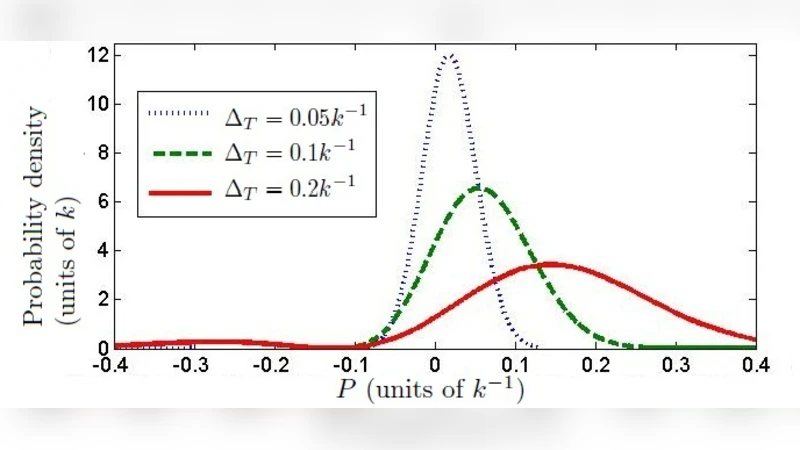
Numerical simulations are performed with a two‑level system (qubit) and a Gaussian meter. The weak value is taken as C_w = i w (purely imaginary). The resulting momentum distribution after post‑selection matches the analytic expression (Eq. 23). For k Δ_T < 1, where Δ_T = Δ⁻² + Δ_p², the distribution remains essentially Gaussian and its centroid shifts linearly with k w Δ_T⁻¹, leading to an SNR that grows linearly with k w √N Δ_T⁻¹. The optimal SNR is reached near k Δ_T ≈ 1; beyond this point the AAV approximation fails and the SNR declines, reproducing the behavior of standard (non‑weak) measurements.
The theoretical findings are linked to two landmark experiments: (i) the observation of the optical spin‑Hall effect by Hosten and Kwiat (Science 2008) and (ii) a precision beam‑deflection measurement using a Sagnac interferometer by Dixon et al. (PRL 2009). Both experiments employed a polarization observable as C, a transverse momentum or position as the meter variable, and deliberately engineered a purely imaginary weak value. In each case the measured signal was proportional to the square of the effective width Δ_T, confirming the paper’s prediction that technical noise in the conjugate variable does not degrade, and can even improve, the measurement precision.
Importantly, the work emphasizes that no entanglement between meters is required to reach the Cramér‑Rao bound; the classical correlations introduced by post‑selection suffice, preserving the √N scaling. By treating technical noise as a resource rather than a nuisance, the authors suggest that low‑cost light sources (e.g., white light) and ambient‑temperature, non‑vacuum setups could achieve quantum‑limited precision. This perspective broadens the practical applicability of weak‑measurement metrology across optics, solid‑state, and atomic platforms, offering a straightforward route to enhance precision without the experimental overhead of generating entangled probes.
Comments & Academic Discussion
Loading comments...
Leave a Comment