Categorification of Hopf algebras of rooted trees
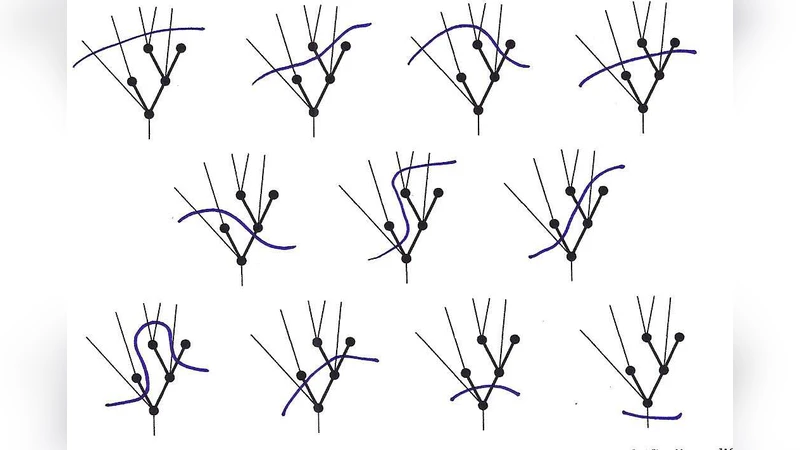
We exhibit a monoidal structure on the category of finite sets indexed by P-trees for a finitary polynomial endofunctor P. This structure categorifies the monoid scheme (over Spec N) whose semiring of functions is (a P-version of) the Connes–Kreimer bialgebra H of rooted trees (a Hopf algebra after base change to Z and collapsing H_0). The monoidal structure is itself given by a polynomial functor, represented by three easily described set maps; we show that these maps are the same as those occurring in the polynomial representation of the free monad on P.
💡 Research Summary
The paper presents a categorical construction that lifts the Connes–Kreimer Hopf algebra of rooted trees from an algebraic object to a categorical one. The authors work with a finitary polynomial endofunctor (P) on the category of sets and consider the associated class of (P)-trees, which are trees decorated by the operations of (P). The central idea is to replace the semiring of natural numbers (\mathbb{N}) (the Burnside semiring of finite sets) with a distributive category (\mathcal{F}) of finite‑set‑valued polynomial functors, and then to endow the category (\mathcal{A}_T) of finite sets indexed by (P)-trees with a monoidal structure (M). This monoidal structure is itself a polynomial functor, described by three elementary set maps. The authors show that these three maps are precisely the maps that appear in the polynomial representation of the free monad on (P). Consequently, pre‑composition with (M) yields a comonoidal (i.e. coalgebra) structure on (\mathcal{F}) that categorifies the comultiplication of the Connes–Kreimer bialgebra.
The paper proceeds as follows. Section 2 reviews the classical Connes–Kreimer bialgebra (H) built from combinatorial rooted trees, its coproduct defined by admissible cuts, and the passage to operadic trees (trees with explicit leaves). The authors introduce a bialgebra (B) generated by isomorphism classes of operadic (P)-trees; unlike (H), (B) is not connected because each colour of edge contributes a group‑like generator in degree zero. A “core” functor that removes leaves and the root edge provides a surjective bialgebra homomorphism (B\to H).
Section 3 recalls the theory of polynomial functors in the slice‑category language (\mathbf{Set}/B). The three adjoint functors (\Sigma_f), (\Delta_f), and (\Pi_f) (lower‑shriek, pullback, lower‑star) are introduced, together with the explicit description of a polynomial functor as a diagram (E \xrightarrow{p} B \xleftarrow{s} I \xrightarrow{t} J). Substitution of polynomial functors is expressed via pullbacks and pushforwards, laying the groundwork for later constructions.
In Section 4 the authors treat categories of polynomial functors as “polynomial rings” and categories of indexed finite sets as “affine spaces”. They develop a dictionary that treats objects of (\mathcal{A}_T) as points of an affine space over the base of (P)-trees, while morphisms correspond to polynomial maps. This viewpoint clarifies how the monoidal product on (\mathcal{A}_T) can be seen as a polynomial operation.
Section 5 introduces (P)-trees formally. A (P)-tree is a rooted operadic tree whose nodes are labelled by operations of (P) and whose edges are labelled by the corresponding input and output types. The free monad on (P) is constructed as the colimit of all (P)-trees, and its unit, multiplication, and substitution maps are given explicitly by three set maps: (i) the map assigning to each operation its list of input edges, (ii) the grafting map that glues a forest of trees onto a root, and (iii) the flattening map that collapses a tree of trees into a single tree. These maps are precisely the data needed for the monoidal structure later.
Section 6 is the technical heart. The monoidal product (M:\mathcal{A}_T\times\mathcal{A}_T\to\mathcal{A}_T) is defined as a polynomial functor whose underlying diagram is built from the three maps of the free monad. Concretely, for objects ((X,Y)) indexed by a tree (T), the product is \
Comments & Academic Discussion
Loading comments...
Leave a Comment