Quickest Paths in Simulations of Pedestrians
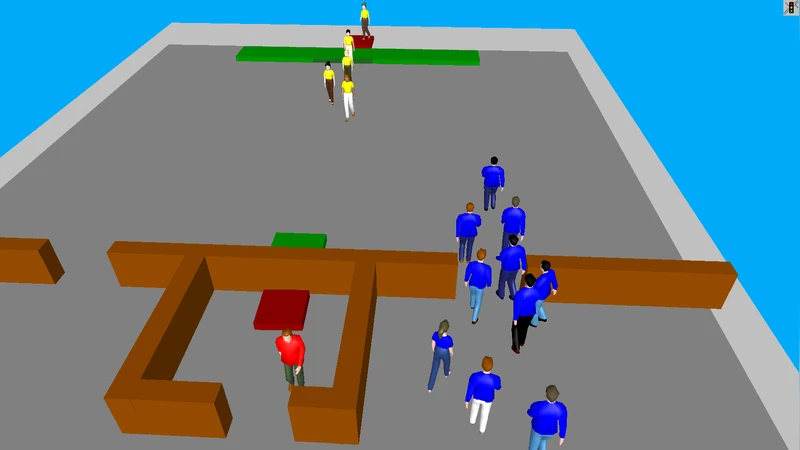
This contribution proposes a method to make agents in a microscopic simulation of pedestrian traffic walk approximately along a path of estimated minimal remaining travel time to their destination. Usually models of pedestrian dynamics are (implicitly) built on the assumption that pedestrians walk along the shortest path. Model elements formulated to make pedestrians locally avoid collisions and intrusion into personal space do not produce motion on quickest paths. Therefore a special model element is needed, if one wants to model and simulate pedestrians for whom travel time matters most (e.g. travelers in a station hall who are late for a train). Here such a model element is proposed, discussed and used within the Social Force Model.
💡 Research Summary
The paper addresses a notable limitation of most microscopic pedestrian simulation models, especially those based on the Social Force Model (SFM): they implicitly assume that pedestrians follow the geometrically shortest path to their destination. While this assumption works for many simple scenarios, it fails when travel time, rather than distance, is the decisive factor for pedestrian decisions—e.g., commuters rushing to a train, or situations where a shorter corridor becomes congested and a longer alternative becomes faster. To overcome this, the authors propose a new model component that steers agents along an estimated minimal remaining travel‑time path, which they call a “dynamic potential”.
The core idea is to replace the static distance field traditionally used for direction calculation with a time‑based field. In a conventional SFM, the desired direction (\hat v_0) is obtained from the gradient of a distance map (S(\mathbf{x})) that solves the Eikonal equation (|\nabla S| f = 1) with a constant (f) (equivalent to a uniform walking speed). The authors generalize this by letting (f) be a spatially varying field equal to the inverse of the expected walking speed at each grid cell. Consequently, solving the same Eikonal equation yields a scalar field (T(\mathbf{x})) representing the estimated remaining travel time to the destination.
The method consists of three steps:
- Estimating local walking speeds – The simulation space is discretized into a regular grid (15–20 cm spacing). For each cell, a factor (f) is assigned. Empty cells receive (f=1). Cells occupied by a pedestrian receive a reduced (f) according to
\
Comments & Academic Discussion
Loading comments...
Leave a Comment