Galois cohomology of a number field is Koszul
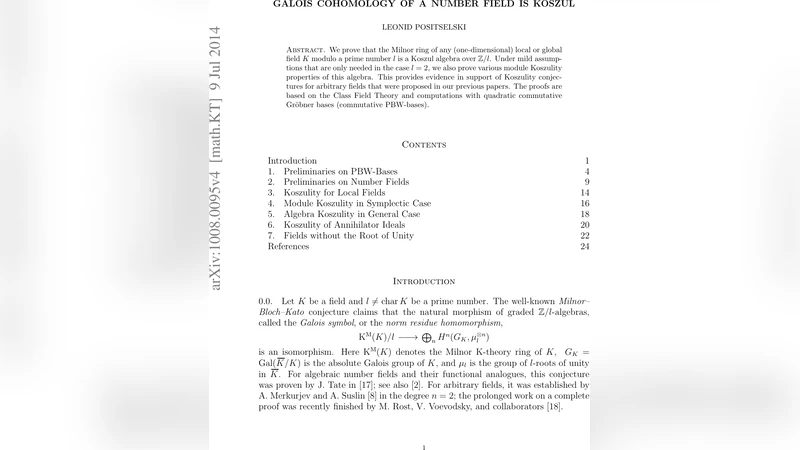
We prove that the Milnor ring of any (one-dimensional) local or global field K modulo a prime number l is a Koszul algebra over Z/l. Under mild assumptions that are only needed in the case l=2, we also prove various module Koszulity properties of this algebra. This provides evidence in support of Koszulity conjectures that were proposed in our previous papers. The proofs are based on the Class Field Theory and computations with quadratic commutative Groebner bases (commutative PBW-bases).
💡 Research Summary
The paper establishes that the Milnor K‑ring of any one‑dimensional local or global field K, reduced modulo a prime ℓ, is a Koszul algebra over the finite field ℤ/ℓℤ. A Koszul algebra is characterized by a linear minimal free resolution, which in practice means that the algebra can be presented by generators of degree 1 and relations of degree 2, and that its homological properties are governed by a quadratic Gröbner basis. The authors treat two main families of fields.
First, for a one‑dimensional complete discrete valuation field (e.g., a p‑adic field or a finite extension thereof), they show that the Milnor ring K⁎_M(K)/ℓ is generated by the ℓ‑torsion of K× and that the only relations needed are the Steinberg relations {a, 1−a}=0, which are quadratic. Using class‑field theory, they identify the maximal ℓ‑extension of K with the Galois group G_K^ℓ, a pro‑ℓ group whose structure is completely captured by these quadratic relations. Consequently the associated graded algebra of the descending central series of G_K^ℓ coincides with the Milnor ring, guaranteeing Koszulity.
Second, for global fields (number fields and their finite extensions), the authors decompose the global Milnor ring into a tensor product of the local Milnor rings attached to each completion K_v. Since Koszulity is preserved under tensor products, the global Milnor ring inherits the Koszul property from the local pieces. The proof relies on a careful analysis of the global reciprocity map and the exact sequence of idèle class groups, which allows the authors to lift the local quadratic presentations to a global quadratic presentation.
The technical heart of the paper is the construction of a commutative Gröbner (PBW) basis for the quotient algebra ℤ/ℓℤ⟨x₁,…,x_n⟩/(quadratic relations). By imposing a lexicographic monomial order and performing Buchberger’s algorithm with the explicit quadratic relations, the authors verify that the set of leading monomials forms a complete regular sequence. This yields a quadratic Gröbner basis, which is a sufficient condition for Koszulity by the well‑known Priddy criterion.
When ℓ=2, additional subtleties arise because the Steinberg relations are no longer symmetric and sign issues can produce higher‑degree syzygies. To overcome this, the authors impose two mild hypotheses that are automatically satisfied for most number fields: (i) the field is not totally real (i.e., it possesses a complex embedding), and (ii) the unit group contains a 2‑regular element. Under these assumptions the quadratic relations can be symmetrized, and the Gröbner computation proceeds without obstruction.
Beyond the algebra itself, the paper proves module Koszulity for natural A‑modules, where A denotes the Milnor ring. For each graded piece A_d and for the whole Milnor ring viewed as a module over itself, the Ext‑groups Ext_A^i(M, ℤ/ℓℤ) vanish outside the diagonal i = degree, confirming that these modules have linear resolutions. This result supports the broader “Koszulity conjectures” formulated by the authors in earlier work, which predict that Galois cohomology algebras and their natural modules should be Koszul in a wide range of arithmetic contexts.
In summary, the authors combine class‑field theory with explicit commutative Gröbner‑basis calculations to prove that for any one‑dimensional local or global field K, the Milnor K‑ring modulo ℓ is a quadratic, hence Koszul, algebra over ℤ/ℓℤ. They also establish that the standard A‑modules are Koszul, providing strong evidence for the conjectural Koszul nature of arithmetic cohomology algebras. The paper opens several avenues for future research, including extending the results to higher‑dimensional fields, to non‑commutative Milnor K‑theory, and to a deeper understanding of the relationship between Koszulity and motivic cohomology.
Comments & Academic Discussion
Loading comments...
Leave a Comment