Local fibered right adjoints are polynomial
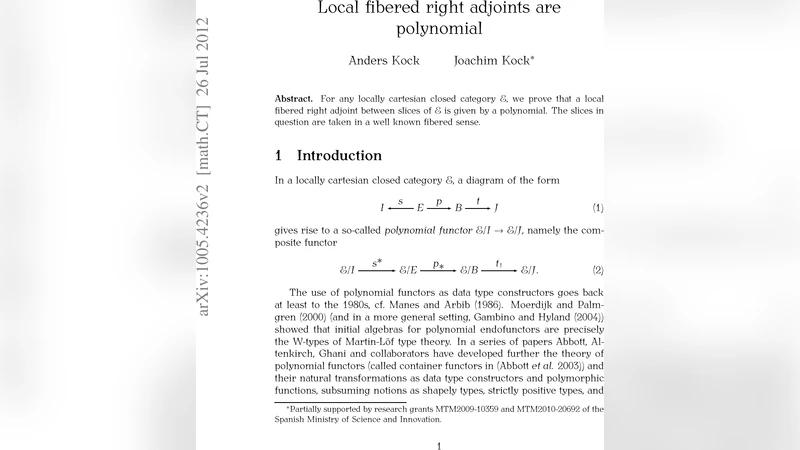
For any locally cartesian closed category E, we prove that a local fibered right adjoint between slices of E is given by a polynomial. The slices in question are taken in a well known fibered sense.
💡 Research Summary
The paper investigates the relationship between fibered right adjoints (FRAs) and polynomial functors in the setting of a locally cartesian closed category E. After recalling the standard fibered 2‑category structure on the slices E/X, the author defines a fibered right adjoint as a functor between slices that not only admits a right adjoint on each fiber but also commutes with pullback (reindexing) in a coherent way. This “local” condition is captured by a fibered Beck‑Chevalley property: for any morphism f:X′→X the natural transformation f* ∘ R ⇒ R ∘ f* is an isomorphism, where R denotes the right adjoint on the appropriate slice.
The central theorem states that any such local fibered right adjoint is necessarily a polynomial functor. In the language of locally cartesian closed categories, a polynomial functor is built from a diagram A ← B → C → D, where the first arrow represents a dependent product (Π‑type), the second a dependent sum (Σ‑type), and the last a morphism in E. The author shows that the data of an FRA can be extracted from such a diagram and, conversely, that any diagram of this shape yields an FRA satisfying the fibered Beck‑Chevalley condition.
The proof proceeds in three stages. First, the existence of a fibered right adjoint is shown to imply that each slice E/X possesses a universal right adjoint that is stable under pullback. Second, using the internal logic of E, the author constructs objects B, together with maps p:B→A and s:B→C, which realize the dependent product and sum required for a polynomial. Finally, the author assembles the polynomial t∘s∘p⁻¹ and verifies, by repeated use of the Beck‑Chevalley isomorphisms, that it is naturally isomorphic to the original FRA. This verification ensures that every commuting square in the fibered setting is preserved, establishing the equivalence.
The paper situates the result within the broader literature on polynomial monads and functors, particularly the work of Gambino and Kock. By extending their constructions to the fibered context, the author demonstrates that polynomial monads retain their defining properties when considered over slices, opening the door to applications in higher‑dimensional type theory and categorical semantics of programming languages. Concrete examples are provided: in Set, the classical polynomial functors (e.g., X↦∑_{i∈I}X^{A_i}) arise as FRAs; in Top, continuous maps between spaces give rise to fibered adjoints that still admit a polynomial description.
In conclusion, the article establishes a precise correspondence: local fibered right adjoints between slices of a locally cartesian closed category are exactly the polynomial functors. This bridges the gap between fibered category theory and the algebraic theory of polynomials, offering a robust tool for researchers working on categorical models of computation, higher‑order logic, and the semantics of dependent type theories.
Comments & Academic Discussion
Loading comments...
Leave a Comment