Coherence for weak units
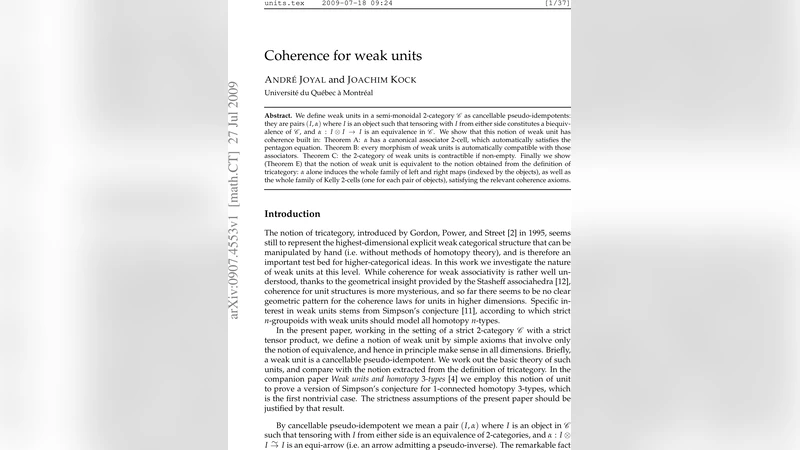
We define weak units in a semi-monoidal 2-category $\CC$ as cancellable pseudo-idempotents: they are pairs $(I,\alpha)$ where $I$ is an object such that tensoring with $I$ from either side constitutes a biequivalence of $\CC$, and $\alpha: I \tensor I \to I$ is an equivalence in $\CC$. We show that this notion of weak unit has coherence built in: Theorem A: $\alpha$ has a canonical associator 2-cell, which automatically satisfies the pentagon equation. Theorem B: every morphism of weak units is automatically compatible with those associators. Theorem C: the 2-category of weak units is contractible if non-empty. Finally we show (Theorem E) that the notion of weak unit is equivalent to the notion obtained from the definition of tricategory: $\alpha$ alone induces the whole family of left and right maps (indexed by the objects), as well as the whole family of Kelly 2-cells (one for each pair of objects), satisfying the relevant coherence axioms.
💡 Research Summary
The paper introduces a streamlined notion of weak units in a semi‑monoidal 2‑category (\mathcal C). A weak unit is a pair ((I,\alpha)) where (I) is an object such that tensoring on either side with (I) yields a biequivalence of (\mathcal C) (the “cancellable” condition), and (\alpha\colon I\otimes I\to I) is an equivalence (the “pseudo‑idempotent” condition). This definition collapses the traditionally elaborate unit data of a tricategory—left and right unitors for every object, Kelly 2‑cells for every pair of objects—into a single 2‑cell together with a cancellability requirement.
Theorem A shows that from (\alpha) one can canonically construct an associator 2‑cell (\Phi\colon (I\otimes I)\otimes I \Rightarrow I\otimes (I\otimes I)). Because (\alpha) is an equivalence, its inverse can be used to build a commuting square that defines (\Phi). The theorem then proves that (\Phi) automatically satisfies the pentagon equation, without any extra coherence axioms.
Theorem B deals with morphisms of weak units. Given a 1‑cell (f\colon I\to J) between weak units ((I,\alpha)) and ((J,\beta)), the cancellability of (I) and (J) forces a unique 2‑cell making the diagram (\beta\circ(f\otimes f)=f\circ\alpha) commute. Consequently every weak‑unit morphism is automatically compatible with the associators constructed in Theorem A; no additional unit‑coherence conditions are required.
Theorem C establishes that the 2‑category of weak units, when non‑empty, is contractible: any two weak units are linked by an equivalence, and all 1‑cells and 2‑cells between them are themselves equivalent. This formalises the intuition that there is essentially a unique unit up to coherent equivalence, eliminating any dependence on arbitrary choices of unit object.
Theorem E connects the new definition with the classical tricategory framework. Starting from (\alpha) alone, the paper reconstructs the full family of left and right unitors (\lambda_X\colon I\otimes X\to X) and (\rho_X\colon X\otimes I\to X) for every object (X), as well as the Kelly 2‑cells (\kappa_{X,Y}) for each pair ((X,Y)). These are defined by composing (\alpha) (or its inverse) with the biequivalences given by cancellability. The reconstructed data satisfy all tricategory unit axioms (unit coherence, interchange, and the pentagon), proving that the “cancellable pseudo‑idempotent” notion is equivalent to the standard tricategorical notion of a weak unit.
Overall, the paper demonstrates that the weak‑unit concept can be reduced to a single piece of data plus a cancellability condition, while automatically inheriting the full suite of coherence properties required in higher‑dimensional category theory. This simplification has significant implications: it reduces the bookkeeping burden in the definition of tricategories, clarifies the essential nature of units, and provides a robust foundation for extending the approach to higher‑dimensional analogues (3‑categories, 4‑categories, etc.). Future work may explore how this streamlined unit interacts with weak monoidal structures, enriched higher categories, and applications in homotopy‑theoretic contexts where coherent units play a pivotal role.
Comments & Academic Discussion
Loading comments...
Leave a Comment