Polynomial functors and trees
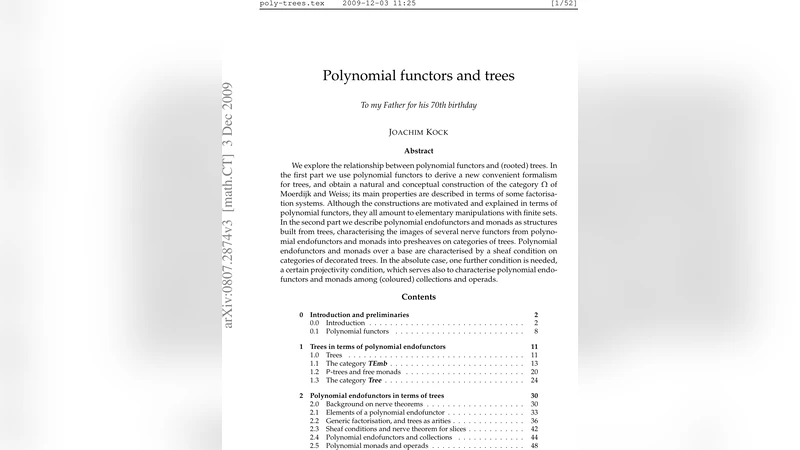
We explore the relationship between polynomial functors and (rooted) trees. In the first part we use polynomial functors to derive a new convenient formalism for trees, and obtain a natural and conceptual construction of the category $\Omega$ of Moerdijk and Weiss; its main properties are described in terms of some factorisation systems. Although the constructions are motivated and explained in terms of polynomial functors, they all amount to elementary manipulations with finite sets. In the second part we describe polynomial endofunctors and monads as structures built from trees, characterising the images of several nerve functors from polynomial endofunctors and monads into presheaves on categories of trees. Polynomial endofunctors and monads over a base are characterised by a sheaf condition on categories of decorated trees. In the absolute case, one further condition is needed, a certain projectivity condition, which serves also to characterise polynomial endofunctors and monads among (coloured) collections and operads.
💡 Research Summary
The paper establishes a deep correspondence between polynomial functors and rooted trees, showing that the intricate categorical structures traditionally used to model operads, collections, and higher‑dimensional algebra can be reduced to elementary manipulations of finite sets. In the first part the authors recall that a polynomial functor is given by a diagram of finite sets (A \leftarrow B \rightarrow C). Interpreting (A) as the set of vertices, (B) as edges, and (C) as leaves, the three maps encode source, target and leaf‑attachment. This simple set‑theoretic picture reproduces the usual definition of a finite rooted tree, and the operations of sum and product of polynomial functors correspond respectively to grafting trees together and to decomposing a tree into its sub‑trees.
Using this viewpoint the authors reconstruct the Moerdijk–Weiss category (\Omega). Objects of (\Omega) are precisely the finite rooted trees, while morphisms are generated by two orthogonal classes: “active” maps that preserve the internal branching structure (they may re‑wire sub‑trees) and “inert” maps that only insert or delete leaves. The paper proves that (\Omega) carries two independent factorisation systems, ((\text{active},\text{inert})) and ((\text{generic},\text{free})), and that these systems are exactly the categorical shadows of the sum‑and‑product operations on polynomial functors. Consequently (\Omega) emerges as the natural ambient category for polynomial‑functor‑based combinatorics.
The second part turns to polynomial endofunctors and polynomial monads. For a given polynomial endofunctor (P) the authors associate to each set (X) a collection of (X)-decorated trees (P(X)); the unit of a monad is interpreted as the trivial one‑node tree, while the multiplication (\mu) flattens a two‑level tree into a single level, exactly mirroring the monad axioms. By enriching the trees with “decorations” (colours, operation symbols, arities, etc.) they obtain a concrete model for coloured collections and operads. The crucial observation is that the presheaf of decorated trees must satisfy a sheaf condition on the category of trees: locally compatible decorations glue uniquely to a global decoration. This sheaf condition characterises the essential image of the nerve functor from polynomial endofunctors (or monads) into the presheaf category (\widehat{\Omega}).
When a base set is present (the relative case) the sheaf condition alone suffices. In the absolute case, however, an additional projectivity condition is required. Projectivity expresses that each tree vertex can be freely split and reassembled, guaranteeing that the underlying polynomial monad is a free object in the appropriate category. The authors prove that this projectivity, together with the sheaf condition, exactly isolates polynomial endofunctors and monads among all coloured collections and operads.
Overall, the paper delivers a unified, elementary framework: every polynomial functor, endofunctor, or monad can be visualised as a family of finite trees equipped with simple set‑theoretic data, and the categorical properties of (\Omega) and of operadic structures emerge from two orthogonal factorisation systems on these trees. This perspective not only clarifies the combinatorial heart of higher‑category theory but also opens the door to concrete applications in homotopy‑theoretic models, type‑theoretic syntax, and computer‑science representations of data types.
Comments & Academic Discussion
Loading comments...
Leave a Comment