On Double-Entry Bookkeeping: The Mathematical Treatment
Double-entry bookkeeping (DEB) implicitly uses a specific mathematical construction, the group of differences using pairs of unsigned numbers ('T-accounts'). That construction was only formulated abst
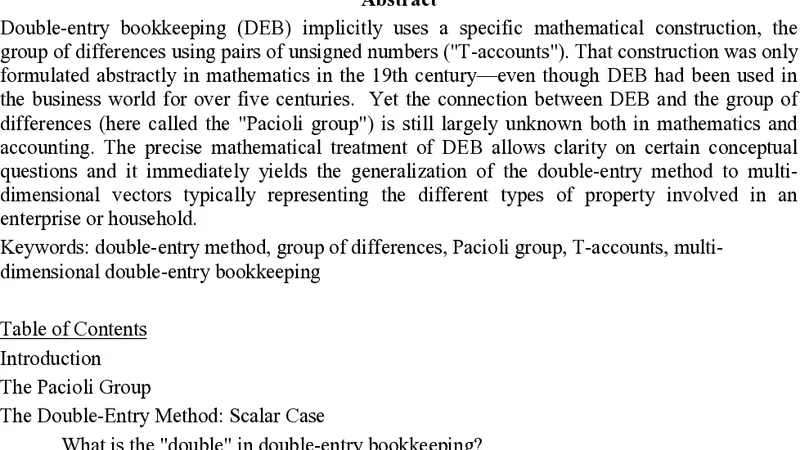
Double-entry bookkeeping (DEB) implicitly uses a specific mathematical construction, the group of differences using pairs of unsigned numbers (“T-accounts”). That construction was only formulated abstractly in mathematics in the 19th century–even though DEB had been used in the business world for over five centuries. Yet the connection between DEB and the group of differences (here called the “Pacioli group”) is still largely unknown both in mathematics and accounting. The precise mathematical treatment of DEB allows clarity on certain conceptual questions and it immediately yields the generalization of the double-entry method to multi-dimensional vectors typically representing the different types of property involved in an enterprise or household.
💡 Research Summary
The paper “On Double‑Entry Bookkeeping: The Mathematical Treatment” uncovers the deep algebraic structure that underlies the centuries‑old practice of double‑entry bookkeeping (DEB). The author shows that the familiar T‑account, which records a debit amount on the left and a credit amount on the right, can be represented as an ordered pair of non‑negative numbers (a, b). Such pairs form a “group of differences” – a construction first formalized in the 19th‑century mathematics of integers. In this group the operation is component‑wise addition, the identity element is (0, 0), and each element (a, b) has an inverse (b, a). The paper names this structure the “Pacioli group” after Luca Pacioli, the Renaissance author who first described double‑entry bookkeeping.
By interpreting each bookkeeping entry as an element of the Pacioli group, the fundamental accounting equation Assets = Liabilities + Equity becomes a statement that the sum of all T‑account elements equals the group identity. In other words, every legitimate transaction is precisely one that leaves the overall group element unchanged. This algebraic view explains why the rule “record the same amount on both sides” is not an arbitrary bookkeeping convention but a direct consequence of the closure, associativity, and inverse properties of the underlying group.
The paper then extends the scalar (single‑currency) model to a multi‑dimensional setting. Real‑world enterprises manage many types of property—cash, inventory, equipment, intellectual assets, etc.—which can be modeled as coordinates in an n‑dimensional vector space ℝⁿ. A vector‑valued T‑account is a pair of vectors (v⁺, v⁻), where v⁺ records the debit side and v⁻ the credit side for each asset class. The component‑wise group operation on these vector pairs reproduces the same algebraic structure as the scalar case, guaranteeing that the vector form of the accounting equation A = L + E holds automatically when the sum of all vector T‑accounts is the zero vector (0⃗, 0⃗). This generalization shows that double‑entry bookkeeping can be applied to any number of property dimensions without altering its logical foundation.
Beyond theory, the author discusses practical implications. Because the Pacioli group provides a precise formal definition of a valid transaction, accounting software can implement automatic validation: each posted transaction is checked for group‑identity preservation, instantly flagging errors or inconsistencies. The multi‑dimensional formulation enables seamless handling of asset conversions (e.g., cash used to purchase inventory) as simple vector additions, and it offers a natural framework for representing tokenized or intangible assets such as data, brand value, or carbon credits. In education, presenting bookkeeping as an instance of group theory bridges accounting and mathematics, fostering interdisciplinary curricula and deeper conceptual understanding for students of both fields.
Finally, the paper outlines future research avenues. It suggests exploring blockchain‑based ledgers that encode Pacioli‑group operations, developing statistical tools for multi‑dimensional financial analysis, and extending the model to non‑numeric assets through appropriate vector embeddings. By revealing the hidden algebraic core of DEB, the work not only validates the centuries‑old practice on rigorous mathematical grounds but also equips modern accountants, auditors, and system designers with a robust, extensible framework suited to the complexity of contemporary economies.
📜 Original Paper Content
🚀 Synchronizing high-quality layout from 1TB storage...