The tractability of CSP classes defined by forbidden patterns
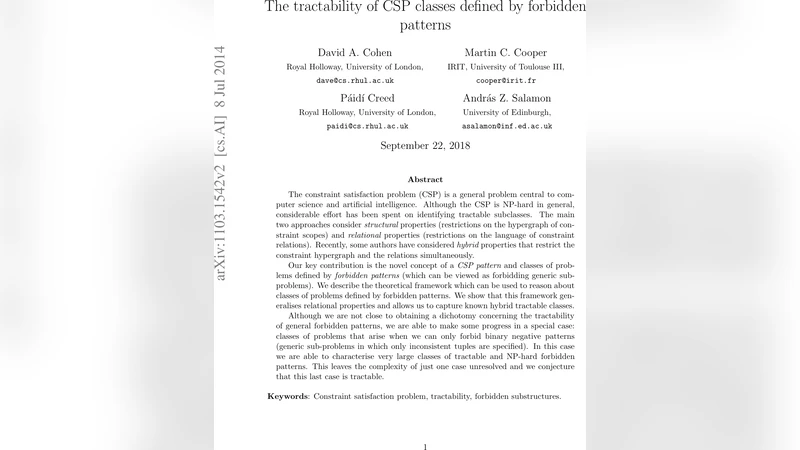
The constraint satisfaction problem (CSP) is a general problem central to computer science and artificial intelligence. Although the CSP is NP-hard in general, considerable effort has been spent on identifying tractable subclasses. The main two approaches consider structural properties (restrictions on the hypergraph of constraint scopes) and relational properties (restrictions on the language of constraint relations). Recently, some authors have considered hybrid properties that restrict the constraint hypergraph and the relations simultaneously. Our key contribution is the novel concept of a CSP pattern and classes of problems defined by forbidden patterns (which can be viewed as forbidding generic subproblems). We describe the theoretical framework which can be used to reason about classes of problems defined by forbidden patterns. We show that this framework generalises relational properties and allows us to capture known hybrid tractable classes. Although we are not close to obtaining a dichotomy concerning the tractability of general forbidden patterns, we are able to make some progress in a special case: classes of problems that arise when we can only forbid binary negative patterns (generic subproblems in which only inconsistent tuples are specified). In this case we are able to characterise very large classes of tractable and NP-hard forbidden patterns. This leaves the complexity of just one case unresolved and we conjecture that this last case is tractable.
💡 Research Summary
The paper tackles the long‑standing problem of identifying tractable subclasses of the Constraint Satisfaction Problem (CSP) by introducing a unified framework that simultaneously captures structural and relational restrictions. The authors define a CSP pattern as a triple ⟨V, D, C⟩ where each constraint is a three‑valued relation (T = allowed, F = disallowed, U = unknown). A pattern therefore represents a family of ordinary CSP instances: any instance that contains the pattern as a sub‑instance must instantiate every U‑value as either T or F. Forbidding a pattern means that no such sub‑instance may appear, which generalises the usual relational “forbidden relation” approach and also subsumes many hybrid tractability results based on coloured micro‑structures.
The authors focus on the simplest non‑trivial setting: binary negative patterns, i.e., patterns whose constraints involve only two variables and specify only disallowed tuples (F) or leave them undefined (U). Within this restricted universe they achieve an almost complete dichotomy:
- Tractable patterns – If the forbidden pattern does not contain certain cyclic or “broken‑triangle” configurations, the resulting CSP class can be solved in polynomial time. The paper shows how to exploit tree‑width‑1 structures, perfect micro‑structures, and known polymorphisms to obtain efficient algorithms.
- NP‑hard patterns – When a binary negative pattern embeds a more complex sub‑graph (e.g., multiple conflicting F‑tuples forming a non‑triangular cycle), the associated CSP class becomes NP‑complete. The authors prove hardness by reductions from graph‑colouring and other classic CSP‑hard problems, demonstrating that the presence of these sub‑structures forces computational intractability.
A key technical contribution is the observation that the size of the forbidden pattern matters: larger patterns impose stronger restrictions but also raise the cost of checking containment. Consequently the authors discuss maximal pattern sizes that still admit polynomial‑time recognition.
The paper provides concrete examples of three‑variable patterns that generate new hybrid tractable classes, and it derives a necessary condition for any forbidden‑pattern class to be tractable. This condition is shown to be almost sufficient; the only remaining open case is a specific variant of the broken‑triangle pattern. The authors conjecture that this last case is tractable, which would complete a full dichotomy for binary negative patterns.
In summary, the work introduces a powerful “forbidden pattern” methodology that unifies structural and relational CSP tractability, delivers a near‑complete classification for binary negative patterns, and opens a clear path toward resolving the final open case and extending the theory to richer, higher‑arity patterns.
Comments & Academic Discussion
Loading comments...
Leave a Comment